Category: Ciencia

  • Artemis II Vehicle Manager Branelle Rodriguez Gets Orion Ready for “Go”

    By the time the Artemis II Orion spacecraft launches to the Moon next year, its many components will already have traveled thousands of miles and moved across multiple facilities before coming together at NASA’s Kennedy Space Center. Branelle Rodriguez, Artemis II vehicle manager for the Orion Program, has overseen many parts of that journey. Her job is to ensure the spacecraft is ready for its historic mission – carrying humans to the Moon for the first time in over 50 years.

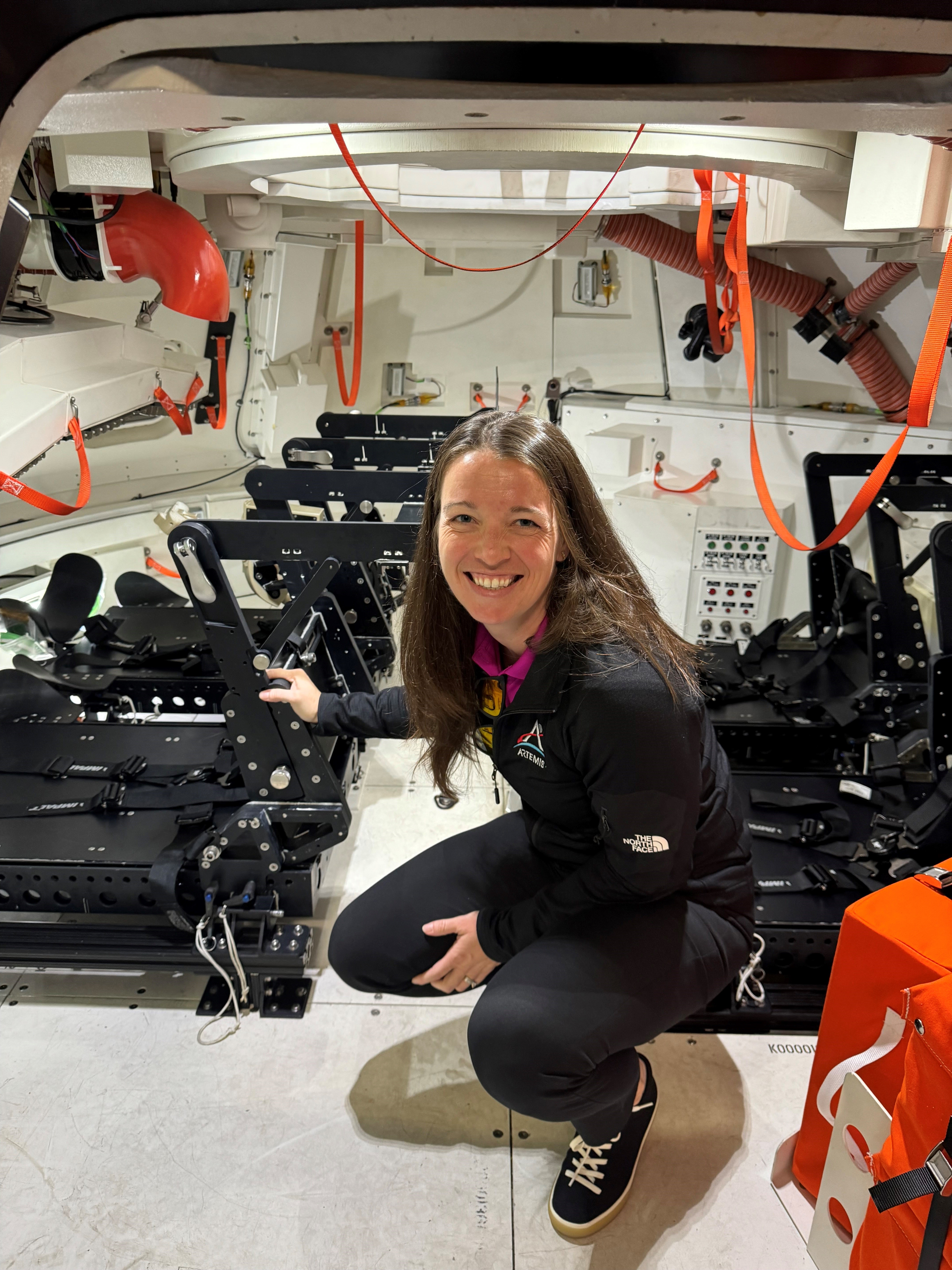
    A woman crouches inside the mockup of a spacecraft that is equipped with seats for crewmembers.
    Branelle Rodriguez crouches inside an Orion spacecraft training unit aboard the USS San Diego in March 2024. The training unit was used during a full recovery simulation with the Artemis II crew.
    Image courtesy of Branelle Rodriguez

    Based at NASA’s Johnson Space Center in Houston, Rodriguez has been involved in every stage of the spacecraft’s lifecycle – from development and production through testing and final launch readiness. Her program-level leadership focuses on ensuring the spacecraft’s hardware and subsystems are integrated and flight-ready. Most recently, she collaborated closely with Exploration Ground Systems at Kennedy to oversee the spacecraft’s move to the Vehicle Assembly Building, where it was mated with NASA’s SLS (Space Launch System) rocket. “We are getting our teams trained and ready so that we are GO for the Artemis II mission,” she said.

    Her 21-year NASA career spans numerous roles at Johnson. She started in the center’s Engineering Directorate, developing and building life support and habitation hardware for the Space Shuttle Program and the International Space Station Program. She went on to lead teams of engineers and flight controllers tasked with real-time resolution of anomalies aboard the International Space Station before transitioning to the Orion Program in 2022.

    “Looking back, every role I’ve held, every team I’ve been a part of, and every milestone we’ve achieved together has been truly remarkable,” she said. “I’m incredibly proud to have played a part in it all.”

    Rodriguez has been fascinated by space since she was a little girl. “Growing up in northern Minnesota, I was lucky to experience the beauty of clear, starlit skies on a regular basis,” she recalled. When Rodriguez was a teenager, her family encouraged her to attend Space Academy in Huntsville, Alabama, where she participated in mock astronaut training, flight controller simulations, and hands-on engineering projects. “It was a pivotal experience that only deepened my passion for space exploration.”
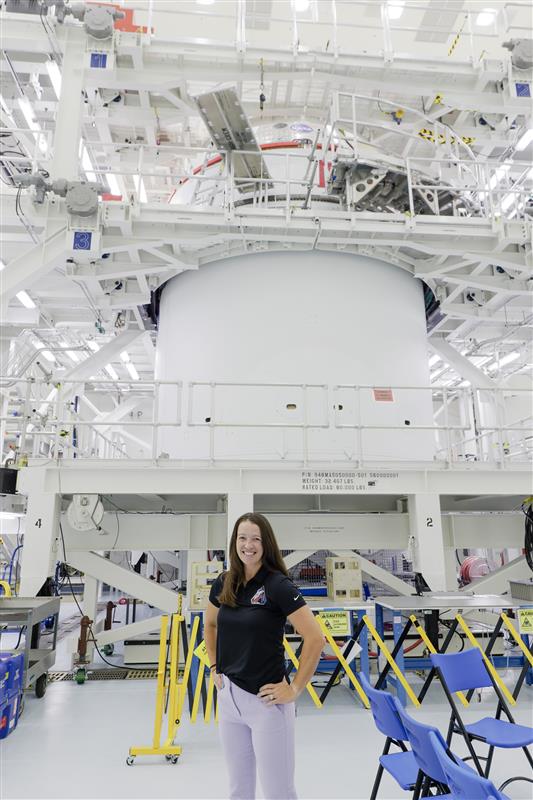
    A woman stands in front of an Orion spacecraft that is elevated on a staging platform.
    Branelle Rodriguez stands in front of the Artemis II Orion spacecraft as it completes processing in the Multi-Payload Processing Facility at NASA’s Kennedy Space Center in Florida.
    Image courtesy of Branelle Rodriguez

    Rodriguez applied to NASA’s internship program while studying mechanical engineering at the University of North Dakota. She was not accepted, but she did not give up. She spent a semester interning at Dow Chemical to gain more experience while continuing to apply for internships across multiple NASA centers. “On my eighth attempt, I was accepted at Johnson,” she said. Three internships and one graduation later, Rodriguez landed a full-time position in the Engineering Directorate’s Crew and Thermal Systems Division. “It’s been an incredible journey—and a dream realized,” she said.

    As a student athlete, Rodriguez knew the importance of teamwork from a young age, but said its value really became clear after joining NASA. “Some goals take time. There will be setbacks and struggles, but when you stick together, you build the kind of trust and relationships that are the foundation for long-term success,” she said. “That’s exactly what NASA represents. We take on some of the most complex and ambitious challenges imaginable—and we do it as a team.”

    She added, “Especially now, it’s more important than ever to remember what we’re capable of when we work together, and to celebrate the wins—big or small—because each one brings us closer to the extraordinary.”

    Rodriguez also appreciates having a team outside of the office. One of the greatest challenges she has faced is balancing the demands of a fulfilling, high-impact career with the needs of her family. “Like many parents, there are days when everything feels in sync, and days when I know I’ve fallen short,” she said, acknowledging that she must continually adapt to shifting needs and prioritize tasks to remain focused on what matters most at any given moment. “I’m beyond grateful for my family,” she said. “They are my foundation, and they truly understand and support my passion for the work I do. Without their love, and the broader village that helps make it all possible, I wouldn’t be where I am today.”
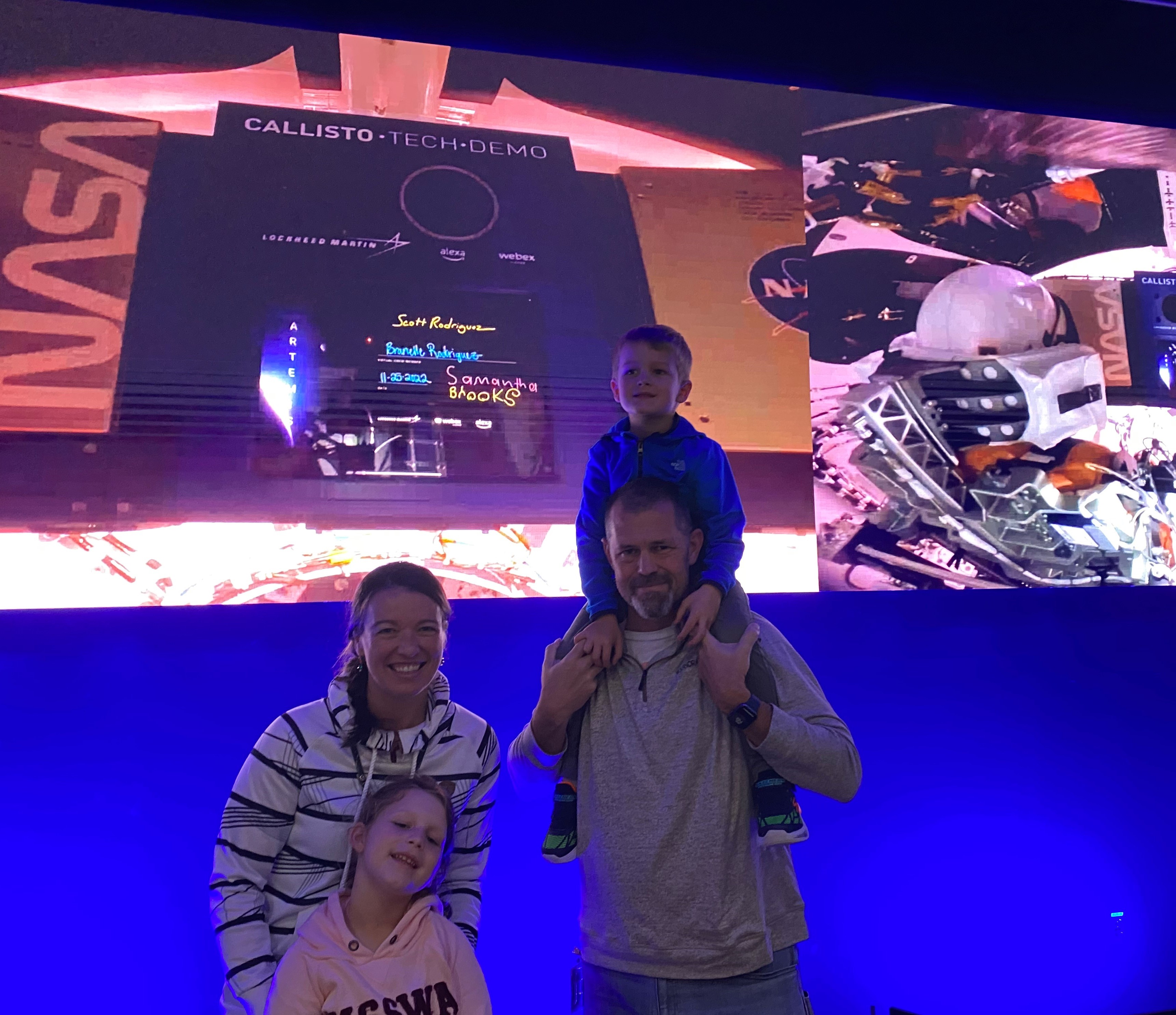
    A family of four - mom, dad, and two young children - stand in front of a large screen showing video from inside the Artemis I spacecraft.
    Branelle Rodriguez, her husband Scott, and her children Samantha and Brooks in the Mission Control Center at Johnson Space Center during the Artemis I mission in 2022. The family had an opportunity to ask the Artemis I Orion spacecraft questions via the Callisto technology demonstration carried aboard the 25-day mission.
    Image courtesy of Branelle Rodriguez

    To her children and future generations, Rodriguez hopes to pass on a desire to keep exploring. “As humans, we are naturally driven to grow, learn, and push beyond our limits,” she said. “Space exploration is still in its early stages when viewed through the lens of history, and the achievements of the next generation will be truly extraordinary. I want them to carry forward the curiosity, courage, and determination needed to reach new frontiers and unlock the unknown.”

  • XRISM Finds Chlorine, Potassium in Cas A

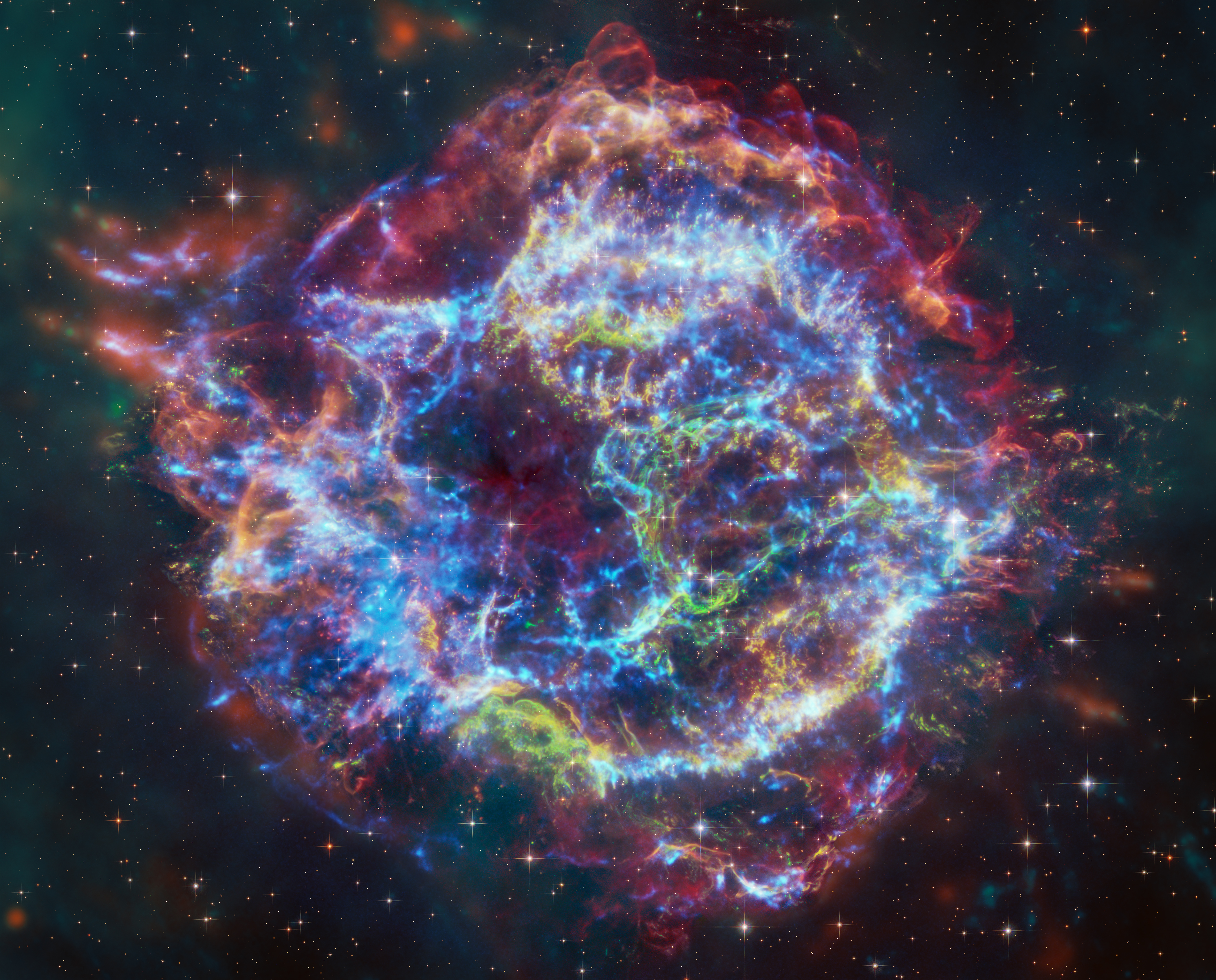
    This image of Cassiopeia A resembles a disk of electric light with red clouds, glowing white streaks, red and orange flames, and an area near the center of the remnant resembling a somewhat circular region of green lightning. X-rays from Chandra are blue and reveal hot gas, mostly from supernova debris from the destroyed star, and include elements like silicon and iron. X-rays are also present as thin arcs in the outer regions of the remnant. Infrared data from Webb is red, green, and blue. Webb highlights infrared emission from dust that is warmed up because it is embedded in the hot gas seen by Chandra, and from much cooler supernova debris. Hubble data shows a multitude of stars that permeate the field of view.
    This composite image of the Cassiopeia A (or Cas A) supernova remnant, released Jan. 8, 2024, contains X-rays from Chandra (blue), infrared data from Webb (red, green, blue), and optical data from Hubble (red and white). A study by the XRISM (X-ray Imaging and Spectroscopy Mission) spacecraft has made the first-ever X-ray detections of chlorine and potassium in the wreckage.
    X-ray: NASA/CXC/SAO; Optical: NASA/ESA/STScI; IR: NASA/ESA/CSA/STScI/Milisavljevic et al., NASA/JPL/CalTech; Image Processing: NASA/CXC/SAO/J. Schmidt and K. Arcand

    The Cassiopeia A supernova remnant glows in X-ray, visible, and infrared light in this Jan. 8, 2024, image that combines data from NASA’s Chandra X-ray Observatory and Hubble, Webb, and Spitzer space telescopes. A study by the XRISM (X-ray Imaging and Spectroscopy Mission) spacecraft has made the first-ever X-ray detections of chlorine and potassium from the wreckage; a paper about the result was published Dec. 4, 2025, in Nature Astronomy.

    Read more about this discovery.

    Image credit: X-ray: NASA/CXC/SAO; Optical: NASA/ESA/STScI; IR: NASA/ESA/CSA/STScI/Milisavljevic et al., NASA/JPL/CalTech; Image Processing: NASA/CXC/SAO/J. Schmidt and K. Arcand

  • Invention Challenge Brings Student Engineers to NASA JPL

    Now in its 26th year, the event brings teams of middle and high school students to the lab to compete with home-built contraptions.

    Teenagers wielding power tools and plywood demonstrated their engineering prowess at the annual Invention Challenge at NASA’s Jet Propulsion Laboratory in Southern California on Friday. Also in evidence: lots of small motors, 3D-printed gears, PVC pipe, and duct tape.

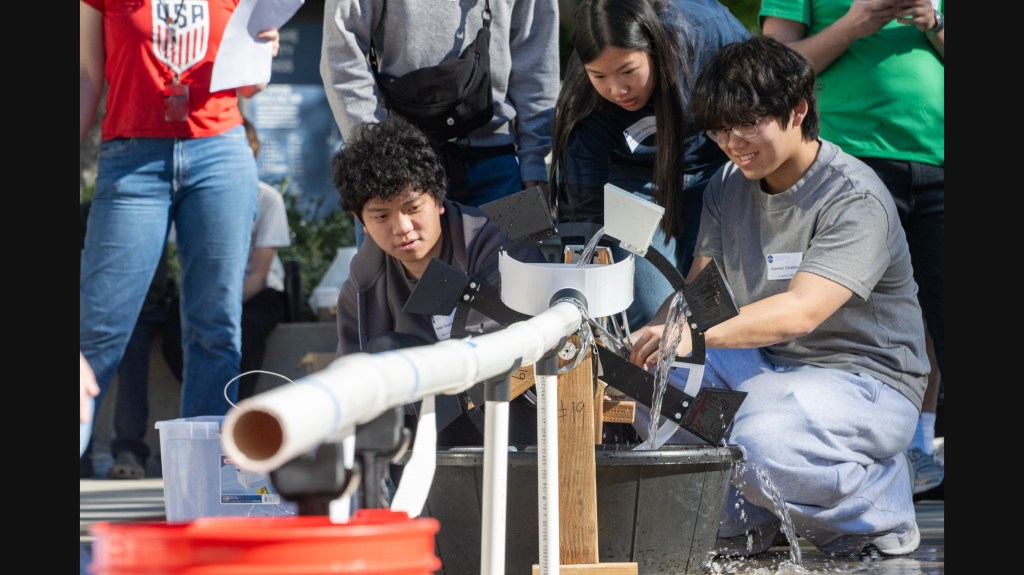
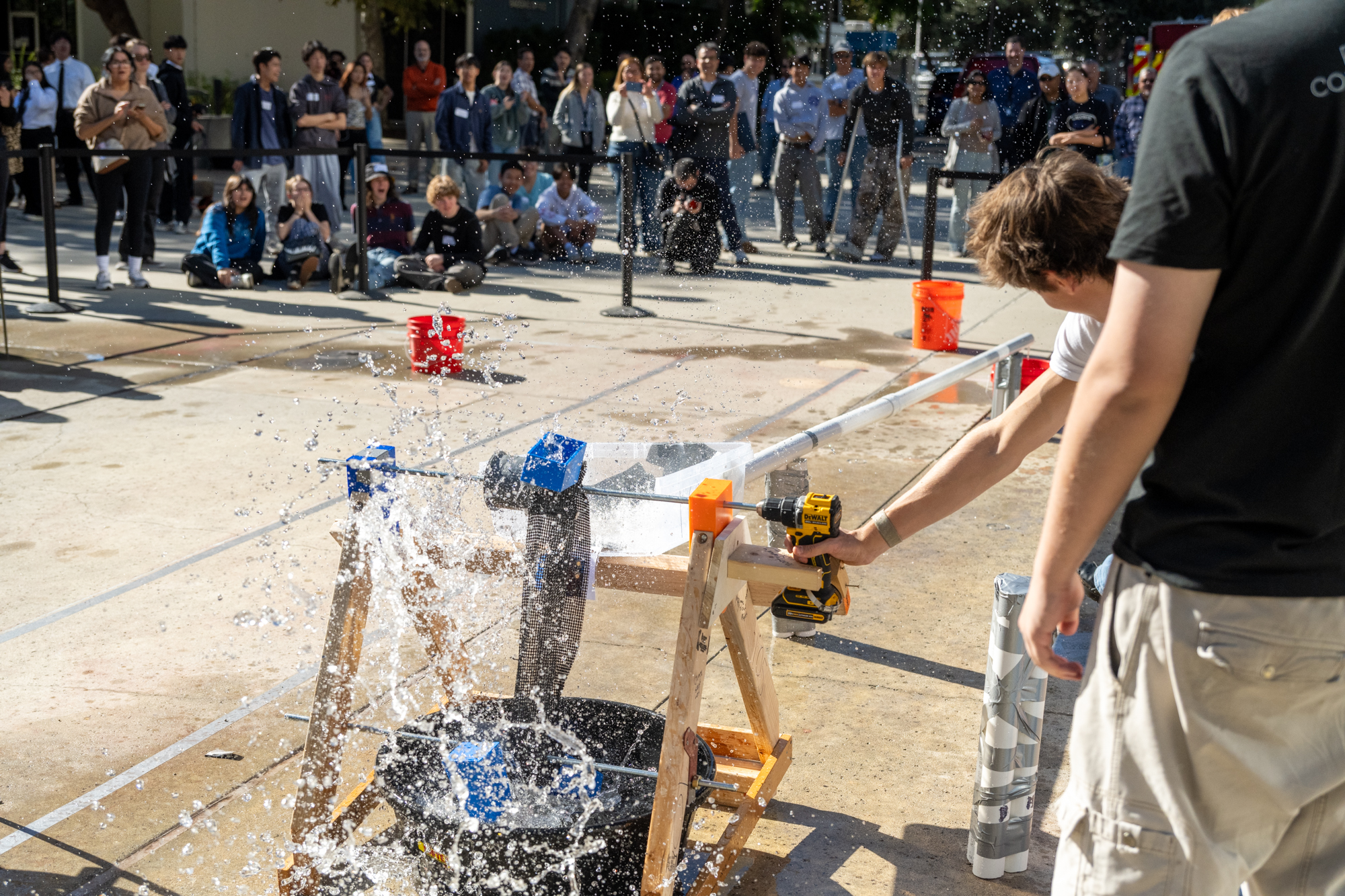
    First held at JPL in 1998, the event pits middle and high school teams against each other as they try to get handmade devices to accomplish a task that changes annually. For this year’s challenge, dubbed the “Bucket Brigade Contest,” teams needed to create devices capable of moving about 2 gallons (8 liters) of water from a holding reservoir into a bucket about 16 feet (5 meters) away in 60 seconds while satisfying a long list of rules.

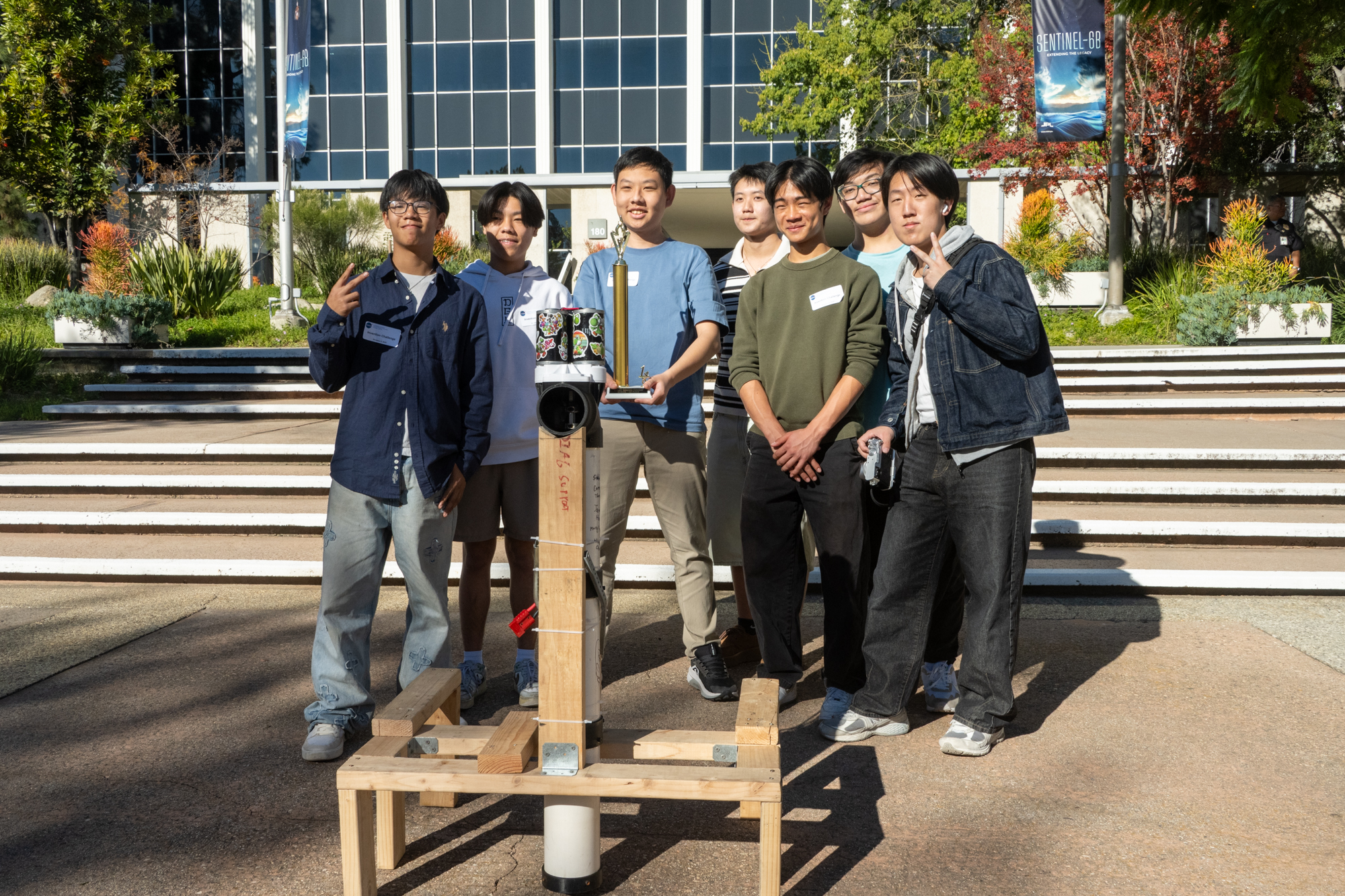
    Arcadia High School’s Team Still Water won first place among student teams in the 2025 Invention Challenge at JPL.
    NASA/JPL-Caltech

    In all, 18 teams of students from middle and high schools across Los Angeles and Orange counties competed. First place went to Arcadia High School’s Team Still Water, which completed the task in just 6.45 seconds. Mission Viejo High’s Team Senior Citizens was close behind, finishing in 6.71 seconds. The Samo Seals of Santa Monica High came in third, at 9.18 seconds.

    Five teams from outside the area — four from schools in Colorado and Massachusetts and one involving professional engineers — were invited to compete as well. Of those, the team led by retired JPL engineer Alan DeVault’s Team “Trial and Error Engineering” came in first (a repeat from last year). And “Team 6” from Pioneer Charter School of Science in the Boston area took second place (also a repeat performance from 2024). No team qualified for third place.

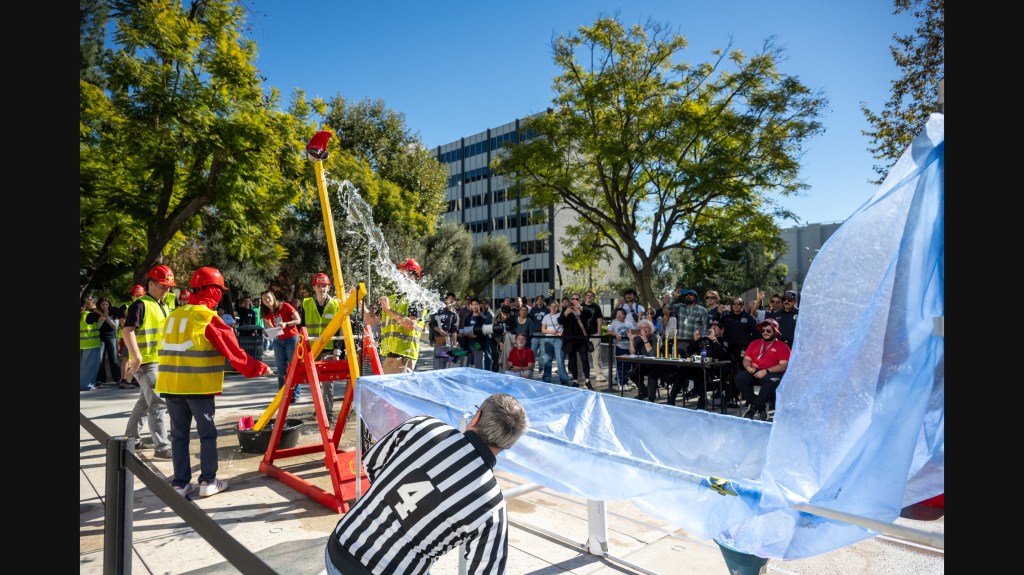
    Some of the devices in the 2025 Invention Challenge at NASA JPL made a big splash.
    NASA/JPL-Caltech

    Judges named Team Clankers from Mission Viejo High most artistic, Team 6 from Pioneer Charter School of Science most unusual, and Team Winning Engineering Team (WET) from Temple City High most creative.

    The event was supported by dozens of volunteers from JPL staff. JPL Fire Chief Dave Dollarhide, familiar with a bucket brigade, was a guest judge.

    News Media Contact

    Melissa Pamer
    Jet Propulsion Laboratory, Pasadena, Calif.
    626-314-4928
    melissa.pamer@jpl.nasa.gov

    2025-135

    Details

    Last Updated

    Dec 05, 2025

  • NASA Wins Second Emmy Award for 2024 Total Solar Eclipse Broadcast

    3 min read

    Preparations for Next Moonwalk Simulations Underway (and Underwater)

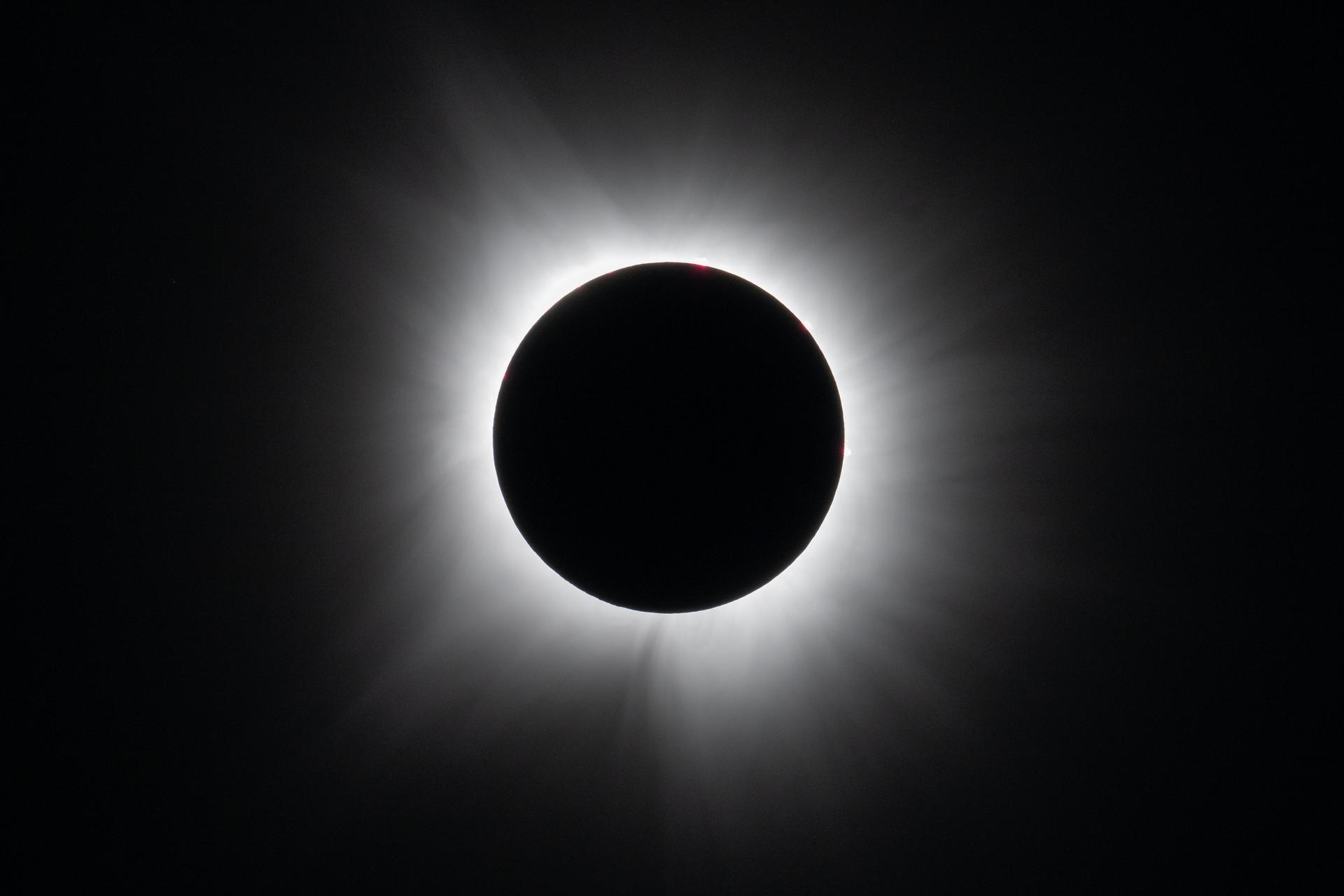
    NASA’s broadcast of the April 8, 2024, total solar eclipse has won an Emmy Award for Excellence in Production Technology.

    At the 76th Technology & Engineering Emmy Awards on Dec. 4, in New York City, the Academy of Television Arts & Sciences announced the win. Walt Lindblom and Sami Aziz accepted the award on behalf of the agency. For the broadcast, Lindblom served as the coordinating producer and Aziz served as the executive producer.

    “By broadcasting the total solar eclipse, this team brought joy and wonder for our Sun, Moon, and Earth to viewers across America and the world,” said Will Boyington, associate administrator for the Office of Communications at NASA Headquarters in Washington. “Congratulations to the production team, whose efforts demonstrate the hard work and dedication to the sharing the marvel that makes our solar system something we strive to understand.” 
    NASA’s live broadcast coverage of the 2024 total solar eclipse was the most complex live project ever produced by the agency. In total, NASA’s eclipse broadcasts garnered almost 40 million live and replay views across its own distribution channels, including on NASA+, the agency’s free streaming service. Externally, the agency’s main broadcast was picked up in 2,208 hits on 568 channels in 25 countries.

    “Our unique place in the solar system allows us on Earth to witness one of the most spectacular science shows nature has to offer. NASA’s production team captured the action every step of the way across the path of totality, including the rare glimpse of the Sun’s corona,” said Nicky Fox, associate administrator for science at NASA Headquarters. “Congratulations to the NASA team for successfully showing the 2024 total solar eclipse through the eyes of NASA for the whole world to experience together.”

    The broadcast spanned three hours, showcasing the eclipse across seven American states and two countries. From cities, parks, and stadiums, 11 hosts and correspondents provided on air commentary, interviews, and live coverage. Viewers tuned in from all over the world, including at watch parties in nine locations, from the Austin Public Library to New York’s Times Square. An interactive “Eclipse Board” provided real time data analysis as the Moon’s shadow crossed North America.

    Live feeds from astronauts aboard the International Space Station and NASA’s WB-57 high-altitude research aircraft were brought in to provide rare and unique perspectives of the solar event. To make this possible, NASA deployed and enabled 67 cameras, 6 NASA Wide Area Network control rooms, 38 encoders, and 35 decoders. The team coordinated 20 live telescope feeds which represented 12 locations across the path of totality.

    NASA’s eclipse broadcast won another Emmy award earlier this year at the 46th Annual News & Documentary Emmy Awards for Outstanding Live News Special. Additionally, the show received an Emmy nomination for Outstanding Show Open or Title Sequence – News. NASA’s eclipse communication and broadcast efforts also won two Webby Awards and two Webby People’s Voice Awards.

    For more information about NASA, visit:

    https://www.nasa.gov

    Abbey Interrante / Karen Fox
    Headquarters, Washington
    301-201-0124 / 202-358-1600
    abbey.a.interrante@nasa.gov / karen.c.fox@nasa.gov

  • Senyar Swamps Sumatra

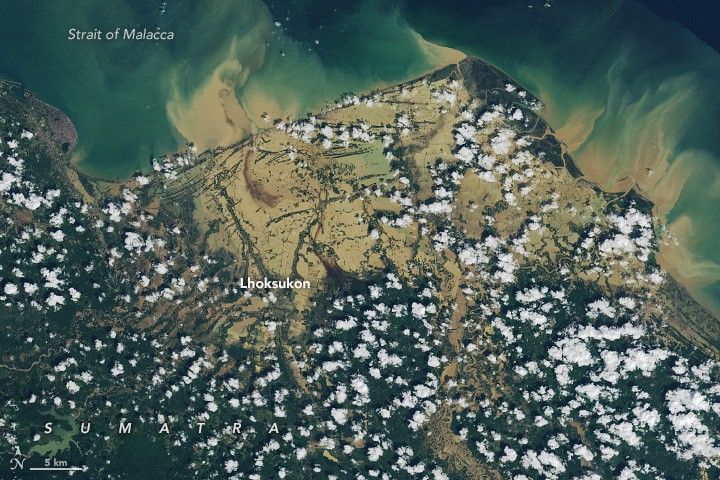
    A satellite image centered on the town of Lhoksukon in Sumatra shows brown, muddy floodwater covering much of a coastal plain near the town. Plumes of brown water are visible mixing with the bluer waters of the Strait of Malacca in the upper part of the image. The lower part of the image is greener, more mountainous, and speckled with small clouds.
    November 30, 2025

    Tropical cyclones almost never form over the Strait of Malacca. The narrow waterway separating Peninsular Malaysia from the Indonesian island of Sumatra sits so close to the equator that the Coriolis effect is usually too weak to allow storms to rotate enough to organize into cyclones. But on November 25, 2025, meteorologists watched as a tropical depression intensified into Cyclone Senyar—just the second documented case of a tropical cyclone forming in the strait.

    Hemmed in by land on both sides, Senyar made landfall in Sumatra later that day as it made a U-turn and headed east toward Malaysia. As the slow-moving storm passed over Sumatra’s mountainous terrain, it dropped nearly 400 millimeters (16 inches) of rain in many areas, according to satellite-based estimates from NASA’s Global Precipitation Measurement (GPM) mission. (Due to the averaging of the satellite data, local rainfall amounts may differ when measured from the ground.)

    The torrent caused extensive flash floods and landslides in Sumatra’s rugged terrain. Streams and rivers rapidly overflowed with sediment-laden, debris-filled waters that swept through villages, cities, and towns. News reports suggest that the damage was worsened by an earthquake that struck on November 27 and the abundance of loose piles of timber in the region that became destructive battering rams in high water. As of December 4, Indonesian authorities reported several hundred deaths and more than 700,000 displaced people.

    The OLI-2 (Operational Land Imager-2) on Landsat 9 captured this image of flooding in Aceh and North Sumatra provinces on November 30, 2025. Muddy sediment-filled water appears to have swamped much of Lhoksukon, a town of 40,000 people, and several surrounding villages. 

    Other tropical cyclones and monsoon rains hitting Sri Lanka, Thailand, Malaysia, and Vietnam at roughly the same time have also caused extensive destruction in the broader region. According to one estimate from the United Nations Office for the Coordination of Humanitarian Affairs, flooding has affected more than 10.8 million people in the region and displaced more than 1.2 million.

    NASA Earth Observatory image by Lauren Dauphin, using Landsat data from the U.S. Geological Survey. Story by Adam Voiland.

    References & Resources

    You may also be interested in:

    Stay up-to-date with the latest content from NASA as we explore the universe and discover more about our home planet.

    Monsoon Rains Flood Pakistan

    3 min read

    Heavy rains and flooding across the country since June 2025 have displaced millions of people, devastated infrastructure, and submerged farmland.

    Article

    Imelda and Humberto Crowd the Atlantic

    3 min read

    The tropical cyclones are close enough in proximity that they may influence one another.

    Article

    Rokan River Painted by the Tides

    2 min read

    Tides and sediment form brushstroke-like patterns across the river estuary in eastern Sumatra.

    Article
  • Hubble Spots a Storm of New Stars

    2 min read

    Hubble Spots a Storm of New Stars

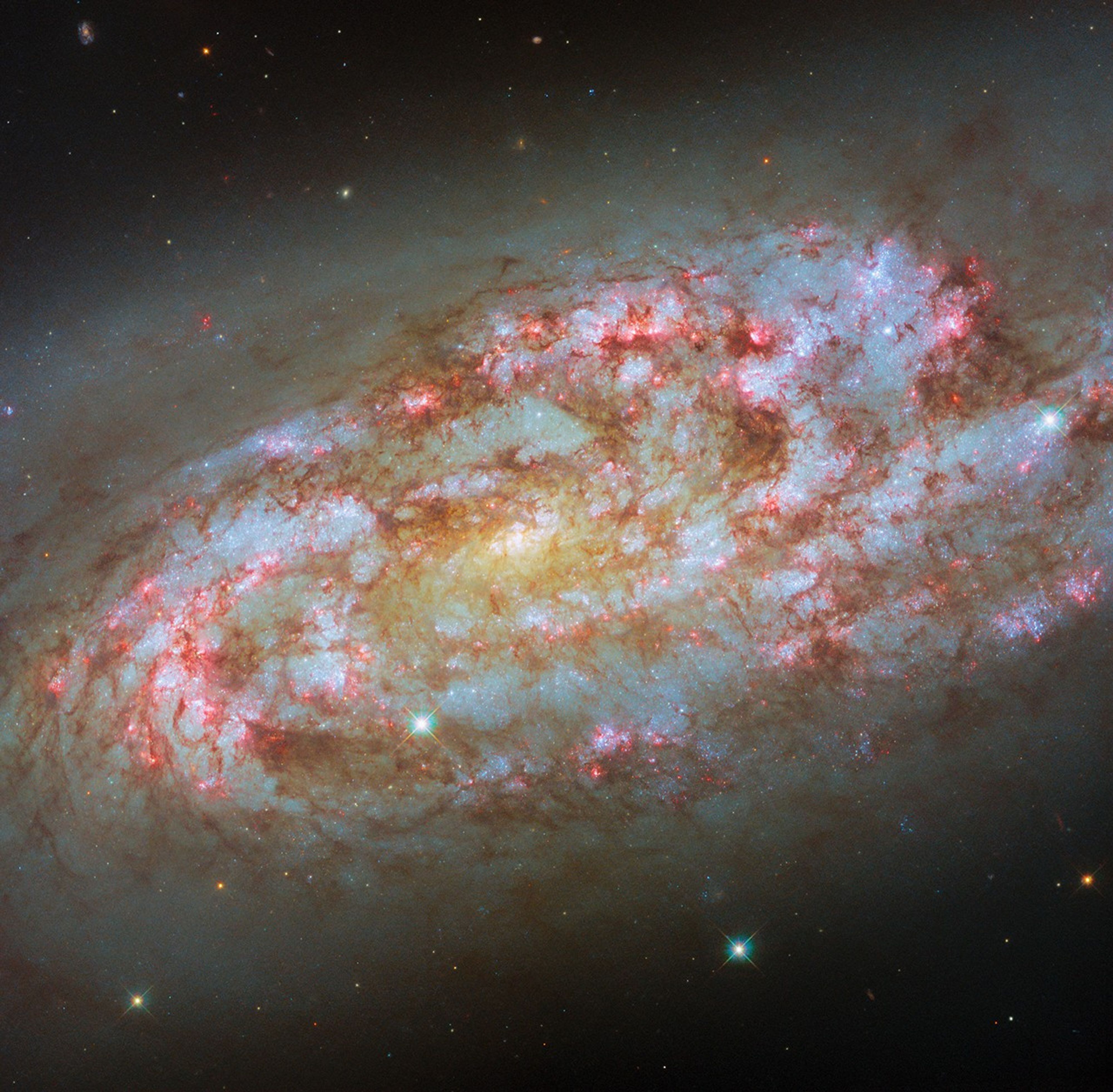
    A spiral galaxy, seen partly from the side, with a messy, turbulent appearance. Its disc is made of multiple patchy arms that contain numerous sparkling blue and glowing red regions — star clusters and star-forming nebulae. Thick clumps of dark reddish dust swirl through the disc. The glow of the disc extends out into the dark background, where both distant and nearby stars can be seen.
    This NASA/ESA Hubble Space Telescope image features the spiral galaxy named NGC 1792.
    ESA/Hubble & NASA, D. Thilker, F. Belfiore, J. Lee and the PHANGS-HST Team

    This NASA/ESA Hubble Space Telescope image features a stormy and highly active spiral galaxy named NGC 1792. Located over 50 million light-years from Earth in the constellation Columba (the Dove), the bright glow of the galaxy’s center is offset by the flocculent and sparkling spiral arms swirling around it.

    NGC 1792 is just as fascinating to astronomers as its chaotic look might imply. Classified as a starburst galaxy, it is a powerhouse of star formation, with spiral arms rich in star-forming regions. In fact, it is surprisingly luminous for its mass. The galaxy is close to a larger neighbor, NGC 1808, and astronomers think the strong gravitational interaction between the two stirred up the reserves of gas in this galaxy. The result is a torrent of star formation, concentrated on the side closest to its neighbor, where gravity has a stronger effect. NGC 1792 is a perfect target for astronomers seeking to understand the complex interactions between gas, star clusters, and supernovae in galaxies.

    Hubble studied this galaxy before. This new image includes additional data collected throughout 2025, providing a deeper view of the tumultuous activity taking place in the galaxy. Blossoming red lights in the galaxy’s arms mark Hydrogen-alpha (H-alpha) emission from dense clouds of hydrogen molecules. The newly forming stars within these clouds shine powerfully with ultraviolet radiation. This intense radiation ionizes the hydrogen gas, stripping away electrons which causes the gas to emit H-alpha light. H-alpha is a very particular red wavelength of light and a tell-tale sign of new stars.

    Media Contact:

    Claire Andreoli (claire.andreoli@nasa.gov)
    NASA’s Goddard Space Flight CenterGreenbelt, MD

  • Testing Drones for Mars in the Mojave Desert

    Two people stand atop a sand dune, facing the camera. They are both looking at a drone flying in front of them. The person on the right holds a controller. Other sand dunes behind them make up the background of the entire image.
    NASA/JPL-Caltech

    Researchers from NASA’s Jet Propulsion Laboratory monitor a research drone in this September 2025 photo. This flight occurred in Dumont Dunes, an area of the Mojave Desert, as part of a larger test campaign to develop navigation software that would guide future rotorcraft on Mars. The work was among 25 projects funded by NASA’s Mars Exploration Program this past year to push the limits of future technologies.

    Whether it’s new navigation software, slope-scaling robotic scouts, or long-distance gliders, the technology being developed by the Mars Exploration Program envisions a future where robots can explore all on their own — or even help astronauts do their work.

    Read more about the drone flight software test.

    Text credit: NASA/Andrew Good

    Image credit: NASA/JPL-Caltech

  • NASA Selects 2 Instruments for Artemis IV Lunar Surface Science

    4 min read

    NASA Selects 2 Instruments for Artemis IV Lunar Surface Science

    NASA has selected two science instruments designed for astronauts to deploy on the surface of the Moon during the Artemis IV mission to the lunar south polar region. The instruments will improve our knowledge of the lunar environment to support NASA’s further exploration of the Moon and beyond to Mars. 

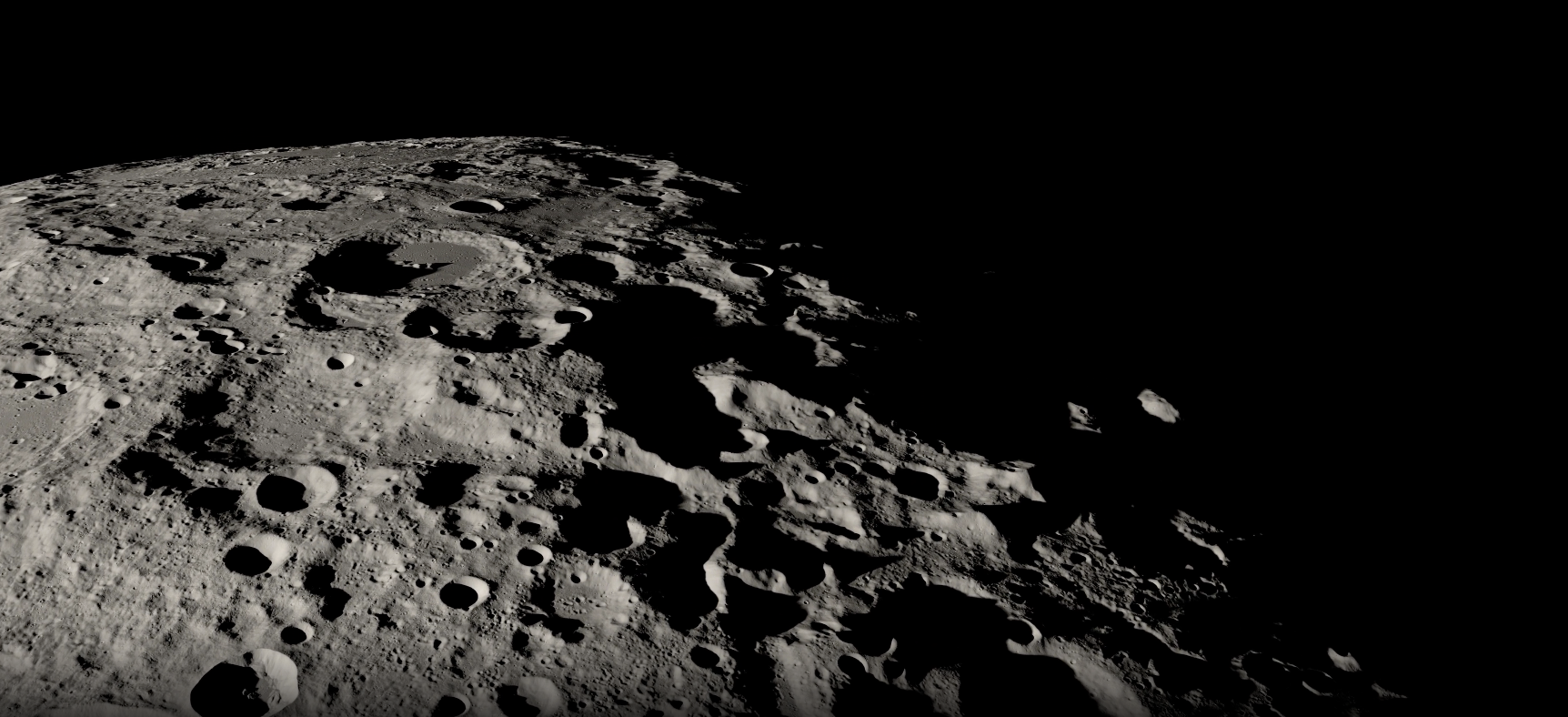
    A visualization of the Moon’s South Pole region created with data from NASA’s Lunar Reconnaissance Orbiter, which has been surveying the Moon with seven instruments since 2009. 
    NASA’s Scientific Visualization Studio/Ernie Wright

    “The Apollo Era taught us that the further humanity is from Earth, the more dependent we are on science to protect and sustain human life on other planets,” said Nicky Fox, associate administrator, Science Mission Directorate at NASA Headquarters in Washington. “By deploying these two science instruments on the lunar surface, our proving ground, NASA is leading the world in the creation of humanity’s interplanetary survival guide to ensure the health and safety of our spacecraft and human explorers as we begin our epic journey back to the Moon and onward to Mars.”

    After his voyage to the Moon’s surface during Apollo 17, astronaut Gene Cernan acknowledged the challenge that lunar dust presents to long-term lunar exploration. Moon dust sticks to everything it touches and is very abrasive. The knowledge gained from the DUSTER (DUst and plaSma environmenT survEyoR) investigation will help mitigate hazards to human health and exploration. Consisting of a set of instruments mounted on a small autonomous rover, DUSTER will characterize dust and plasma around the landing site. These measurements will advance understanding of the Moon’s natural dust and plasma environment and how that environment responds to the human presence, including any disturbance during crew exploration activities and lander liftoff. The DUSTER instrument suite is led by Xu Wang of the University of Colorado Boulder. The contract is for $24.8 million over a period of three years. 

    A model of the DUSTER instrument suite
    A model of the DUSTER instrument suite consisting of the Electrostatic Dust Analyzer (EDA)—which will measure the charge, velocity, size, and flux of dust particles lofted from the lunar surface—and Relaxation SOunder and differentiaL VoltagE (RESOLVE)—which will characterize the average electron density above the lunar surface using plasma sounding. Both instruments will be housed on a Mobile Autonomous Prospecting Platform (MAPP) rover, which will be supplied by Lunar Outpost, a company based in Golden, Colorado, that develops and operates robotic systems for space exploration.
    LASP/CU Boulder/Lunar Outpost

    Data from the SPSS (South Pole Seismic Station) will enable scientists to characterize the lunar interior structure to better understand the geologic processes that affect planetary bodies. The seismometer will help determine the current rate at which the Moon is struck by meteorite impacts, monitor the real-time seismic environment and how it can affect operations for astronauts, and determine properties of the Moon’s deep interior. The crew will additionally perform an active-source experiment using a “thumper” that creates seismic energy to survey the shallow structure around the landing site. The SPSS instrument is led by Mark Panning of NASA’s Jet Propulsion Laboratory in Southern California. The award is for $25 million over a period of three years. 

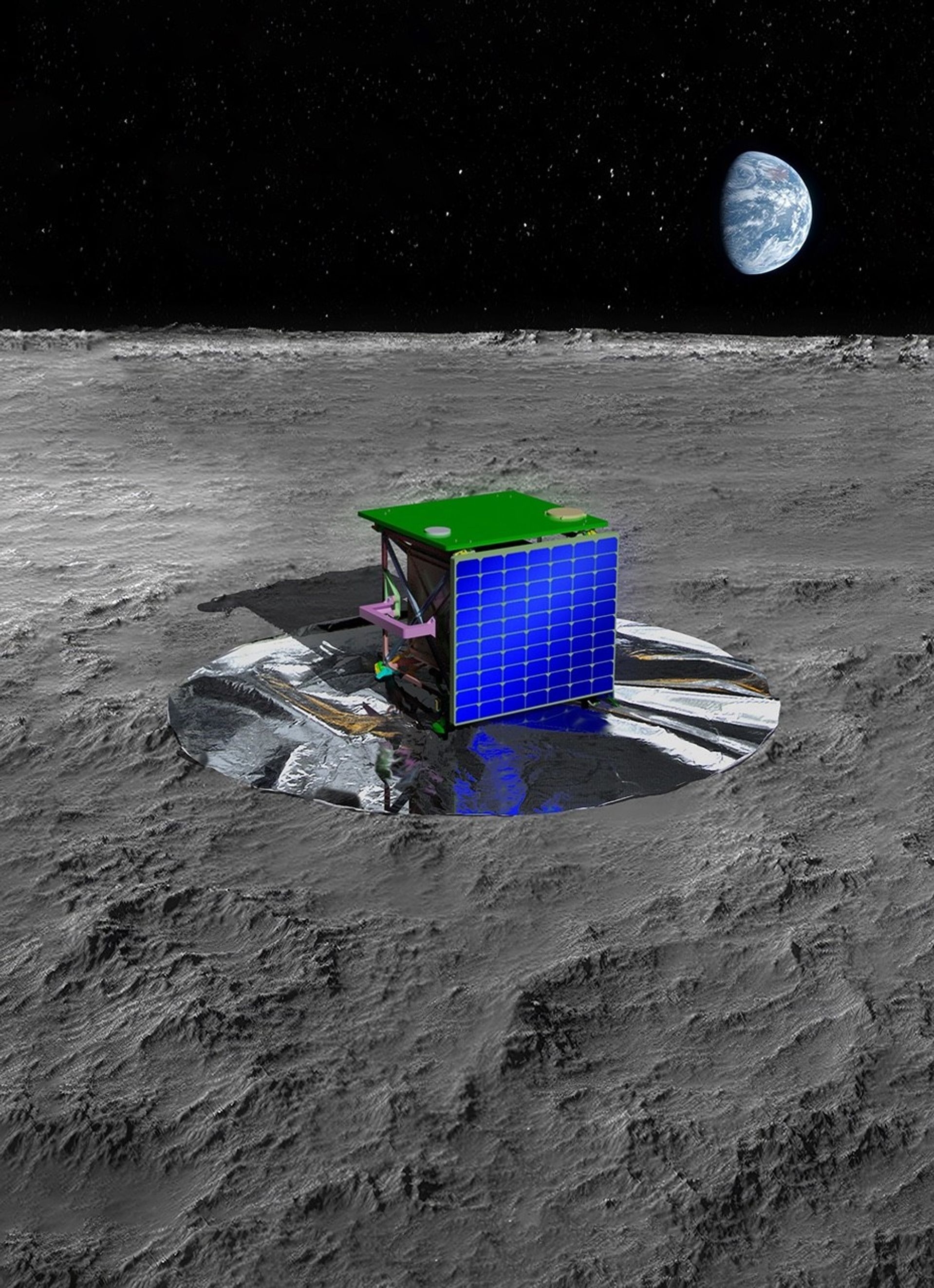
    An artist’s concept of SPSS (South Pole Seismic Station)
    An artist’s concept of SPSS (South Pole Seismic Station) to be deployed by astronauts on the lunar surface.
    NASA/JPL-Caltech

    “These two scientific investigations will be emplaced by human explorers on the Moon to achieve science goals that have been identified as strategically important by both NASA and the larger scientific community”, said Joel Kearns, deputy associate administrator for exploration, Science Mission Directorate at NASA Headquarters. “We are excited to integrate these instrument teams into the Artemis IV Science Team.”

    The two payloads were selected for further development to fly on Artemis IV; however, final manifesting decisions about the mission will be determined at a later date. 

    Through Artemis, NASA will address high priority science questions, focusing on those that are best accomplished by on-site human explorers on and around the Moon and by using the unique attributes of the lunar environment, aided by robotic surface and orbiting systems. The Artemis missions will send astronauts to explore the Moon for scientific discovery, economic benefits, and build the foundation for the first crewed missions to Mars.

    For more information on Artemis, visit:

    https://www.nasa.gov/humans-in-space/artemis

    Karen Fox / Molly Wasser
    Headquarters, Washington
    202-358-1600 
    karen.c.fox@nasa.gov / molly.l.wasser@nasa.gov

  • NASA Sets Coverage for Astronaut Jonny Kim, Crewmates Return

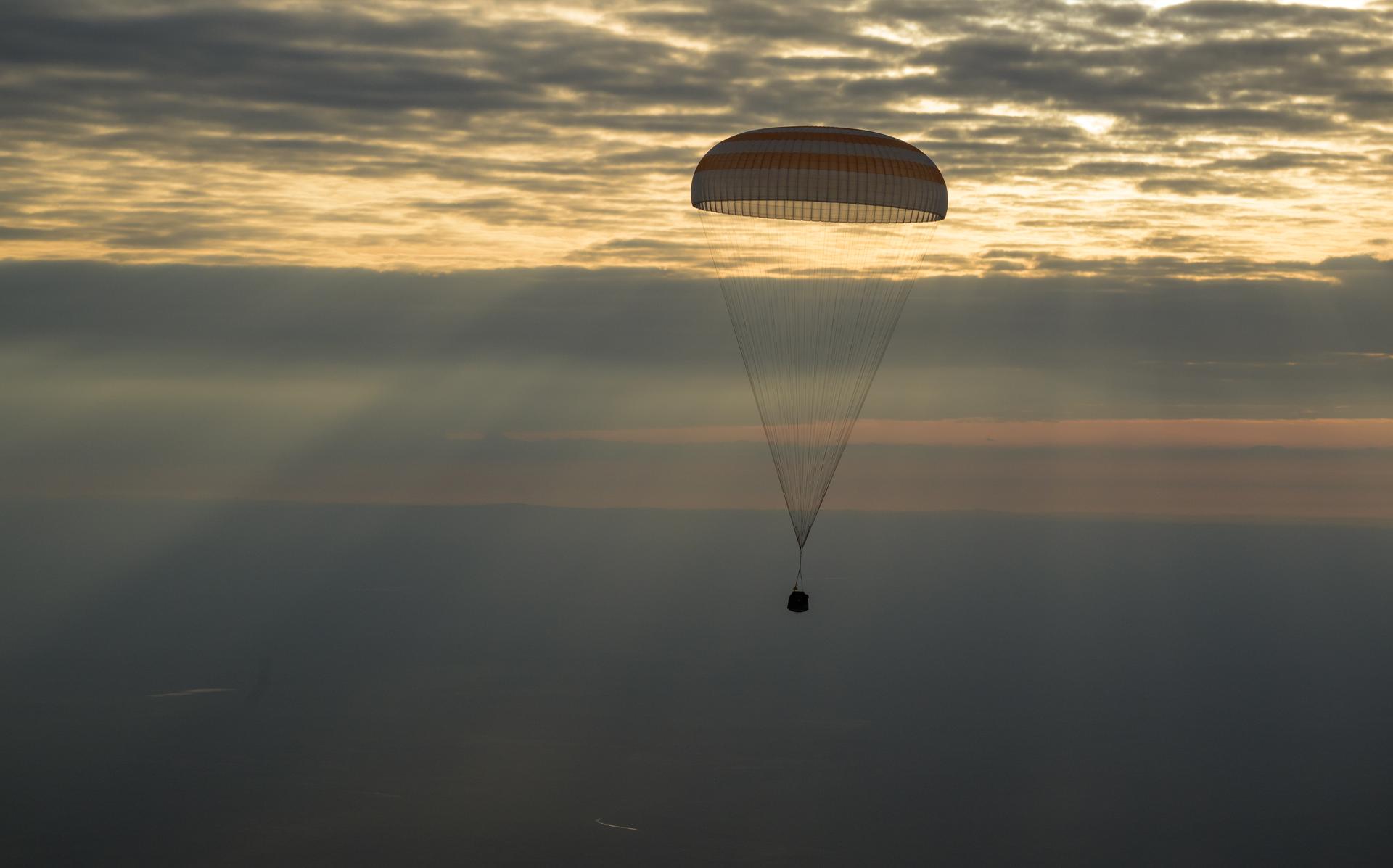
    The photo features a dim horizon with the Soyuz MS-26 spacecraft as it lands by parachute.
    The Soyuz MS-26 spacecraft is seen as it lands on April 20, 2025 (April 19 Eastern time) in a remote area near the town of Zhezkazgan, Kazakhstan, with the Expedition 71/72 crew aboard.
    NASA/Bill Ingalls

    NASA astronaut Jonny Kim, accompanied by Roscosmos cosmonauts Sergey Ryzhikov and Alexey Zubritsky, is preparing to depart the International Space Station aboard the Soyuz MS-27 spacecraft and return to Earth.

    Kim, Ryzhikov, and Zubritsky will undock from the station’s Prichal module at 8:41 p.m. EST on Monday, Dec. 8, headed for a parachute-assisted landing at 12:04 a.m. on Tuesday, Dec. 9 (10:04 a.m. local time in Kazakhstan), on the steppe of Kazakhstan, southeast of the city of Dzhezkazgan.

    Watch NASA’s live coverage of the crew’s return on NASA+, Amazon Prime, and the agency’s YouTube channel. Learn how to stream NASA content through a variety of online platforms, including social media.

    The space station change of command ceremony will begin at 10:30 a.m. Sunday, Dec. 7, on NASA+ and the agency’s YouTube channel. Rzyhikov will hand over station command to NASA astronaut Mike Fincke for Expedition 74, which begins at the time of Soyuz MS-27 undocking.

    Kim and his crewmates are completing a 245-day mission aboard the station. At the conclusion of their mission, they will have orbited Earth 3,920 times and traveled nearly 104 million miles. This was the first flight for Kim and Zubritsky to the orbiting laboratory, while Ryzhikov is ending his third trip to space.

    After landing, the three crew members will fly by helicopter to Karaganda, Kazakhstan, where recovery teams are based. Kim will board a NASA aircraft and return to Houston, while Ryzhikov and Zubritsky will depart for their training base in Star City, Russia.

    NASA’s coverage is as follows (all times Eastern and subject to change based on real-time operations):

    Sunday, Dec. 7:

    10:30 a.m. – Expedition 73/74 change of command ceremony begins on NASA+ Amazon Prime, and YouTube.

    Monday, Dec. 8:

    4:45 p.m. – Farewells and hatch closing coverage begins on NASA+, Amazon Prime, and YouTube.

    5:10 p.m. – Hatch closing

    8:15 p.m. – Undocking coverage beings on NASA+, Amazon Prime, and YouTube.

    8:41 p.m. – Undocking

    10:30 p.m. – Deorbit and landing coverage begins on NASA+, Amazon Prime, and YouTube.

    11:10 p.m. – Deorbit burn

    Tuesday, Dec. 9:

    12:04 a.m. – Landing

    For more than 25 years, people have lived and worked continuously aboard the International Space Station, advancing scientific knowledge and making research breakthroughs that are not possible on Earth. The station is a critical testbed for NASA to understand and overcome the challenges of long-duration spaceflight and to expand commercial opportunities in low Earth orbit. As commercial companies concentrate on providing human space transportation services and destinations as part of a robust low Earth orbit economy, NASA is focusing its resources on deep space missions to the Moon as part of the Artemis campaign in preparation for future human missions to Mars.

    Learn more about International Space Station research and operations at:

    https://www.nasa.gov/station

    -end-

    Josh Finch / Jimi Russell
    Headquarters, Washington
    202-358-1100
    joshua.a.finch@nasa.gov / james.j.russell@nasa.gov

    Sandra Jones / Joseph Zakrzewski
    Johnson Space Center, Houston
    281-483-5111
    sandra.p.jones@nasa.gov / joseph.a.zakrzewski@nasa.gov

    Details

    Last Updated

    Dec 04, 2025

    Editor
    Elizabeth Shaw

  • NASA’s Nancy Grace Roman Space Telescope Completed

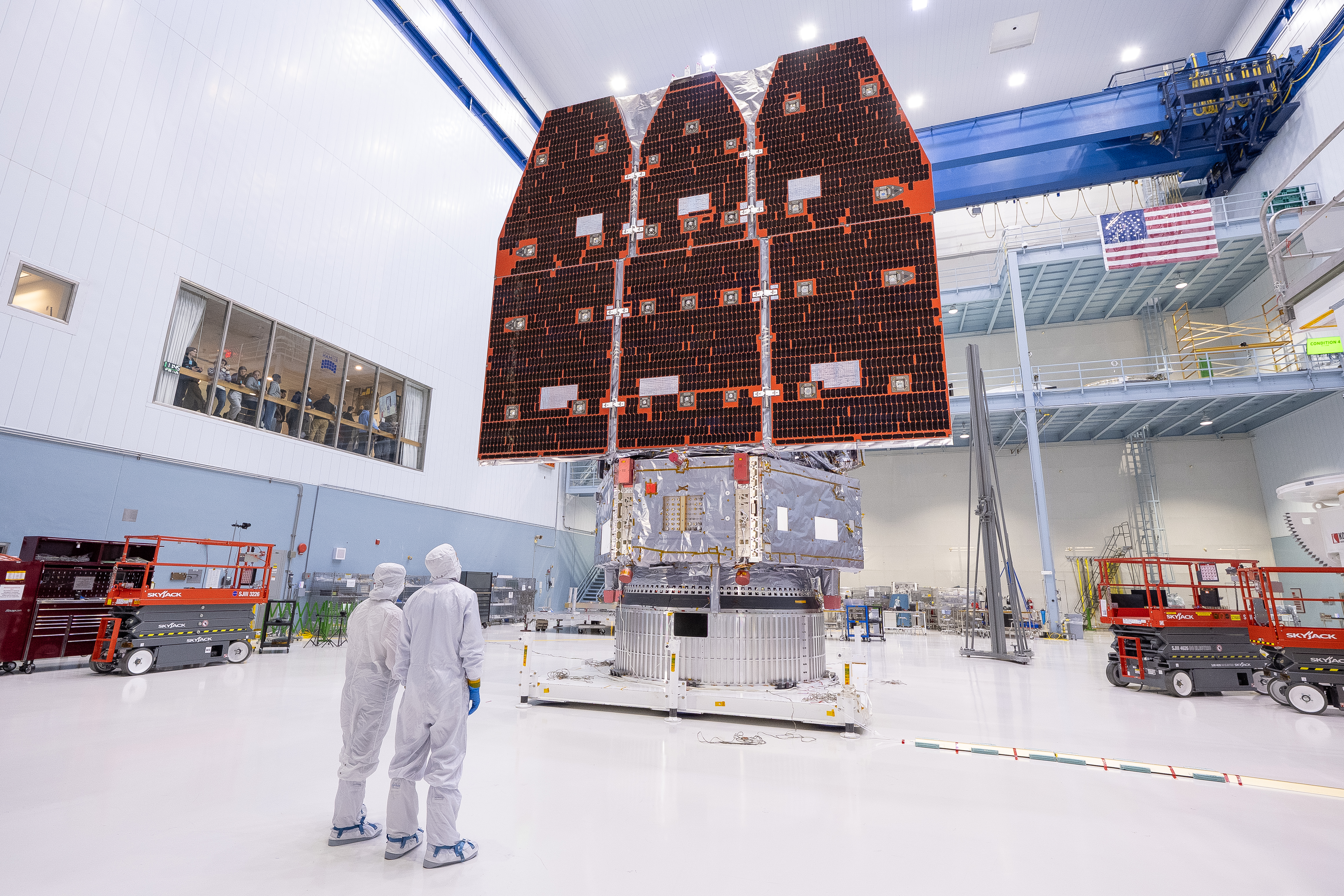
    Two people in white jumpsuits look up at a large telescope with three black and orange panels facing them. They are in a large white cleanroom with equipment and scaffolding.
    Over the course of several hours, technicians meticulously connected the inner and outer segments of NASA’s Nancy Grace Roman Space Telescope.
    NASA/Jolearra Tshiteya

    Two technicians look up at NASA’s Nancy Grace Roman Space Telescope after its inner and outer segments were connected at the agency’s Goddard Space Flight Center in Greenbelt, Maryland on Nov. 25, 2025. This marked the end of Roman’s construction. After final testing, the telescope will move to the launch site at NASA’s Kennedy Space Center in Florida for launch preparations in summer 2026. Roman  — named after Dr. Nancy Grace Roman, NASA’s first chief astronomer — is slated to launch by May 2027, but the team is on track for launch as early as fall 2026.

    See more photos of the completed observatory.

    Image credit: NASA/Jolearra Tshiteya