Blog

  • Student Art Murals at Johnson Celebrate 25 Years of Humanity in Space 

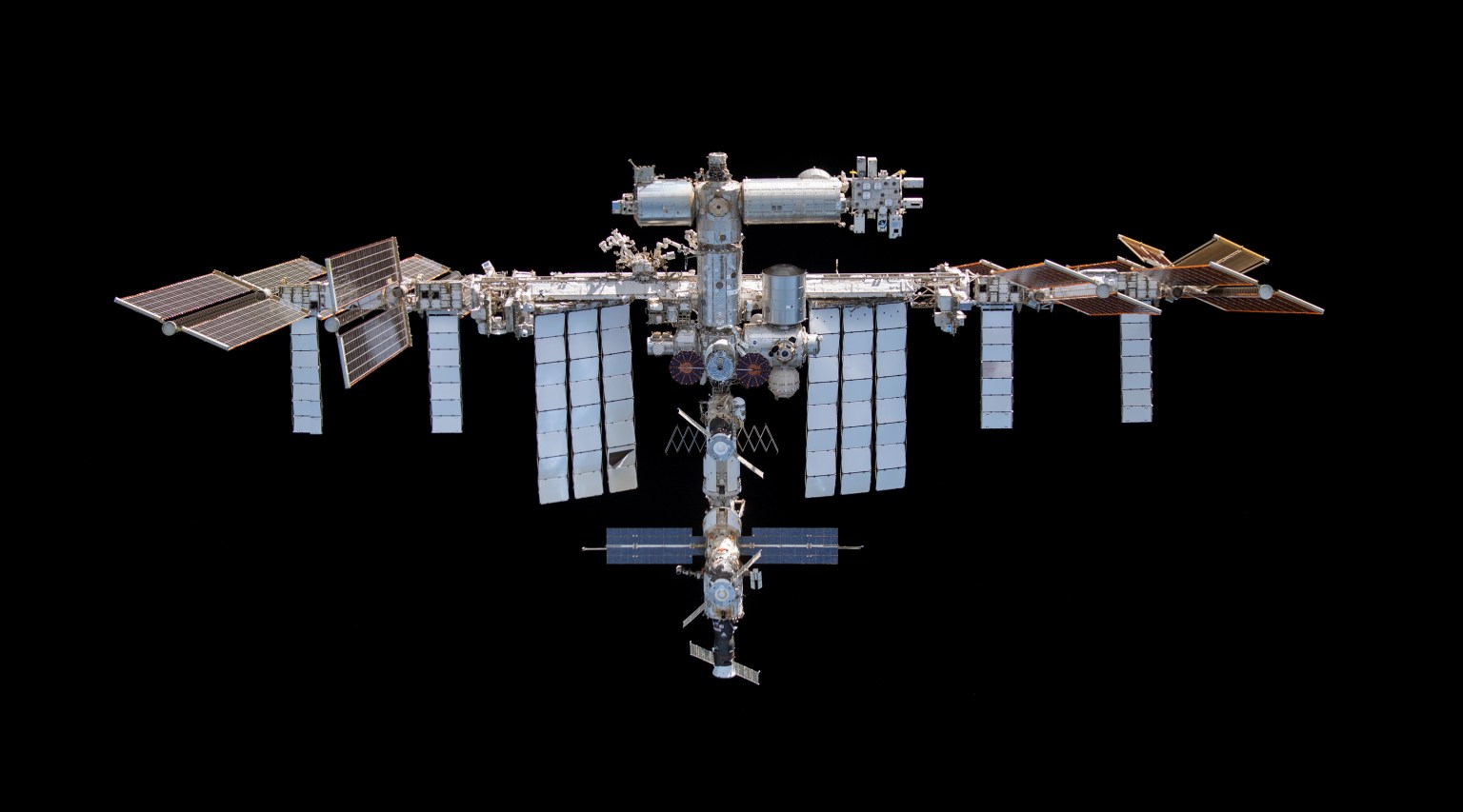
    Select walls at NASA’s Johnson Space Center have been transformed into works of art. Each piece reflects creativity, collaboration, and the spirit of discovery. Painted by Texas students, the murals honor the legacy of the International Space Station and 25 years of continuous human presence in space. 

    The International Space Station Program Mural Project began in 2022 as part of a broader effort to bring color and inspiration into the workplace while connecting classrooms to NASA’s mission. 
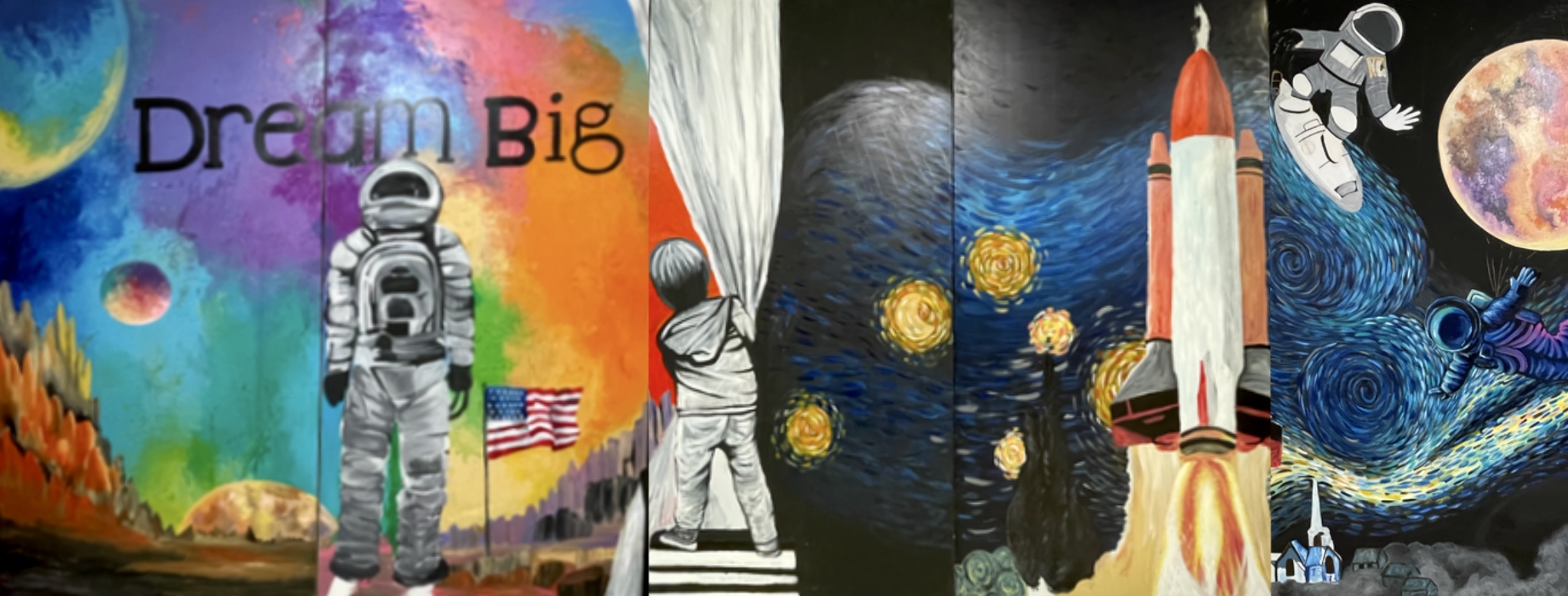
    A colorful art mural representing space exploration. The words "Dream Big" appear in the upper left corner.
    “Dream Big,” created by Texas City High School students with the International Space Station Program Mission and Program Integration team in 2025, symbolizes imagination becoming exploration.

    “The mural collection is a reminder that today’s dreams can be tomorrow’s realities,” said Space Operations Mission Directorate Deputy Associate Administrator Joel Montalbano. “The future of space exploration depends on the imagination of our students.” 

    As NASA prepares for the next giant leap through Artemis, the art on the walls serves as a reminder that every mission begins with creativity and courage. This initiative continues to inspire the next generation to Dare | Unite | Explore. While art allows for interpretation, each mural required careful planning, communication, and problem-solving, just like the work behind human spaceflight.  

    The most recent mural, “Dream Big,” was installed in the hallway leading to the International Space Station Program suite on the fifth floor of building 1. Created by Texas City High School students with the International Space Station Program Mission Integration and Operations team, the artwork shows a grayscale child pulling back a curtain to reveal rockets, astronauts, and bright planetary landscapes.  

    The mural’s design draws from both classic and modern art influences. The students were inspired by Van Gogh’s impressionistic style and Banksy’s Behind the Curtain, combining movement and curiosity to reflect how imagination can open the door to exploration. 

    “The National Art Honor Society was honored to take on this inspiring project,” said Texas City High School art teacher Jennifer Massie. “They chose ‘Where Creativity Meets Reality’ to show how a child’s creative mind keeps moving and evolving—and that with big dreams and hard work, kids can follow in their heroes’ footsteps.” 

    What started as an idea between Gary Johnson, technical manager in the International Space Station Mission Integration and Operations Office, and Raul Tijerina, then the program’s building graphics lead, has grown into a gallery-sized initiative that bridges science and creativity. 

    “We want students to have the unique opportunity to contribute to NASA’s legacy through their artwork,” Johnson said. “These murals show that every mission begins with imagination and that the next generation of explorers is already helping paint humanity’s future among the stars.”  
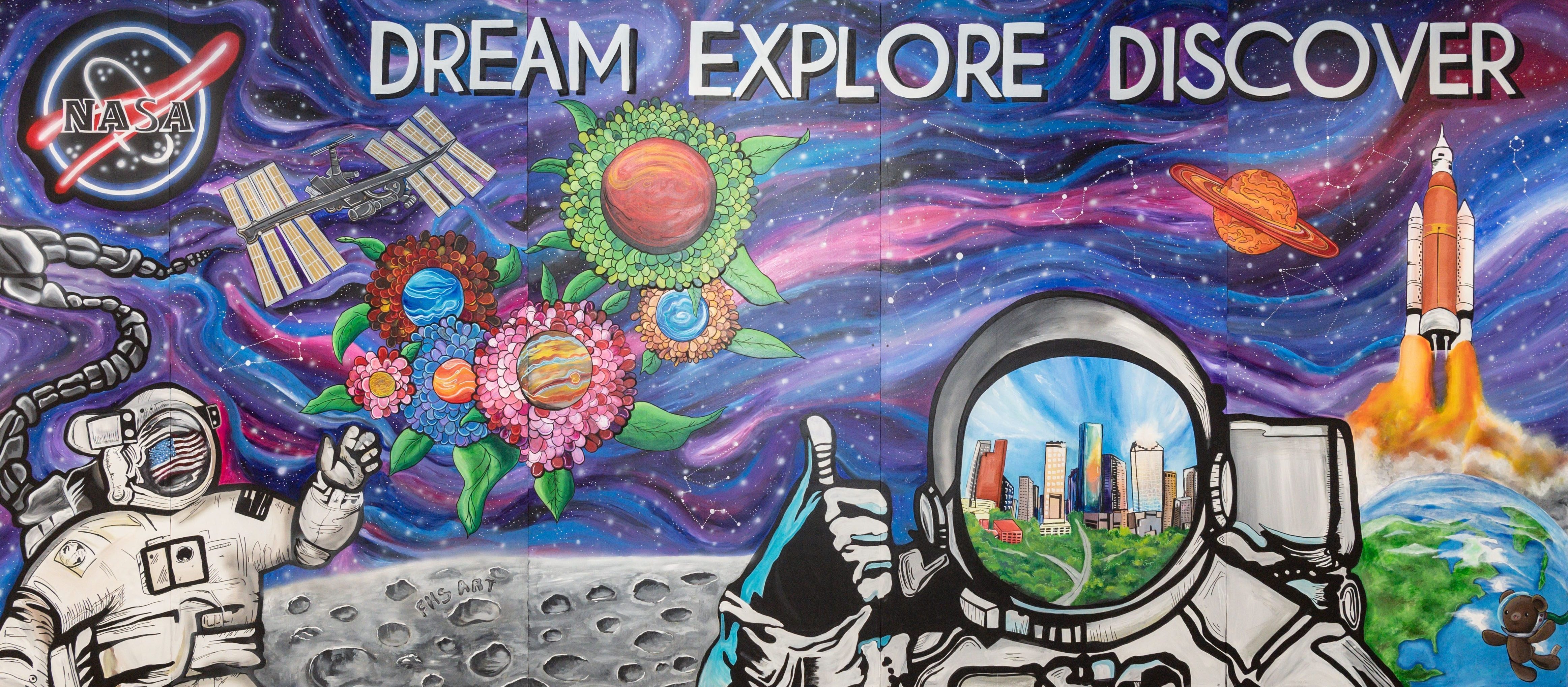
    A colorful art mural featuring two astronauts on a lunar landscape with the Earth and a rocket in the background. The NASA meatball insignia is in the top left corner.
    “Dream Explore Discover” was the first art mural created by Friendswood High School students in 2022.
    NASA/Bill Stafford

    Two murals are now housed in the hallway of the Neutral Buoyancy Laboratory’s International Space Development Integration Laboratory, known as the SDIL. The first, “Dream Explore Discover,” created by Friendswood High School students, was originally displayed in building 4 south. Under the guidance of art teacher Mandy Harris, more than 30 students designed and painted the 8-by-18-foot mural, starting with sketches and brainstorming sessions that considered how art could reflect human space exploration. The students combined their ideas into a single design celebrating the beauty and excitement of discovery. 

    Elements of the mural include an astronaut’s visor reflecting the Houston skyline, zinnias symbolizing life and science connecting beyond Earth, and a small floating teddy bear representing both the dreams of children who look up to the stars and the generations of explorers who carried small tokens of home into space. It serves as a reminder of the human heart behind every mission.  

    The mural also features the launch of NASA’s SLS (Space Launch System) rocket with NASA’s Orion spacecraft riding on top, heading for the next giant leap in exploration. Beside the capsule, the Orion constellation appears in the sky, symbolizing how the stars continue to guide humanity’s journey to the Moon, Mars, and beyond.  
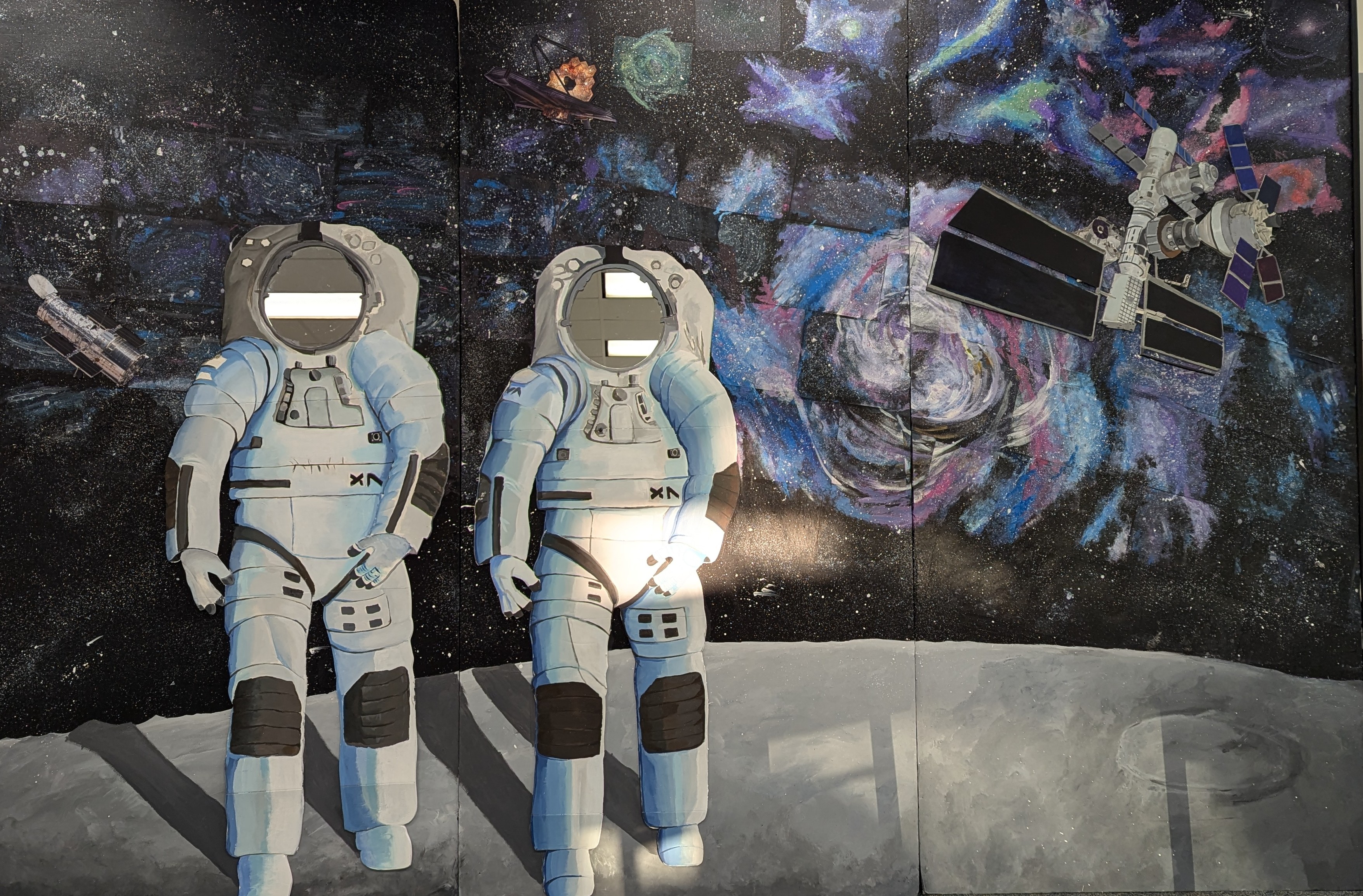
    A mural showcases two spacesuit cutouts on a lunar surface, allowing visitors to pose as astronauts. The backdrop features a depiction of space, with colorful galaxies, the Hubble Space Telescope, and a satellite orbiting a distant planet.
    “The Moon Now,” created by La Marque High School students, depicts two astronauts on the lunar surface in Axiom spacesuits with mirrored visors.

    “The Moon Now,” created by students from La Marque High School, Blocker Middle School, and Giles Middle School, is also housed at the SDIL. The artwork depicts two astronauts on the lunar surface wearing Axiom spacesuits with mirrored visors that reflect the faces of the next generation who will carry humanity back to the Moon. Individual student artworks of the Milky Way and celestial objects were collaged into the final piece, creating a tapestry of imagination and exploration. 
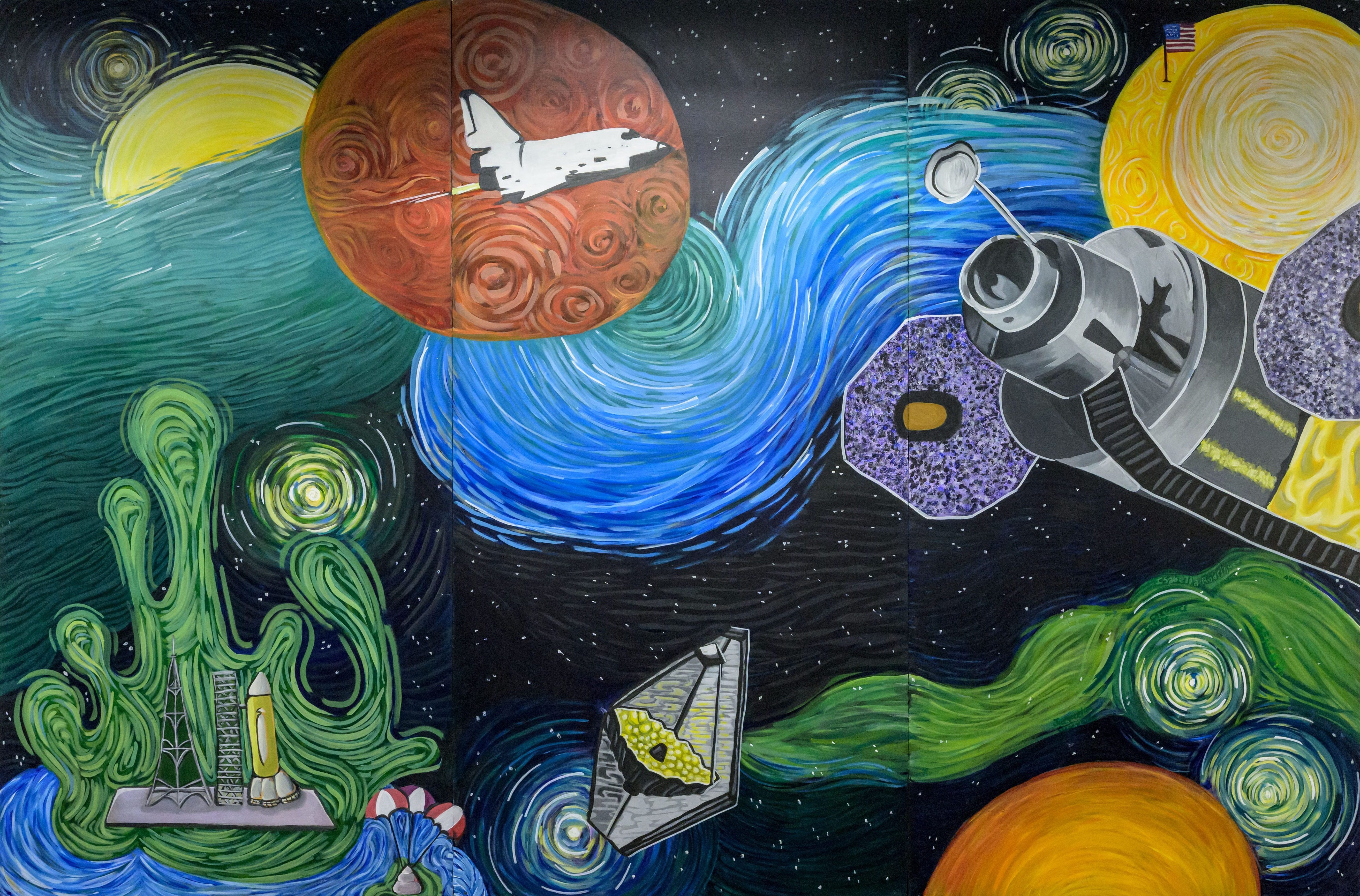
    A colorful art mural with a Van Gogh style depicting space exploration.
    Dickinson High School’s “A Starry Night” reimagines classic artistry through the lens of modern spaceflight.
    NASA/Josh Valcarcel

    The remaining murals are installed in building 4 south at Johnson. In 2023, the program expanded to include Dickinson High School, whose students created “A Starry Night,” a blend of Renaissance-style painting and modern space imagery. “Everyone wanted to be involved,” said art teacher Jennifer Sumrall. “The kids loved it and did their own research on how each of NASA’s missions impacts the world.” 
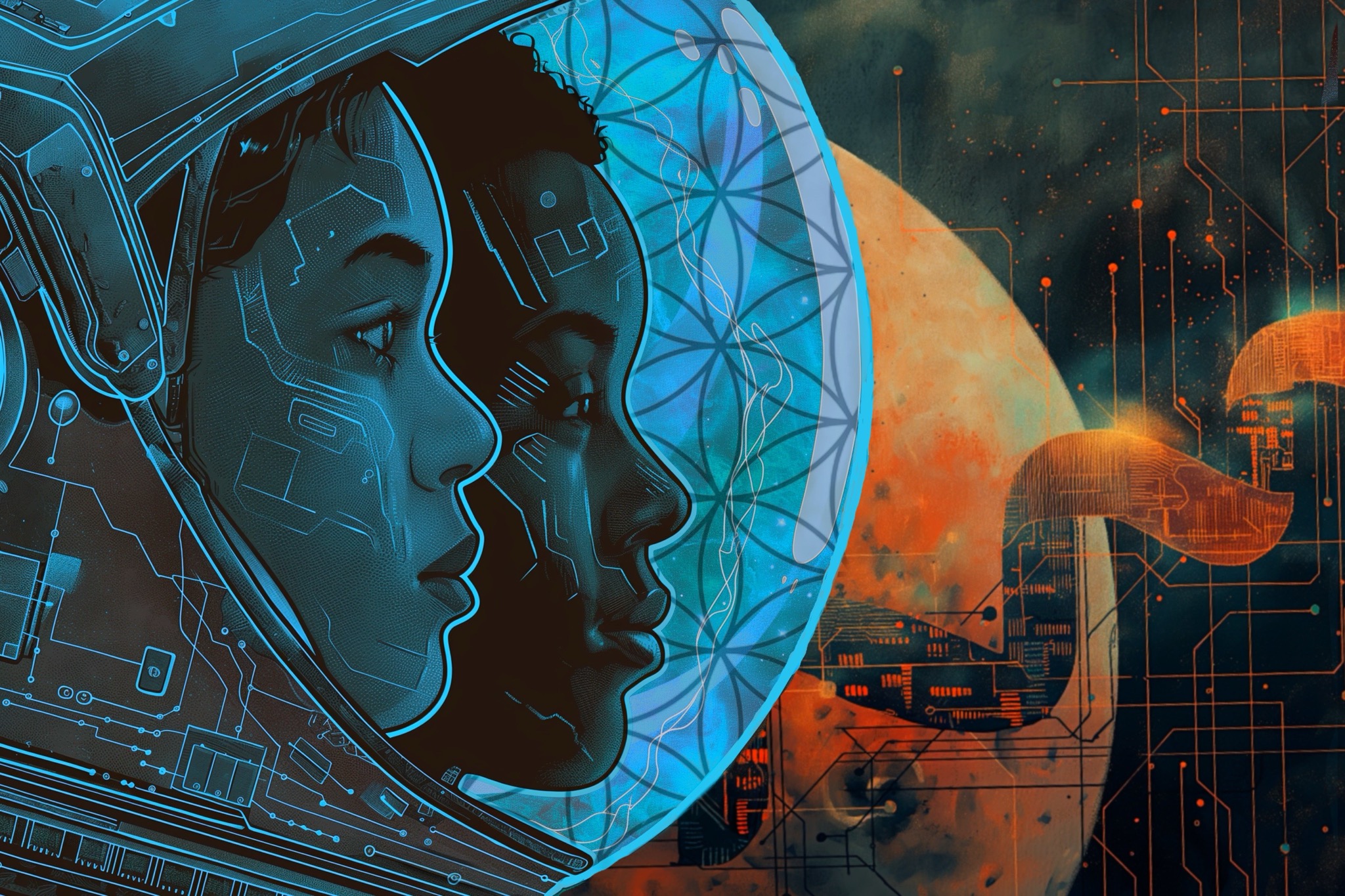
    A stylized digital artwork featuring two individuals in profile within an astronaut helmet. The helmet’s design incorporates circuitry patterns. In the background, Mars looms with orange and red hues, surrounded by abstract geometric lines and digital elements.
    “Absolute Equality: Breaking Boundaries” by Reginald C. Adams, symbolizes unity and humanity’s collective future in space exploration.

    “Absolute Equality: Breaking Boundaries” by Houston artist Reginald C. Adams symbolizes unity and humanity’s shared future in space exploration. Two figures share a single helmet. Patterns inspired by circuitry surround the faces and suggest the role of technology in connecting people around the world and beyond it. 
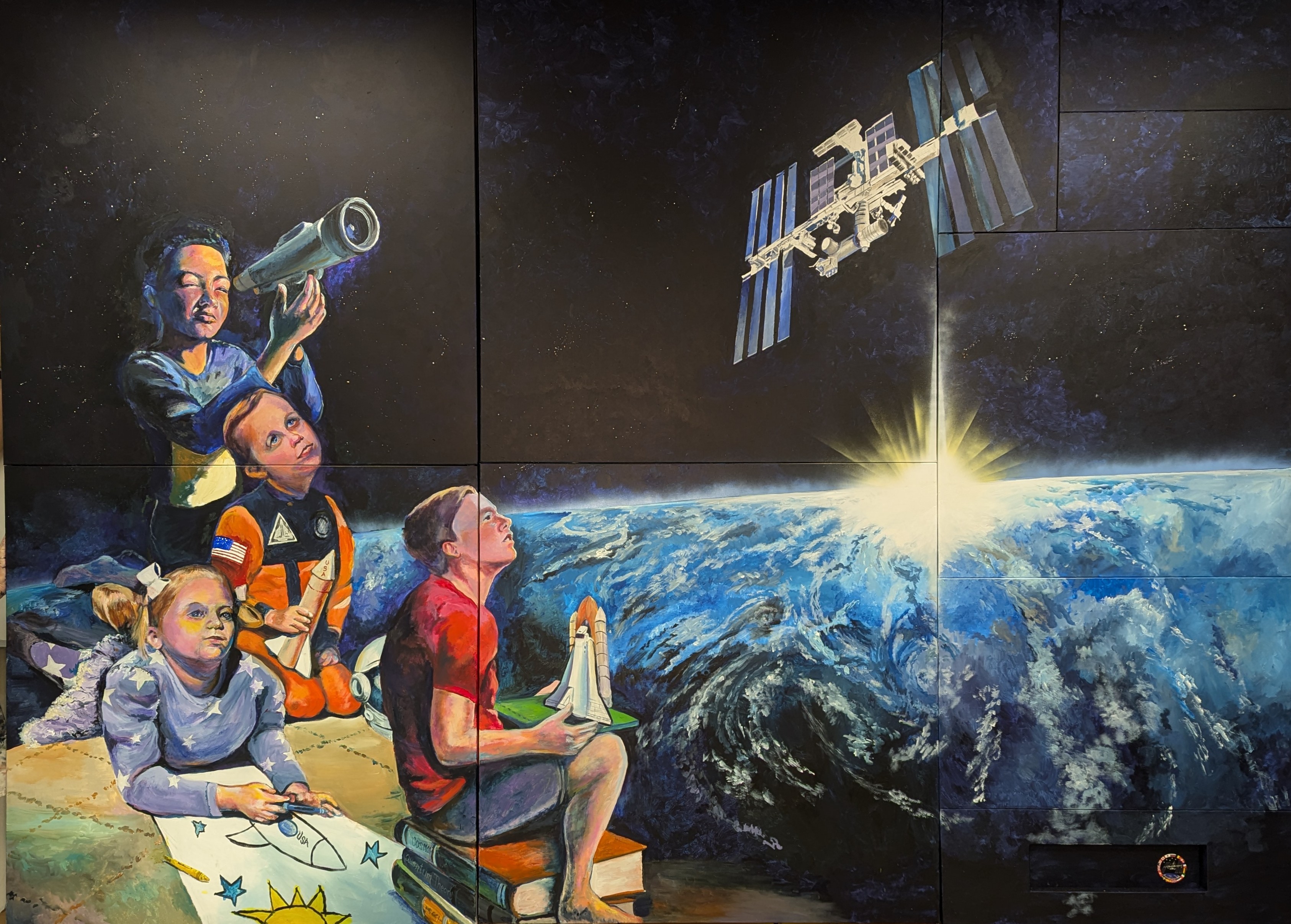
    A mural depicts children gazing at the night sky. One child looks through a telescope, while others hold models of rockets and spacecraft. The International Space Station orbits above Earth.
    La Marque High School students, art teacher Joan Finn, and artist Cheryl Evans painted “Collaboration” to illustrate the interconnected roles in space exploration.

    “Collaboration” was painted by La Marque High School students with art teacher Joan Finn and artist Cheryl Evans to depict the interconnected roles of visionaries, engineers, artists, and astronauts in exploration. Built from 10 stretched canvases bolted together — a nod to the station’s assembly across more than 40 missions — the mural includes the space station patch at the bottom to represent the collaboration of the 15 countries involved.

    NASA Johnson thanks Joel Montalbano, who championed student engagement that connects classrooms to mission work during his tenure as International Space Station Program manager. The center also acknowledges Gary Johnson for conceiving the mural project and guiding its partnerships, Raul Tijerina for early design leadership that set the standard, Gordon Andrews for opening doors through behind-the-scenes tours, and art educators for mentoring the students who brought each mural to life.  
  • NASA Rover Detects Electric Sparks in Mars Dust Devils, Storms

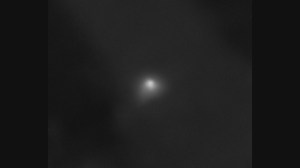
    Three Martian dust devils can be seen near the rim of Jezero Crater in this short video made of images taken by a navigation camera aboard NASA’s Perseverance rover on Sept. 6, 2025. The microphone on the rover’s SuperCam previously captured audio when a dust devil passed over.
    NASA/JPL-Caltech/SSI

    Perseverance confirmed a long-suspected phenomenon in which electrical discharges and their associated shock waves can be born within Red Planet mini-twisters.

    NASA’s Perseverance Mars rover has recorded the sounds of electrical discharges —sparks — and mini-sonic booms in dust devils on Mars. Long theorized, the phenomenon has now been confirmed through audio and electromagnetic recordings captured by the rover’s SuperCam microphone. The discovery, published Nov. 26 in the journal Nature, has implications for Martian atmospheric chemistry, climate, and habitability, and could help inform the design of future robotic and human missions to Mars.

    A frequent occurrence on the Red Planet, dust devils form from rising and rotating columns of warm air. Air near the planet’s surface becomes heated by contact with the warmer ground and rises through the denser, cooler air above. As other air moves along the surface to take the place of the rising warmer air, it begins to rotate. When the incoming air rises into the column, it picks up speed like spinning ice skaters bringing their arms closer to their body. The air rushing in also picks up dust, and a dust devil is born.

    SuperCam has recorded 55 distinct electrical events over the course of the mission, beginning on the mission’s 215thMartian day, or sol, in 2021. Sixteen have been recorded when dust devils passed directly over the rover.

    Decades before Perseverance landed, scientists theorized that the friction generated by tiny dust grains swirling and rubbing against each other in Martian dust devils could generate enough of an electrical charge to eventually produce electrical arcs. Called the triboelectric effect, it’s the phenomenon at play when someone walks over a carpet in socks and then touches a metal doorknob, generating a spark. In fact, that is about the same level of discharge as what a Martian dust devil might produce.

    “Triboelectric charging of sand and snow particles is well documented on Earth, particularly in desert regions, but it rarely results in actual electrical discharges,” said Baptiste Chide, a member of the Perseverance science team and a planetary scientist at L’Institut de Recherche en Astrophysique et Planétologie in France. “On Mars, the thin atmosphere makes the phenomenon far more likely, as the amount of charge required to generate sparks is much lower than what is required in Earth’s near-surface atmosphere.”

    Perseverance’s SuperCam instrument carries a microphone to analyze the sounds of the instrument’s laser when it zaps rocks, but the team has also captured the sounds of wind and even the first audio recording of a Martian dust devil. Scientists knew it could pick up electromagnetic disturbance (static) and sounds of electrical discharges in the atmosphere. What they didn’t know was if such events happened frequently enough, or if the rover would ever be close enough, to record one. Then they began to assess data amassed over the mission, and it didn’t take long to find the telltale sounds of electrical activity.

    The SuperCam microphone on NASA’s Perseverance captured this recording of the sounds of electrical discharge as a dust devil passed over the Mars rover on Oct. 12, 2024. The three crackles can be heard in between the sounds of the dust devil’s front and trailing walls.
    Credit: NASA/JPL-Caltech/LANL/CNES/CNRS/ISAE-Supaero

    Crackle, pop

    “We got some good ones where you can clearly hear the ‘snap’ sound of the spark,” said coauthor Ralph Lorenz, a Perseverance scientist at the Johns Hopkins Applied Physics Lab in Laurel, Maryland. “In the Sol 215 dust devil recording, you can hear not only the electrical sound, but also the wall of the dust devil moving over the rover. And in the Sol 1,296 dust devil, you hear all that plus some of the particles impacting the microphone.”

    Thirty-five other discharges were associated with the passage of convective fronts during regional dust storms. These fronts feature intense turbulence that favor triboelectric charging and charge separation, which occurs when two objects touch, transfer electrons, and separate — the part of the triboelectric effect that results in a spark of static electricity.

    Researchers found electrical discharges did not seem to increase during the seasons when dust storms, which globally increase the presence of atmospheric dust, are more common on Mars. This result suggests that electrical buildup is more closely tied to the localized, turbulent lifting of sand and dust rather than high dust density alone.

    While exploring the rim of Jezero Crater on Mars, NASA’s Perseverance rover captured new images of multiple dust devils in January 2025. These captivating phenomena have been documented for decades by the agency’s Red Planet robotic explorers.
    Credit: NASA/JPL-Caltech/LANL/CNES/CNRS/INTA-CSIC/Space Science Institute/ISAE-Supaero/University of Arizona

    Profound effects

    The proof of these electrical discharges is a discovery that dramatically changes our understanding of Mars. Their presence means that the Martian atmosphere can become sufficiently charged to activate chemical reactions, leading to the creation of highly oxidizing compounds, such as chlorates and perchlorates. These strong substances can effectively destroy organic molecules (which constitute some of the components of life) on the surface and break down many atmospheric compounds, completely altering the overall chemical balance of the Martian atmosphere.

    This discovery could also explain the puzzling ability of Martian methane to vanish rapidly, offering a crucial piece of the puzzle for understanding the constraints life may have faced and, therefore, the planet’s potential to be habitable.

    Given the omnipresence of dust on Mars, the presence of electrical charges generated by particles rubbing together would seem likely to influence dust transport on Mars as well. How dust travels on Mars plays a central role in the planet’s climate but remains poorly understood.

    Confirming the presence of electrostatic discharges will also help NASA understand potential risks to the electronic equipment of current robotic missions. That no adverse electrostatic discharge effects have been reported in several decades of Mars surface operations may attest to careful spacecraft grounding practices. The findings could also inform safety measures developed for future astronauts exploring the Red Planet.

    More about Perseverance

    Managed for NASA by Caltech, the Jet Propulsion Laboratory in Southern California built and manages operations of the Perseverance rover on behalf of the agency’s Science Mission Directorate as part of NASA’s Mars Exploration Program portfolio.

    To learn more about Perseverance visit:
    https://science.nasa.gov/mission/mars-2020-perseverance

    News Media Contacts

    DC Agle
    Jet Propulsion Laboratory, Pasadena, Calif.
    818-393-9011
    agle@jpl.nasa.gov

    Karen Fox / Molly Wasser
    NASA Headquarters, Washington
    202-358-1600 / 240-419-1732
    karen.c.fox@nasa.gov / molly.l.wasser@nasa.gov

    2025-132

    Details

    Last Updated

    Dec 03, 2025

  • Hubble Seeks Clusters in ‘Lost Galaxy’

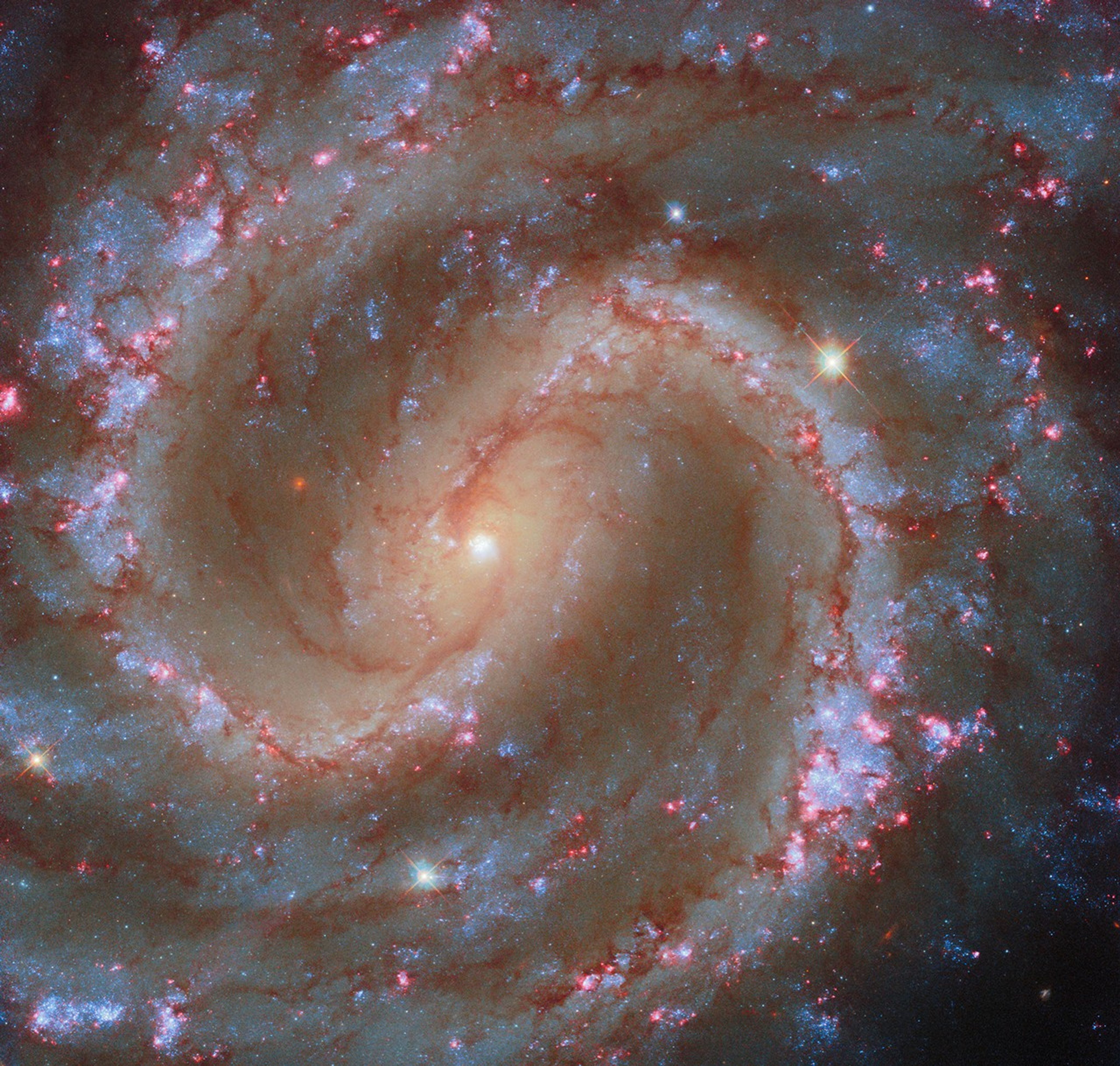
    A close-in view of a spiral galaxy that faces the viewer. Brightly lit spiral arms swing outward through the galaxy’s disk, starting from an elliptical region in its center. Thick strands of dark reddish dust spread across the disk, primarily along the spiral arms. The arms also contain many glowing, pink-red spots where stars form and clumps of bright-blue star clusters. Beyond its spiral arms, the galaxy is a bit fainter and speckled with blue stars.
    ESA/Hubble & NASA, F. Belfiore, J. Lee and the PHANGS-HST Team

    This NASA/ESA Hubble Space Telescope image features the spiral galaxy NGC 4535, which is situated about 50 million light-years away in the constellation Virgo (the Maiden). Through a small telescope, this galaxy appears extremely faint, giving it the nickname ‘Lost Galaxy’. With a mirror spanning nearly eight feet (2.4 meters) across and its location above Earth’s light-obscuring atmosphere, Hubble can easily observe dim galaxies like NGC 4535 and pick out features like its massive spiral arms and central bar of stars.

    This image features NGC 4535’s young star clusters, which dot the galaxy’s spiral arms. Glowing-pink clouds surround many of these bright-blue star groupings. These clouds, called H II (‘H-two’) regions, are a sign that the galaxy is home to especially young, hot, and massive stars that blaze with high-energy radiation. Such massive stars shake up their surroundings by heating their birth clouds with powerful stellar winds, eventually exploding as supernovae.

    The image incorporates data from an observing program designed to catalog roughly 50,000 H II regions in nearby star-forming galaxies like NGC 4535. Hubble released a previous image of NGC 4535 in 2021. Both the 2021 image and this new image incorporate observations from the PHANGS observing program, which seeks to understand the connections between young stars and cold gas. Today’s image adds a new dimension to our understanding of NGC 4535 by capturing the brilliant red glow of the nebulae that encircle massive stars in their first few million years of life.

    Image credit: ESA/Hubble & NASA, F. Belfiore, J. Lee and the PHANGS-HST Team

  • Hazardous Material Summary Tables (HMSTs)

    3 min read

    Preparations for Next Moonwalk Simulations Underway (and Underwater)

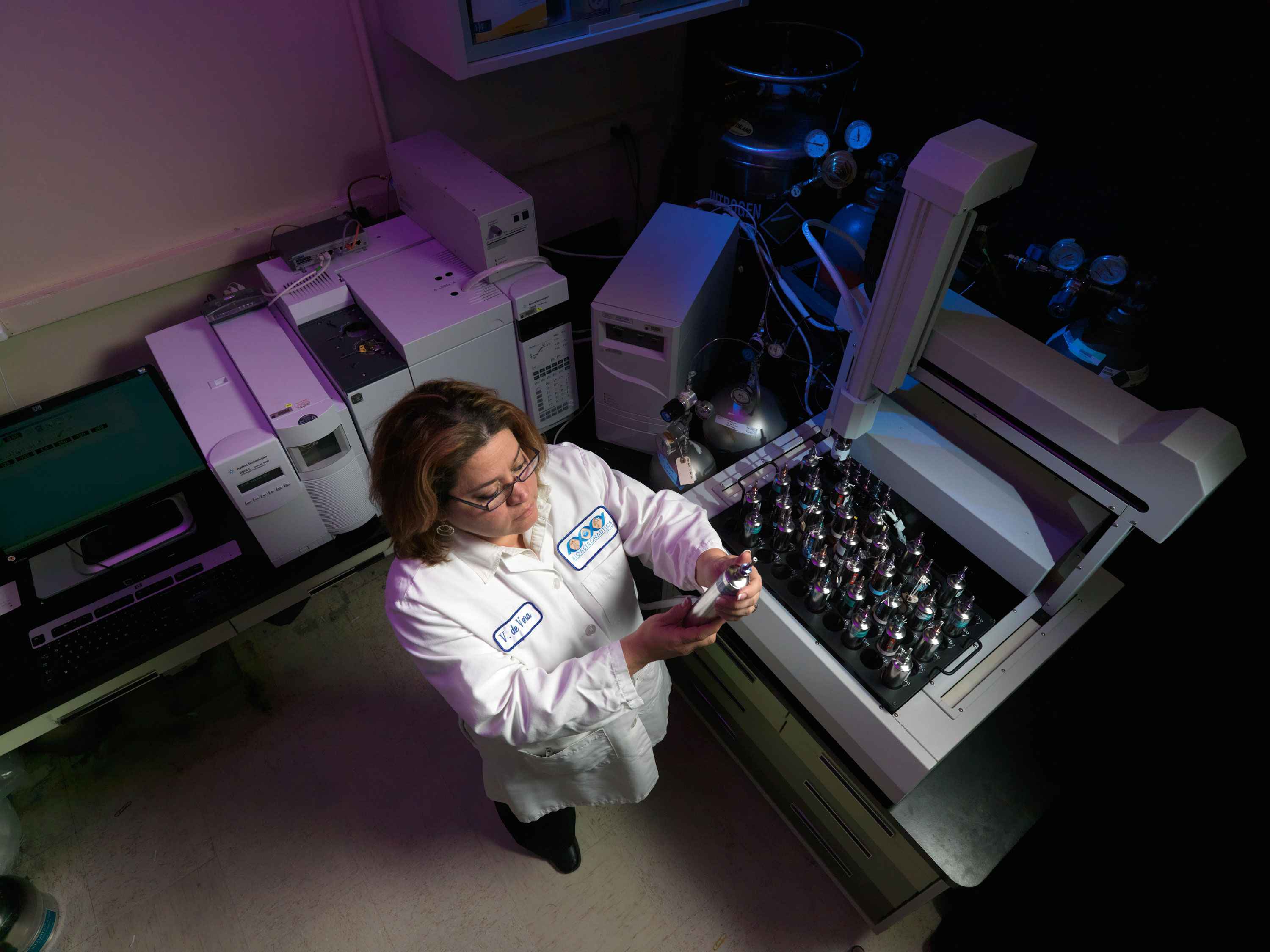
    space toxicologist
    A space toxicologist at NASA JSC.
    NASA

    Hazardous Materials Summary Tables (HMSTs) are a compilation of the chemical, biological, and flammability hazards of materials on a given flight or mission. HMSTs are required by Safety for all Programs, including but not limited to ISS, Commercial Crew Program (CCP), Multi Purpose Crew Vehicle (MPCV), and Gateway. Johnson Space Center (JSC) toxicologists evaluate the toxic hazard level of all liquids, gases, particles, or gels flown on or to any manned U.S. spacecraft. The biosafety hazard level and flammability levels are assigned by JSC microbiologists and materials experts and are documented in an HMST and in a computerized in-flight version of the HMST called the HazMat (Hazardous Materials) database.
    How To Obtain Toxicological Hazard Assessments

    “Requirements for Submission of Data Needed for Toxicological Assessment of Chemical and Biologicals to be Flown on Manned Spacecraft”

    • JSC 27472 (PDF, 766KB) defines the terms “chemicals” and “biological materials” as applied to items being flown on or to any U.S. spacecraft. It explains who must submit information to the JSC toxicologists concerning the materials to be flown and specifies what information is needed. It provides schedules, formats, and contact information.
    • Additional US requirements for biological materials can be found on the Biosafety Review Board (BRB) page.
    • Additional US requirements for environmental control and life support (ECLS) assessments can be found in JSC 66869 (PDF, 698KB).

    Data Submission

    For all flights to ISS and all Artemis requests (Orion, Gateway, Human Lander System (HLS)), please submit data via the electronic hazardous materials summary table (eHMST) tool. If you do not have access to this tool, please submit a NAMS request for access to JSC – CMC External Tools. Please reference eHMST training for more information

    NOTE:  For experimental payloads/hardware planned for launch on a Russian vehicle, stowed and/or operated on the Russian Segment of ISS, or planned for return or disposal on a Russian vehicle, we strongly encourage payload providers to submit biological and chemical data to the Russian Institute for Biomedical Problems (moukhamedieva@imbp.ru OR barantseva@imbp.ru).

    Hazard Assessments

    Toxicological hazard assessments are conducted according to JSC 26895 – Guidelines for Assessing the Toxic Hazard of Spacecraft Chemicals and Test Materials. The resulting Toxicity Hazard Level (THL) in combination with the BioSafety Level (BSL) and Flammability Hazard Level (FHL) form the basis for the combined Hazard Response Level (HRL) used for labeling and operational response per flight rule B20-16.

    Share

    Details

    Last Updated

    Dec 03, 2025

    Editor
    Robert E. Lewis

  • Toxicology Analysis of Spacecraft Air

    4 min read

    Preparations for Next Moonwalk Simulations Underway (and Underwater)

    SpaceX Crew-1 uses a GSC en route to the ISS
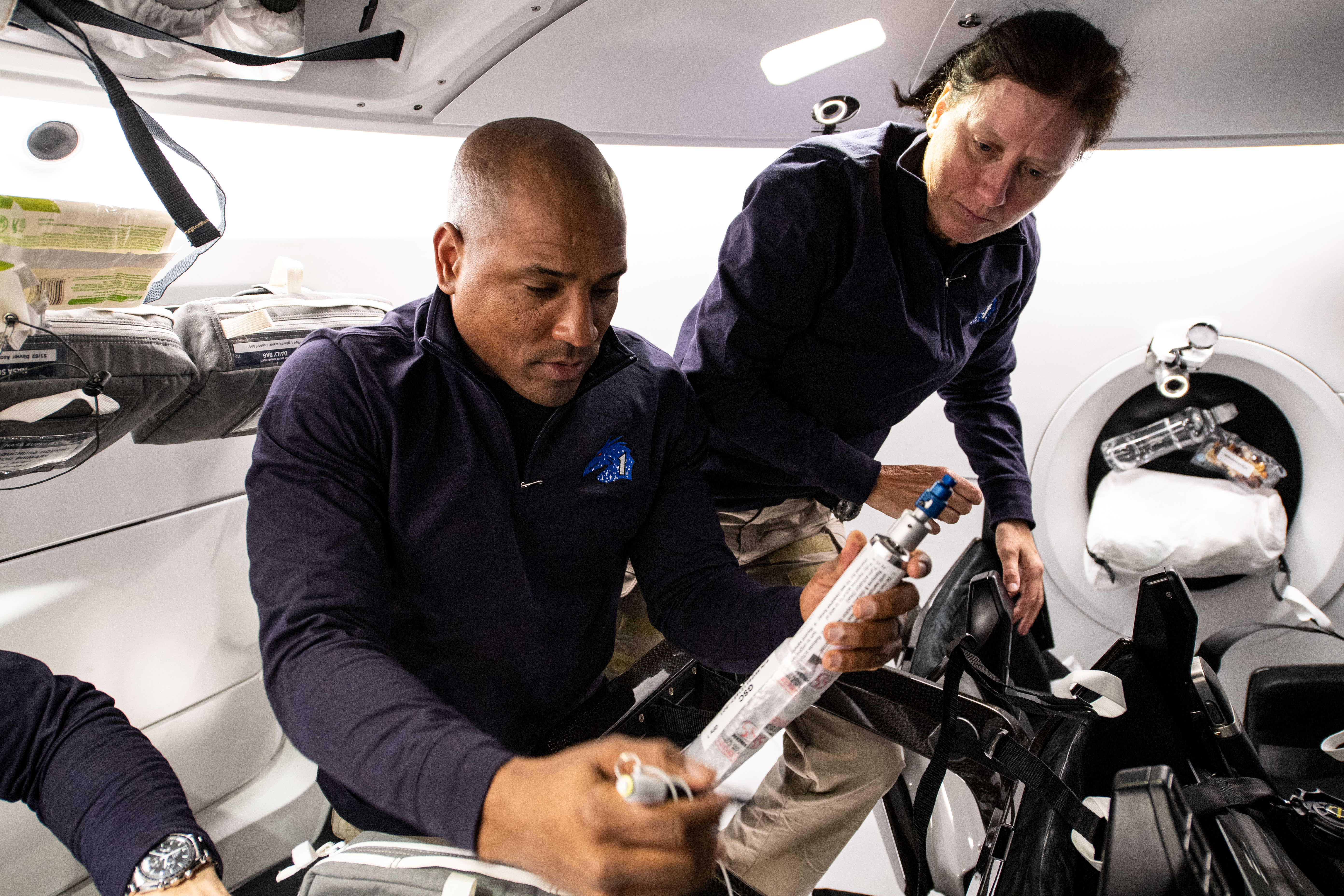
    SpaceX Crew-1 Pilot Victor Glover and Mission Specialist Shannon Walker work with a Grab Sample Container (GSC) in the SpaceX Crew Dragon Resilience spacecraft while en route to the ISS.
    NASA

    Toxicology and Environmental Chemistry (TEC) monitors airborne contaminants in both spacecraft air and water. In-flight monitors are employed to provide real-time insight into the environmental conditions on ISS. Archival samples are collected and returned to Earth for full characterization of ISS air and water.

    Real-time in-flight air analytical instruments include the Air Quality Monitors (AQM), carbon dioxide (CO2 monitors), and a compound specific analyzer for combustion products (CSA-CP). Real-time in-flight water monitoring capabilities include the colorimetric water quality monitoring kit (CWQMK) and the ISS total organic carbon analyzer (TOCA).

    Post-flight analyses are performed on archival samples of spacecraft air and water obtained at specific times and locations during a mission. Air archival samples are collected using “grab sample containers” (GSC) and formaldehyde badges. The U.S. and Russian water recovery systems on the ISS process atmospheric moisture (U.S. and Russian systems) and urine distillate (U.S. system only) into clean, potable water for the crew to use.  The Water Kit is utilized to collect archival samples of the potable water and are routinely returned to the ground to monitor the quality of the water produced by the systems.  Samples of condensate and wastewater are also collected and returned to check for the presence of contaminants that could break through the water recovery systems.   

    Results of Post-Flight Analysis of In-Flight Air Samples  (Most Recent First)


    Details

    Last Updated

    Dec 03, 2025

    Editor
    Robert E. Lewis

  • NASA Astronaut Jonny Kim Advances Research Aboard Space Station

    5 min read

    Preparations for Next Moonwalk Simulations Underway (and Underwater)

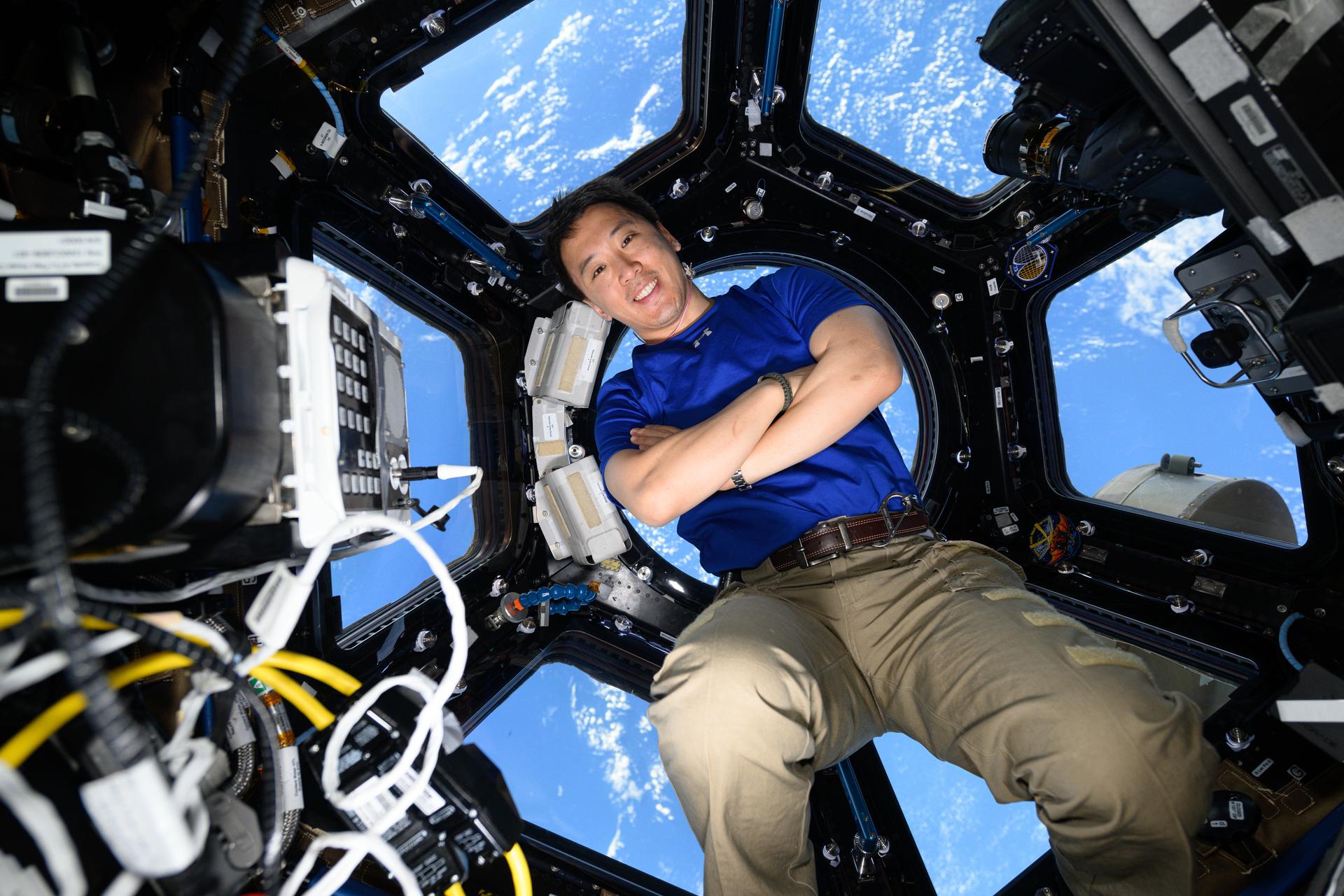
    NASA astronaut Jonny Kim floats in the center of the image with his arms crossed, smiling. He wears a blue shirt and khaki pants. Behind him, the seven windows of the space station’s cupola reveal Earth’s blue oceans below. In the foreground, on the left, a rectangular device with a keypad and multiple wires is visible.
    NASA astronaut Jonny Kim floats inside the Cupola of the International Space Station.
    NASA

    NASA astronaut Jonny Kim is wrapping up his first mission aboard the International Space Station in early December. During his stay, Kim conducted scientific experiments and technology demonstrations to benefit humanity on Earth and advance NASA’s Artemis campaign in preparation for future human missions to Mars.

    Here is a look at some of the science Kim completed during his mission:

    Medical check-ups in microgravity

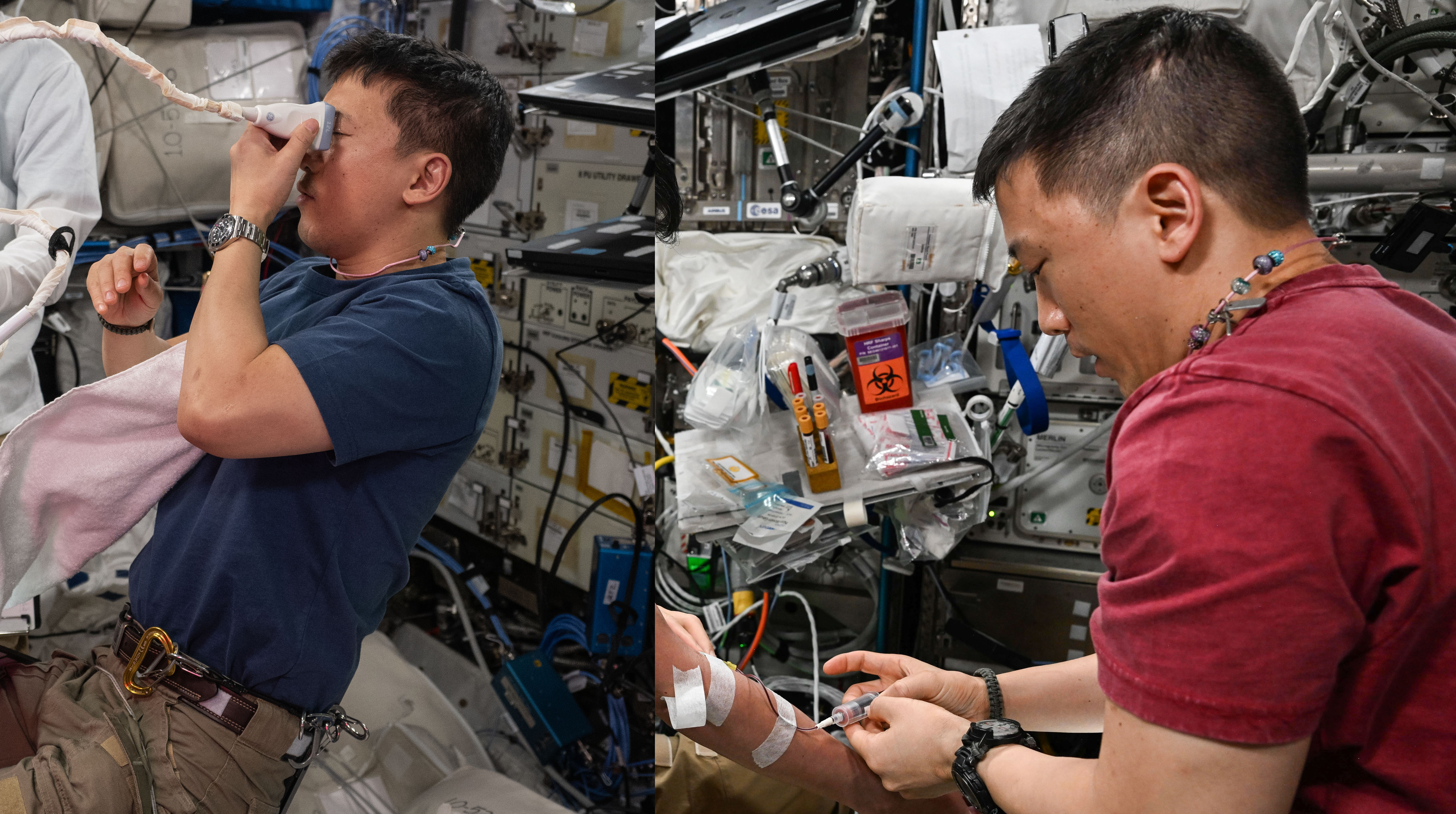
    Left: NASA astronaut Jonny Kim, wearing a navy-blue shirt and brown cargo pants, holds a small medical device to his left eye. Kim wears a silver watch on his left wrist, and there are many electronic devices and wires embedded in the surrounding walls. Right: Kim, wearing a red shirt and a black watch, draws blood from a fellow crew member’s arm, which has multiple white adhesives attached. A small workstation with multiple blood vials and a biohazard disposal container is in the background.
    NASA

    NASA astronaut Jonny Kim, a medical doctor, completed several routine medical exams while aboard the International Space Station. NASA flight surgeons and researchers monitor crew health using a variety of tools, including blood tests, eye exams, and ultrasounds.

    Kim conducts an ultrasound of his eye in the left image. Eye exams are essential as long-duration spaceflight may cause changes to the eye’s structure and affect vision, a condition known as spaceflight associated neuro-ocular syndrome, or SANS. In the right image, Kim draws blood from a fellow crew member. These blood sample collections provide important insights into crew cartilage and bone health, cardiovascular function, inflammation, stress, immune function, and nutritional status.

    NASA astronauts complete regular medical exams before, during, and after spaceflight to monitor astronaut health and develop better tools and measures for future human exploration missions to the Moon and Mars.

    Learn more about human research on space station.

    Low light plant growth

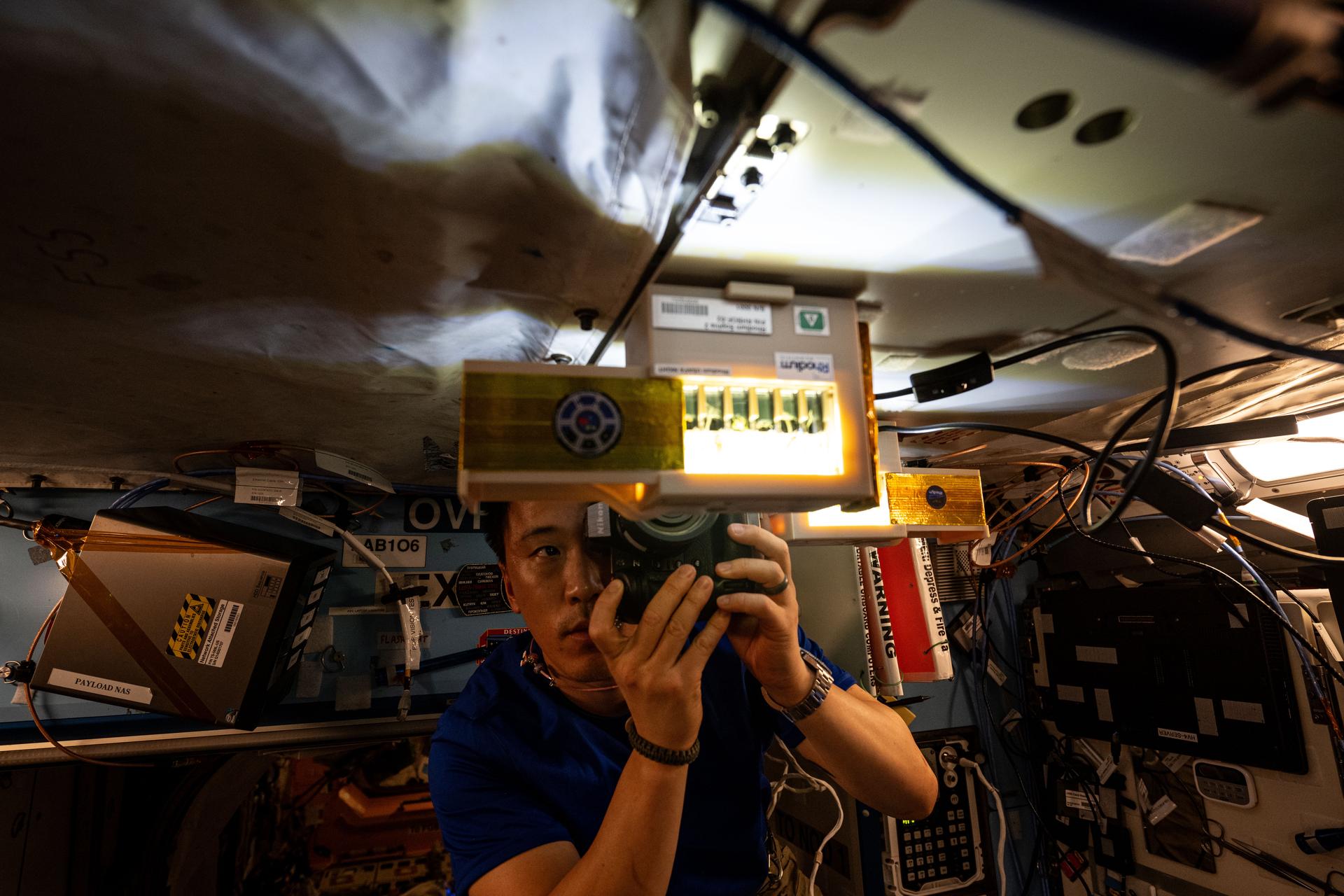
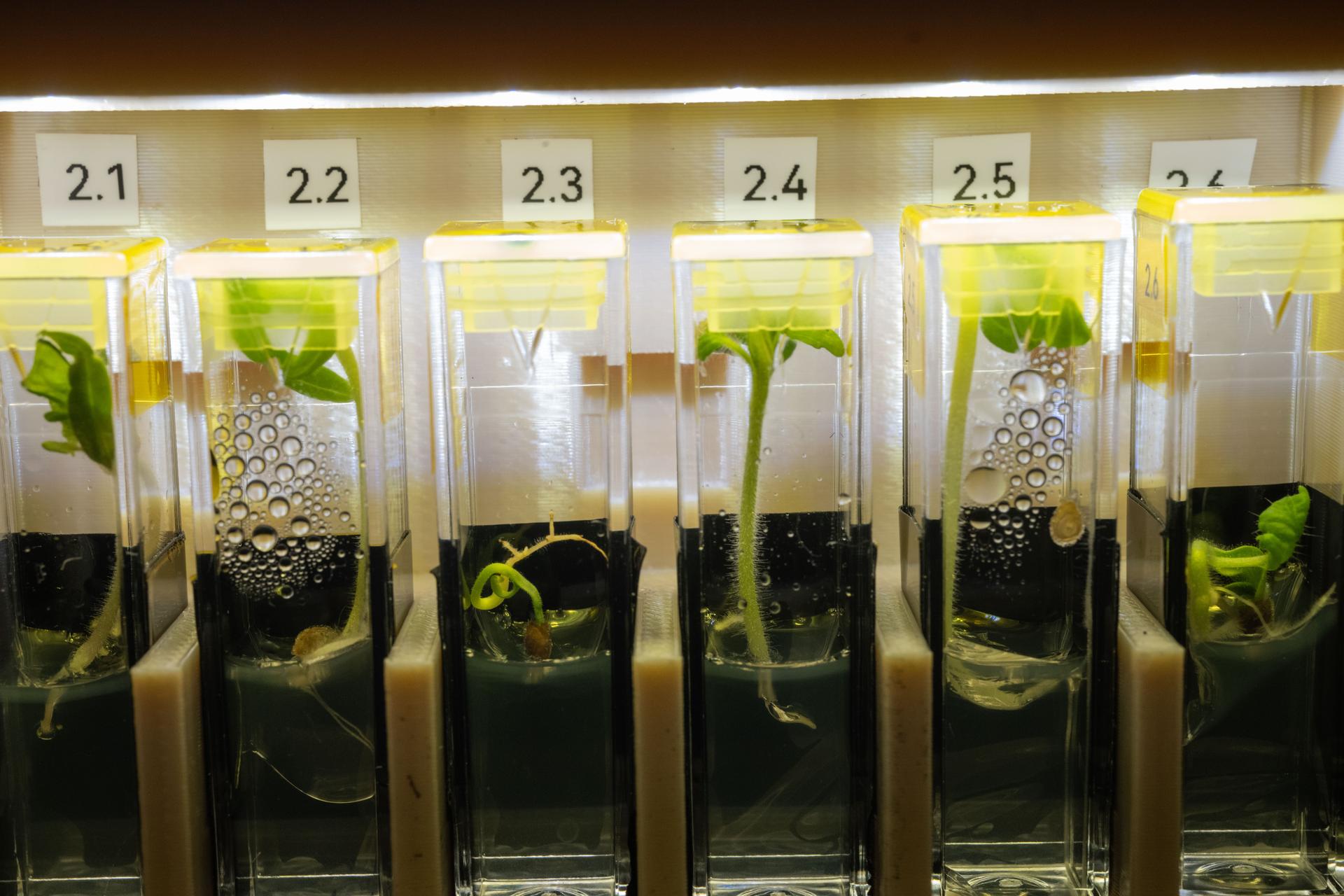
    NASA astronaut Jonny Kim photographs dwarf tomato sprouts grown using a nutrient supplement instead of photosynthesis as part of a study on plant development and gene expression. The plants are given an acetate supplement as a secondary nutrition source, which could increase growth and result in better yields, all while using less power and fewer resources aboard the space station and future spacecraft. 

    Learn more about Rhodium USAFA NIGHT.

    Radioing future space explorers

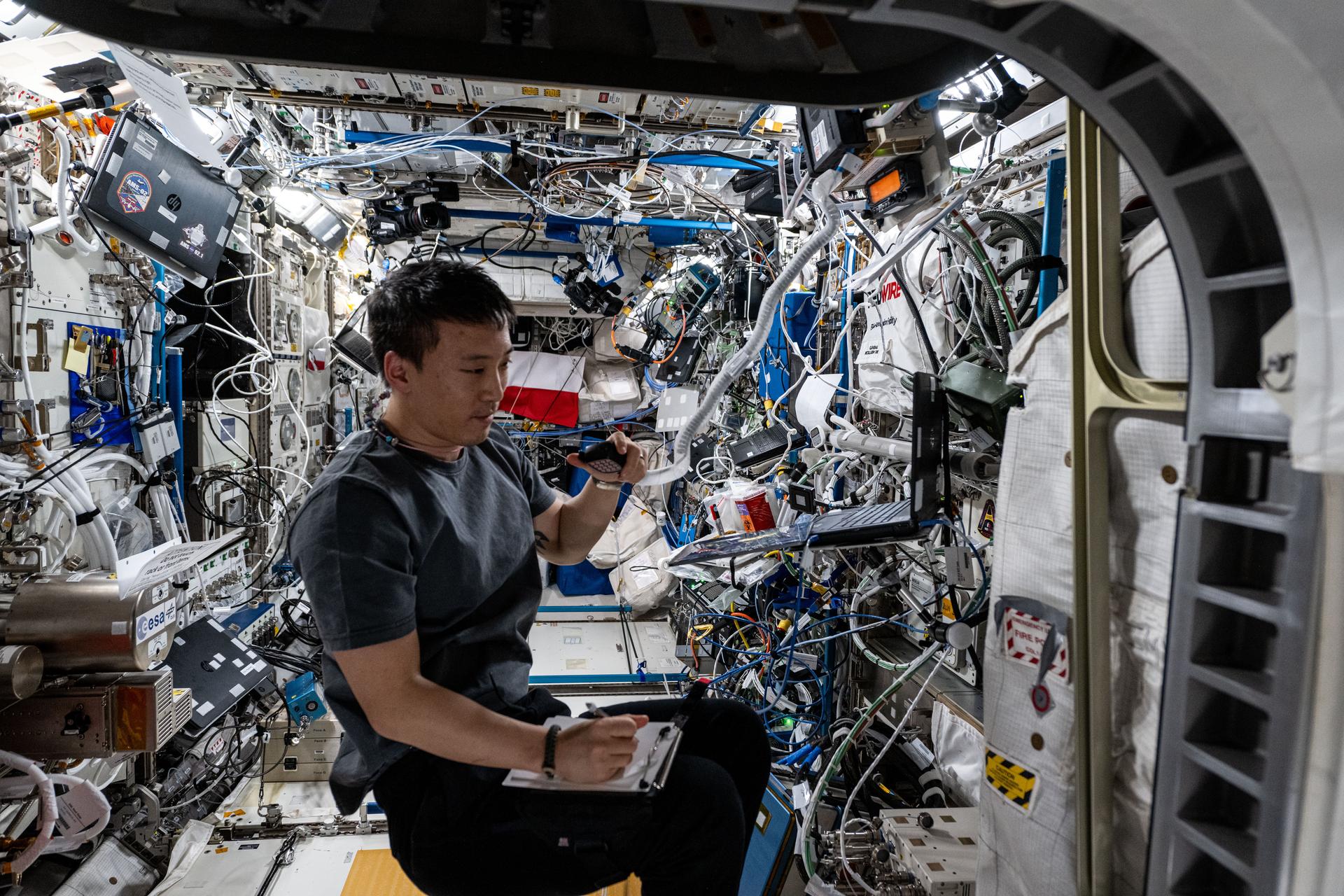
    NASA astronaut Jonny Kim, wearing a black shirt and black pants, sits with a clipboard on his right leg and a radio in his left hand. His right hand rests on the clipboard as he takes notes while looking at a laptop. Densely packed electronics and wiring along the walls of the space station are visible in the background.
    NASA

    NASA astronaut Jonny Kim uses a ham radio to speak with students on Earth via an educational program connecting students worldwide with astronauts aboard the International Space Station. Students can ask about life aboard the orbiting laboratory and the many experiments conducted in microgravity. This program encourages an interest in STEM (science, technology, engineering, and mathematics) and inspires the next generation of space explorers.

    Learn more about ISS Ham Radio.

    Encoding DNA with data

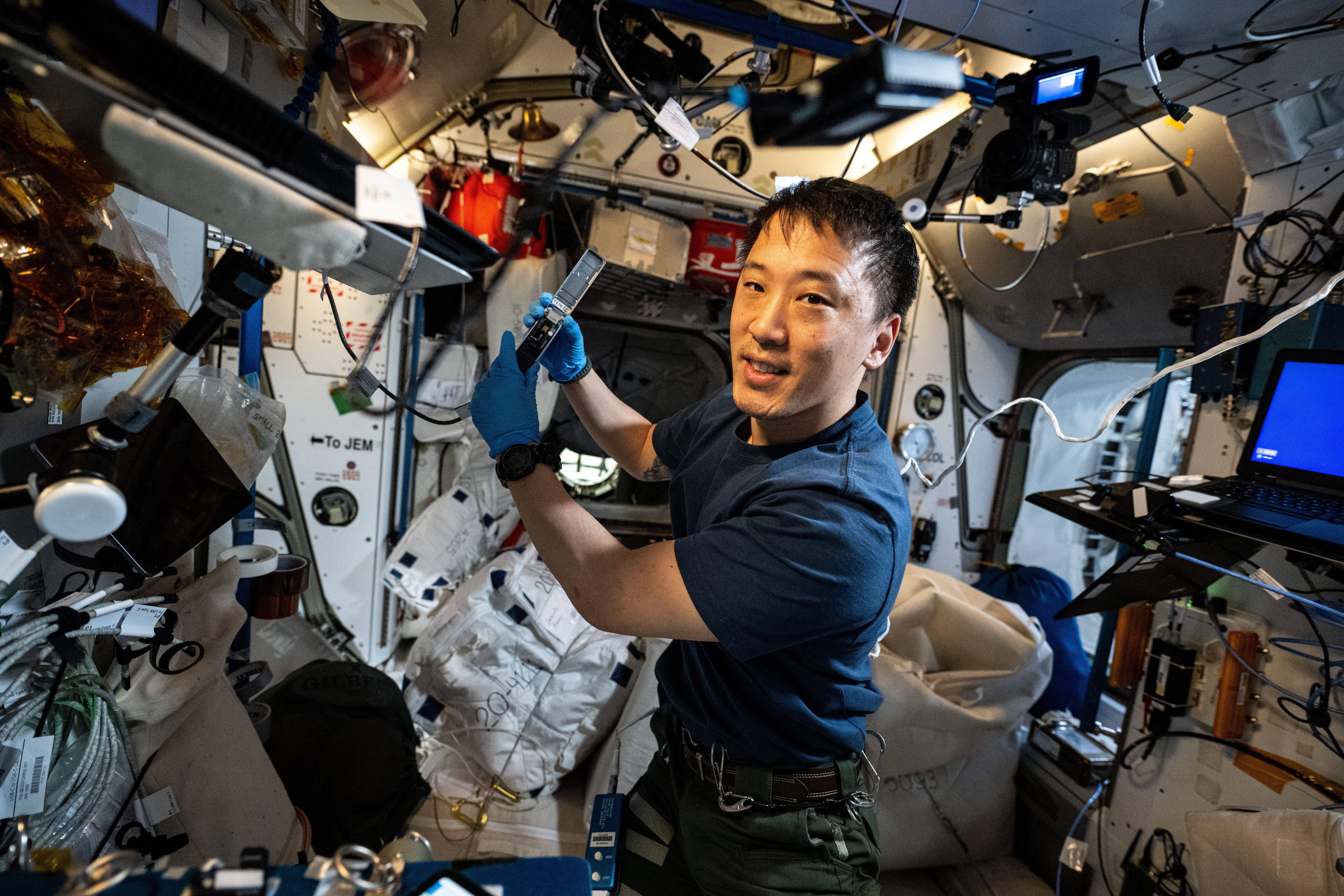
    NASA astronaut Jonny Kim, wearing a navy-blue shirt and blue latex gloves, holds up a rectangular, controller-sized device with both hands. He is surrounded by electronic equipment and wires.
    NASA

    Secure and reliable data storage and transmission are essential to maintain the protection, accuracy, and accessibility of information. In this photo, NASA astronaut Jonny Kim displays research hardware that tests the viability of encoding, transmitting, and decoding encrypted information via DNA sequences. As part of this experiment, DNA with encrypted information is sequenced aboard the space station to determine the impact of the space environment on its stability. Using DNA to store and transmit data could reduce the weight and energy requirements compared to traditional methods used for long-duration space missions and Earth-based industries.

    Learn more about Voyager DNA Decryption.

    Remote robotics

    NASA astronaut Jonny Kim, wearing a black shirt, faces left as he reaches for a laptop with his right hand. His left hand rests on a joystick controller. Multiple electronics panels are embedded into the wall directly in front of him, with numerous wires visible in the surrounding area.
    NASA

    Future deep space exploration could rely on robotics remotely operated by humans. NASA astronaut Jonny Kim tests a technology demonstration that allows astronauts to remotely control robots on Earth from the International Space Station. Findings from this investigation could help fine-tune user-robot operating dynamics during future missions to the Moon, Mars, and beyond. 

    Learn more about Surface Avatar.

    Blocking bone loss

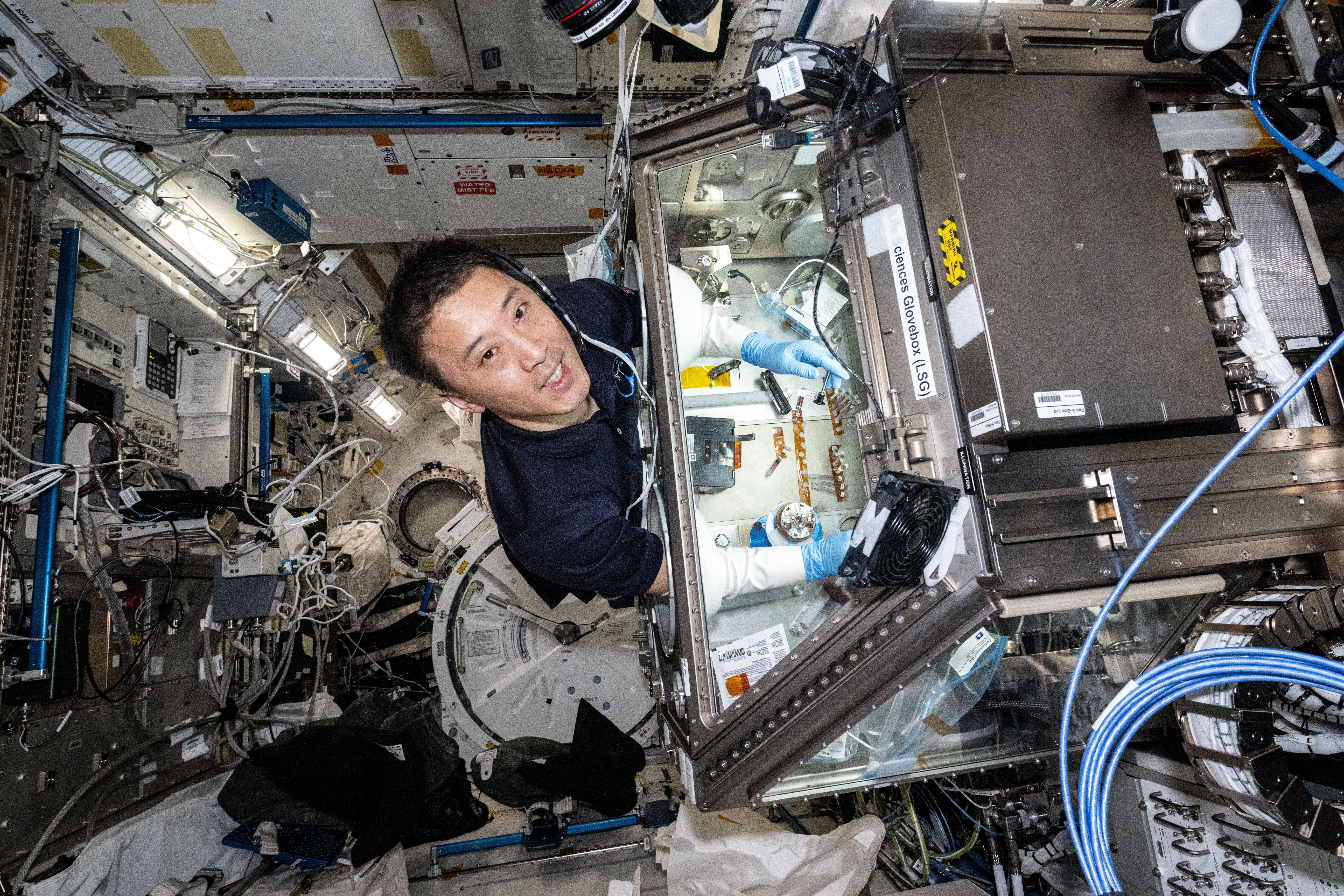
    NASA astronaut Jonny Kim, wearing a black shirt, smiles as he is photographed from above. His arms are inserted into a clear-paneled glovebox, where his hands, covered in blue latex gloves, handle small sterile items sealed in paper wrappers. Wires and electronics line the surrounding walls of the space station.
    NASA

    NASA astronaut Jonny Kim conducts an investigation to assess the effects of microgravity on bone marrow stem cells, including their ability to secrete proteins that form and dissolve bone. Bone loss, an age-related factor on Earth, is aggravated by weightlessness and is a health concern for astronauts. Researchers are evaluating whether blocking signals that cause loss could protect astronauts during long-duration spaceflights. The findings could also lead to preventative measures and treatments for bone loss caused by aging or disease on Earth.  

    Learn more about MABL-B.

    Upscaling production

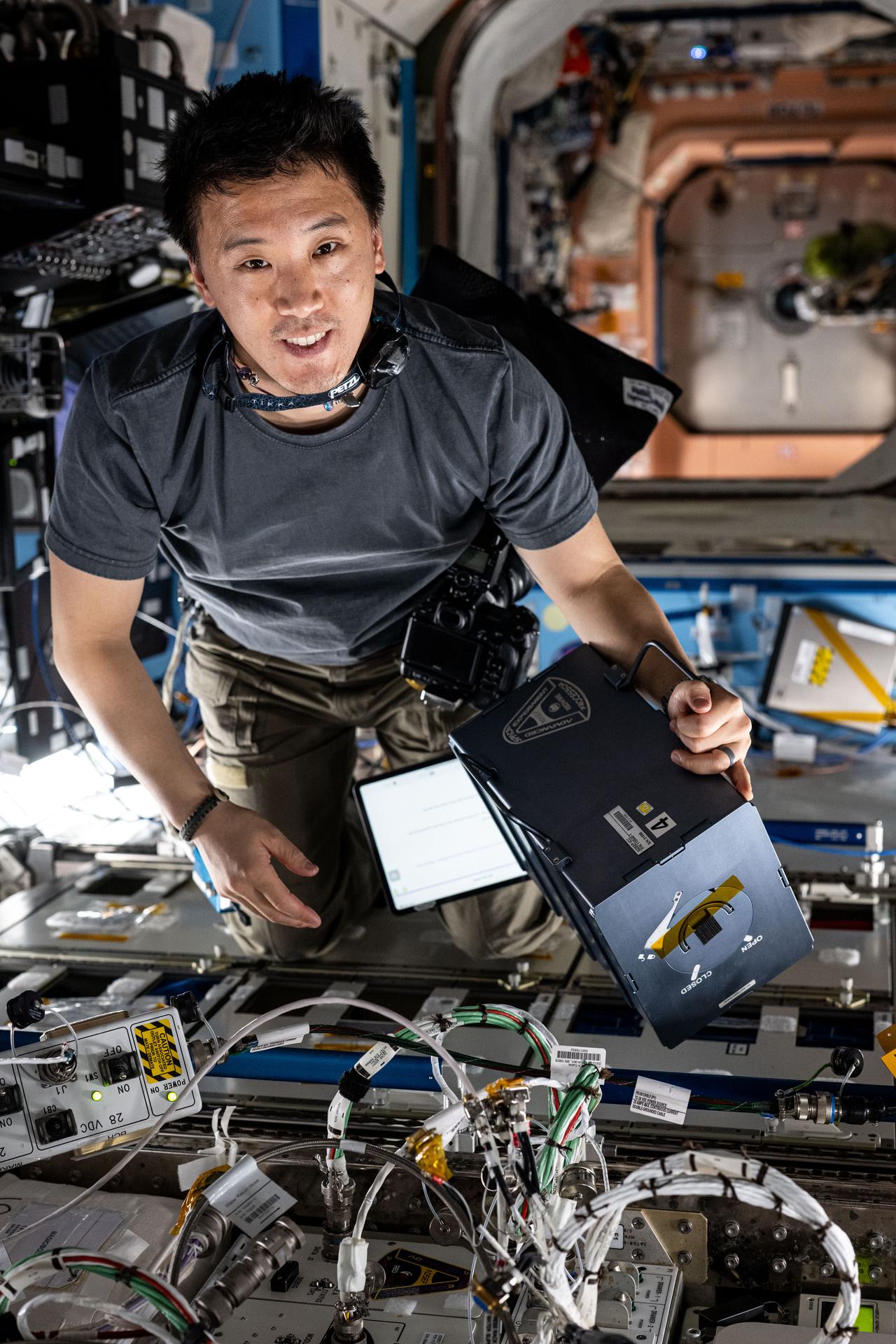
    NASA astronaut and Expedition 73 Flight Engineer Jonny Kim swaps hardware that promotes physical science and crystalization research inside the Advanced Space Experiment Processor-4 (ADSEP-4) aboard the International Space Station. The ADSEP-4 is supporting a technology demonstration potentially enabling the synthesis of medications during deep space missions and improving the pharmaceutical industry on Earth.
    NASA

    NASA astronaut Jonny Kim tests new hardware installed to an existing crystallization facility that enables increased production of crystals and other commercially relevant materials, like golden nanospheres. These tiny, spherical gold particles have optical and electronic applications, and are biocompatible, making them useful for medication delivery and diagnostics. As part of this experiment aboard the space station, Kim attempted to process larger, more uniform golden nanospheres than those produced on the ground.

    Learn more about ADSEP-ICC.

    Nutrients on demand

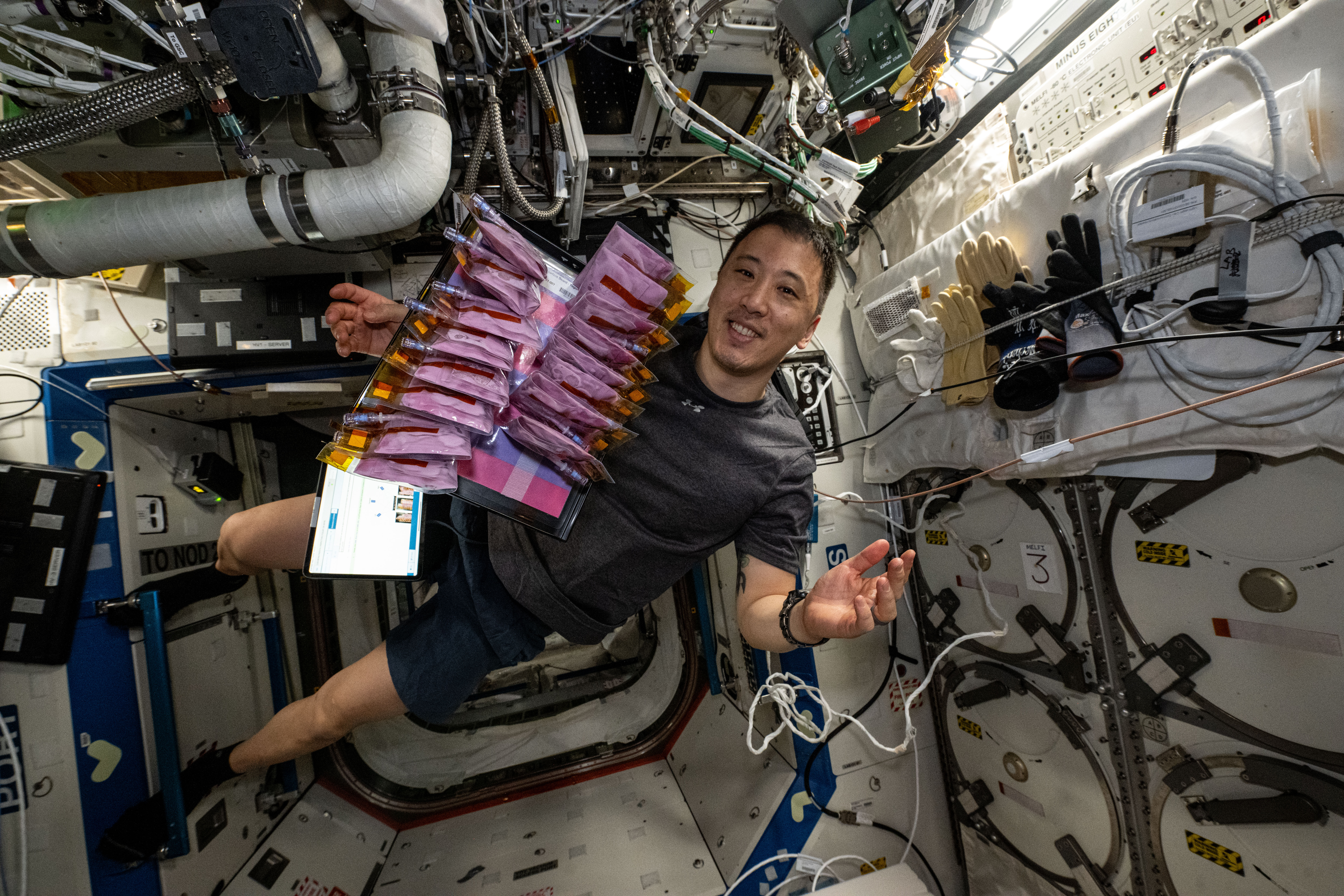
    NASA astronaut Jonny Kim, centered and smiling, wears a gray shirt, and black shorts as he floats in front of clear stacked bags filled with yogurt or kefir, which contain color-changing food dye. The walls are white, and a board holding gloves is to his left. Multiple wires and a tube run overhead.
    NASA

    Some vitamins and nutrients in foods and supplements lose their potency during long-term storage, and insufficient intake of even a single nutrient can lead to diseases and other health issues. NASA astronaut Jonny Kim displays purple-pink production bags for an investigation aimed at producing nutrient-rich yogurt and kefir using bioengineered yeasts and probiotics. The unique color comes from a food-grade pH indicator that allows astronauts to visually monitor the fermentation process.

    Learn more about BioNutrients-3.

    Next-Gen medicine and manufacturing

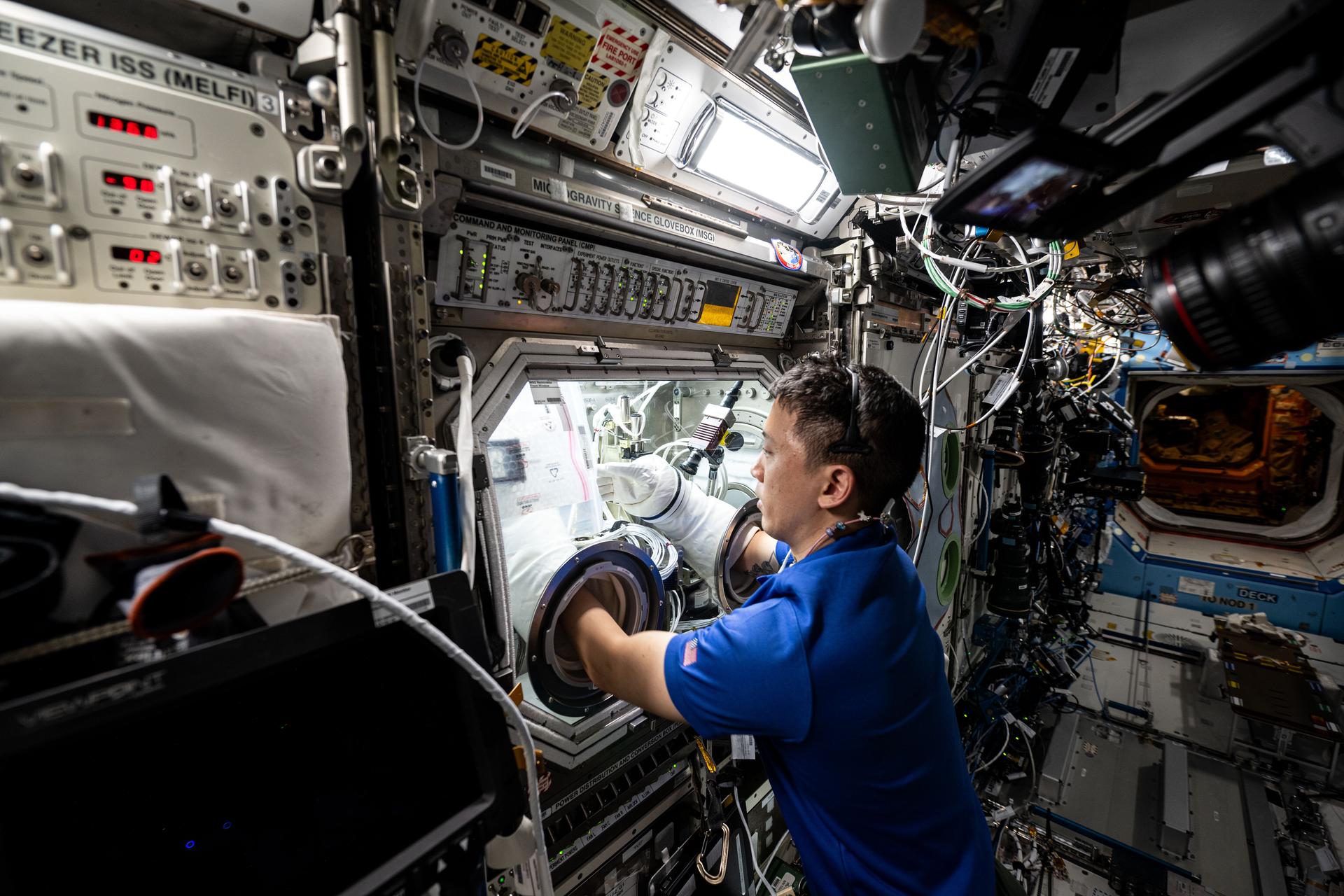
    NASA astronaut Jonny Kim, wearing a blue shirt, faces the forward with his arms inserted into a clear-paneled glovebox aboard the International Space Station. His gloved hands are visible through the window as he handles materials inside. Scientific instruments, control panels with switches and lights, and cables run along the ceiling and walls, and a camera mounted above and to the right records the activity.
    NASA

    NASA astronaut Jonny Kim uses the Microgravity Science Glovebox to study how high-concentration protein fluids behave in microgravity. This study helps researchers develop more accurate models to predict the behavior of these complex fluids in various scenarios, which advances manufacturing processes in space and on Earth. It also can enable the development of next-generation medicines for treating cancers and other diseases. 

    Learn more about Ring Sheared Drop-IBP-2.

    Observing colossal Earth events

    An image shows the Earth’s curved horizon outlined by a bright yellow-green light against the blackness of space and filled with stars. A massive swirl of gray clouds, rotating counterclockwise, dominates the Earth’s surface that is visible. The hurricane’s eye is brightly lit with flashes of blue-white lightning.
    NASA

    On Sept. 28, 2025, NASA astronaut Jonny Kim photographed Hurricane Humberto from the International Space Station. Located at 250 miles above Earth, the orbiting laboratory’s unique orbit allows crew members to photograph the planet’s surface including hurricanes, dust storms, and fires. These images are used to document disasters and support first responders on the ground. 

    Learn more about observing Earth from space station.

  • Los crateres en la Luna: historia, formación y cómo observarlos desde la Tierra

    Los crateres en la luna capturan la imaginación desde la antigüedad y siguen siendo claves para entender la historia del Sistema Solar. Si alguna vez te has preguntado por qué la superficie lunar está tan marcada por hoyos y montículos, este artículo te ofrece una guía clara y accesible para comprender su origen y cómo verlos con tus propios ojos.

    ¿Qué son los crateres en la luna?

    Los cráteres son depresiones circulares en la superficie causadas mayoritariamente por impactos de meteoritos y cometas. En la Luna, la falta de atmósfera significativa y erosión hace que estos impactos se conserven durante miles o millones de años.

    Además, algunos cráteres se formaron por procesos volcánicos en las primeras eras lunares, aunque son menos frecuentes que los de impacto. Por lo tanto, la lectura de estas marcas nos permite reconstruir la cronología y la intensidad de colisiones en el pasado.

    Cómo se forman los cráteres lunares

    Cuando un objeto espacial choca contra la Luna a alta velocidad, libera una enorme cantidad de energía que excava material y crea una cavidad. El proceso suele incluir una fase inicial de compresión, seguida por excavación y reacomodo del material ejectado alrededor del cráter.

    En consecuencia, la forma final del cráter depende del tamaño del impactor, la velocidad y el ángulo de choque. Los cráteres pequeños tienden a ser simples y en forma de cuenco, mientras que los grandes muestran picos centrales y terrazas en sus paredes.

    Tipos de cráteres y características clave

    Existen varias categorías: cráteres simples, complejos y cuencas de impacto. Los cráteres simples suelen medir menos de 15 km y tienen paredes inclinadas suaves.

    Por otro lado, los cráteres complejos poseen picos centrales y estructuras internas más elaboradas. Las cuencas de impacto son enormes depresiones que a menudo se rellenan con lavas antiguas, formando los llamados maria lunares.

    Cráteres de impacto versus cráteres volcánicos

    Es importante distinguir entre cráteres de impacto y los de origen volcánico. Los de impacto muestran un patrón radial de escombros y anillos concéntricos, mientras que los volcánicos suelen asociarse a flujos de lava y domos.

    Sin embargo, en la práctica algunos cráteres presentan rasgos mixtos, lo que obliga a los geólogos lunares a combinar observaciones remotas y muestras para resolver su historia.

    Por qué los crateres en la luna son importantes para la ciencia

    Los cráteres funcionan como registros geológicos que permiten datar eventos y entender la dinámica del Sistema Solar. Al estudiar su distribución y degradación, los científicos estiman tasas de impacto y reconstruyen épocas de bombardeo intenso.

    Además, el análisis de los materiales ejectados revela la composición del subsuelo lunar, esencial para futuras misiones humanas y robóticas. Por lo tanto, cada cráter es una ventana al pasado y una pista para la exploración futura.

    Cómo visualizar y fotografiar los cráteres desde la Tierra

    Observar crateres en la luna es accesible con un telescopio pequeño o incluso con binoculares en noches despejadas. El mejor momento para ver detalles es durante las fases crecientes o menguantes, cuando las sombras del terminador realzan relieves y profundidades.

    Si deseas fotografiarlos, utiliza una cámara con teleobjetivo o acopla una cámara a un telescopio. Ajusta la exposición para evitar que la superficie quede sobreexpuesta y realiza varias tomas para apilar y mejorar el detalle.

    Consejos prácticos para la observación

    Primero, consulta aplicaciones astronómicas que muestren mapas lunares y fases. Segundo, apunta a regiones ricas en cráteres fáciles de localizar, como Tycho, Copernicus y Plato.

    Finalmente, toma notas de la fase lunar y condiciones atmosféricas; la estabilidad atmosférica (seeing) afecta mucho la nitidez de la imagen.

    Implicaciones para la exploración y la investigación

    Los cráteres no solo cuentan la historia de impactos: también ofrecen sitios potenciales para recursos, como regolito y posibles depósitos de hielo en cráteres polares. Esto tiene impacto directo en la planificación de bases lunares y misiones tripuladas.

    Por consiguiente, mapear y estudiar estos relieves ayuda a seleccionar lugares seguros para aterrizajes y zonas con mayor potencial de recursos.

    Si quieres empezar hoy mismo, descarga una app lunar, busca la fase adecuada y prueba observar con binoculares o un telescopio amateur; identifica primero los cráteres más brillantes y luego amplía la observación a regiones menos conocidas. Al hacerlo, comprenderás mejor cómo los crateres en la luna son testigos silenciosos del pasado cósmico y piezas clave para el futuro de la exploración espacial.

  • Serpientes como mascotas: guía práctica para cuidar ofidios en casa

    ¿Has pensado en tener serpientes como mascotas pero no sabes por dónde empezar? Muchas personas se sienten intrigadas por estos reptiles y por buenas razones: son silenciosas, limpias y pueden establecer vínculos con sus cuidadores. En esta guía práctica encontrarás información clara y concisa para decidir si un ofidio es la mascota adecuada para ti y cómo ofrecerle un hábitat seguro.

    Serpientes como mascotas: ¿qué especies son ideales para principiantes?

    Al elegir una serpiente, es importante optar por especies manejables y de temperamento dócil. Entre las más recomendadas para principiantes están la serpiente del maíz (corn snake) y la bola de pitón (ball python).

    Estas especies toleran bien la manipulación y no suelen crecer tanto como otras ofidios, lo que facilita su mantenimiento en terrarios domésticos. Además, su alimentación y necesidades ambientales son más sencillas de controlar.

    Cuidados básicos para serpientes como mascotas

    Un buen terrario es la base del cuidado. Debe ofrecer espacio suficiente para que la serpiente se estire, un sustrato adecuado y escondites para sentir seguridad.

    La temperatura y la humedad son críticas: instala una fuente de calor regulada y mide las condiciones con termómetros e higrómetros. Mantener un gradiente térmico permite que el reptil se autoregule según su ritmo biológico.

    Alimentación y horarios

    La mayoría de las serpientes comen roedores precongelados y descongelados. La frecuencia varía según la especie y la edad; por ejemplo, las crías comen con más regularidad que los adultos.

    Evita manipular después de la comida para reducir el estrés y el riesgo de regurgitación. Asegúrate de ofrecer presas del tamaño adecuado para evitar problemas digestivos.

    Higiene y salud

    La limpieza del terrario debe ser regular: retira desechos y renueva parte del sustrato con frecuencia. Desinfecta accesorios y revisa la piel del ejemplar para detectar mudas incompletas o parásitos.

    También es recomendable contar con un veterinario especializado en reptiles para chequeos periódicos y ante signos como falta de apetito, letargo o problemas respiratorios.

    Instalaciones y equipamiento para mantener ofidios felices

    El terrario deberá incluir termostato, lámparas seguras y escondites tanto en la zona caliente como en la fría. Asegura que haya agua fresca disponible en un recipiente adecuado y estable.

    El sustrato puede ser fibra de coco, papel periódico o viruta específica; evita materiales que puedan causar obstrucción si son ingeridos. Añade ramas y elementos para enriquecimiento ambiental y ejercicio.

    Aspectos legales y responsabilidad en la tenencia de reptiles

    Antes de adquirir una serpiente, verifica la normativa local sobre especies permitidas y requisitos de tenencia. Algunas zonas regulan la importación y venta de reptiles por razones sanitarias y de conservación.

    Adoptar una mascota exótica implica compromiso a largo plazo: muchas serpientes viven décadas, por lo que planifica cuidado y posibles cambios en tu vida para asegurar su bienestar.

    Manejo seguro y socialización

    Para que la serpiente tolere la manipulación, realiza sesiones cortas y tranquilas, siempre apoyando su cuerpo. Evita movimientos bruscos y ten presente el lenguaje corporal del reptil.

    La socialización no es como en mamíferos; se trata de acostumbrar al animal a la presencia humana y reducir su estrés con tiempo y constancia. Nunca forces el contacto si muestra rechazo.

    Consejos rápidos para decidirte

    Si buscas una mascota silenciosa y de bajo mantenimiento relativo, las serpientes pueden ser una opción excelente. Investiga sobre la especie que te interesa y habla con criadores responsables y veterinarios herpetológicos.

    Además, considera adoptar antes de comprar: hay muchos ejemplares necesitados de un hogar estable. Esta alternativa promueve la cría responsable y reduce la demanda de captura en la naturaleza.

    En resumen, las serpientes como mascotas requieren información, equipamiento y compromiso, pero con la preparación adecuada son compañeros fascinantes y aptos para quienes disfrutan de reptiles. Si ya te decidiste, comienza por elegir una especie adecuada, prepara el terrario con atención a temperatura y seguridad, y establece contacto gradual para que el ofidio se adapte. De este modo aportarás bienestar a tu mascota y disfrutarás de una relación responsable y duradera.

  • Descubriendo los planetas extrasolares: Un viaje hacia nuevos mundos

    Los planetas extrasolares, también conocidos como exoplanetas, han capturado la imaginación de científicos y aficionados por igual. Estos mundos ubicados fuera de nuestro sistema solar ofrecen una ventana fascinante hacia la diversidad del universo y la posibilidad de encontrar condiciones similares a las de la Tierra.

    ¿Qué son los planetas extrasolares?

    Los planetas extrasolares son cuerpos celestes que orbitan estrellas distintas al Sol. A diferencia de los planetas en nuestro sistema solar, estos exoplanetas se encuentran a años luz de distancia, lo que hace que su estudio requiera tecnologías avanzadas y métodos indirectos de detección.

    Métodos para descubrir exoplanetas

    Una de las técnicas más comunes para detectar planetas extrasolares es el método de tránsito, que consiste en observar la disminución del brillo de una estrella cuando un planeta pasa frente a ella. Otra estrategia es la velocidad radial, que mide las variaciones en el movimiento de la estrella causadas por la gravedad del planeta.

    Importancia de estos métodos

    Estas técnicas han permitido descubrir miles de exoplanetas, ampliando nuestro conocimiento sobre la formación planetaria y la diversidad de sistemas estelares. Además, han abierto la puerta a la búsqueda de planetas habitables.

    Características de los planetas extrasolares

    Los planetas extrasolares presentan una gran variedad en tamaño, composición y órbitas. Algunos son gigantes gaseosos similares a Júpiter, mientras que otros son rocosos y podrían tener condiciones propicias para la vida.

    Planetas habitables y zonas habitables

    La zona habitable es el rango de distancia alrededor de una estrella donde las condiciones podrían permitir la existencia de agua líquida. Encontrar planetas extrasolares en esta zona es crucial para la búsqueda de vida fuera de la Tierra.

    Ejemplos destacados

    Un caso famoso es el sistema TRAPPIST-1, que cuenta con varios planetas en la zona habitable. Estos descubrimientos inspiran nuevas investigaciones y misiones espaciales dedicadas a explorar la posibilidad de vida en otros mundos.

    El futuro de la exploración de planetas extrasolares

    Con el avance tecnológico, la exploración de exoplanetas continúa evolucionando. Telescopios espaciales como el James Webb están diseñados para estudiar atmósferas planetarias y buscar señales bioquímicas.

    Implicaciones científicas y filosóficas

    Más allá del aspecto científico, el estudio de los planetas extrasolares plantea preguntas profundas sobre nuestro lugar en el cosmos y la posibilidad de vida inteligente en otros sistemas estelares.

    Explorar estos mundos remotos no solo amplía nuestro horizonte científico, sino que también enriquece nuestra perspectiva cultural y filosófica. A medida que descubrimos más planetas extrasolares, cada hallazgo nos impulsa a seguir investigando y soñando con la inmensidad del universo y las oportunidades que este guarda para la humanidad.

  • Amigos de las Mascotas: El Vínculo que Transforma Vidas

    Los amigos de las mascotas representan mucho más que simples compañeros; son parte fundamental de nuestras vidas y bienestar emocional. En este artículo exploraremos cómo esta relación especial influye positivamente en nuestra salud, felicidad y sentido de comunidad.

    El Valor de los Amigos de las Mascotas en la Sociedad

    Ser amigos de las mascotas implica una conexión profunda que va más allá del cuidado básico. Estas amistades fomentan empatía, responsabilidad y amor incondicional, atributos que enriquecen nuestras interacciones diarias. Además, promueven un estilo de vida activo y saludable.

    Beneficios emocionales y psicológicos

    La compañía de un animal de compañía puede reducir el estrés, la ansiedad y la soledad. Estudios demuestran que los amigos de las mascotas disfrutan de niveles más bajos de presión arterial y mejor salud mental. Este vínculo crea un espacio seguro para expresar emociones y recibir afecto sin juicios.

    Cómo Cuidar y Fortalecer la Relación con las Mascotas

    Para mantener una relación sólida con las mascotas, es esencial comprender sus necesidades físicas y emocionales. Alimentación adecuada, ejercicio regular y atención veterinaria forman la base de un cuidado responsable.

    Actividades para compartir tiempo de calidad

    Jugar, pasear y entrenar son actividades que fortalecen el lazo entre amigos de las mascotas. Estas interacciones no solo estimulan la mente y el cuerpo del animal, sino que también refuerzan la confianza y el respeto mutuo.

    La Comunidad de Amigos de las Mascotas: Un Espacio para Crecer Juntos

    Formar parte de grupos o asociaciones dedicadas a los amigos de las mascotas ofrece apoyo, información y oportunidades para socializar. Estos espacios fomentan el intercambio de experiencias y consejos, enriqueciendo el conocimiento sobre el cuidado animal.

    Eventos y actividades para amantes de las mascotas

    Participar en encuentros, ferias o talleres permite conocer a otros amigos de las mascotas y aprender nuevas formas de mejorar el bienestar de nuestros compañeros. Además, contribuye a crear conciencia sobre la importancia del respeto y la protección animal.

    Ser amigos de las mascotas significa cultivar una relación basada en amor, respeto y compromiso continuo. Este vínculo transforma vidas, aportando alegría y bienestar tanto a los humanos como a los animales. Al dedicar tiempo y atención a nuestras mascotas, construimos un entorno armonioso y saludable que beneficia a toda la comunidad.