NASA is marking America’s 250th year with a bold new symbol of the nation’s relentless drive to explore.
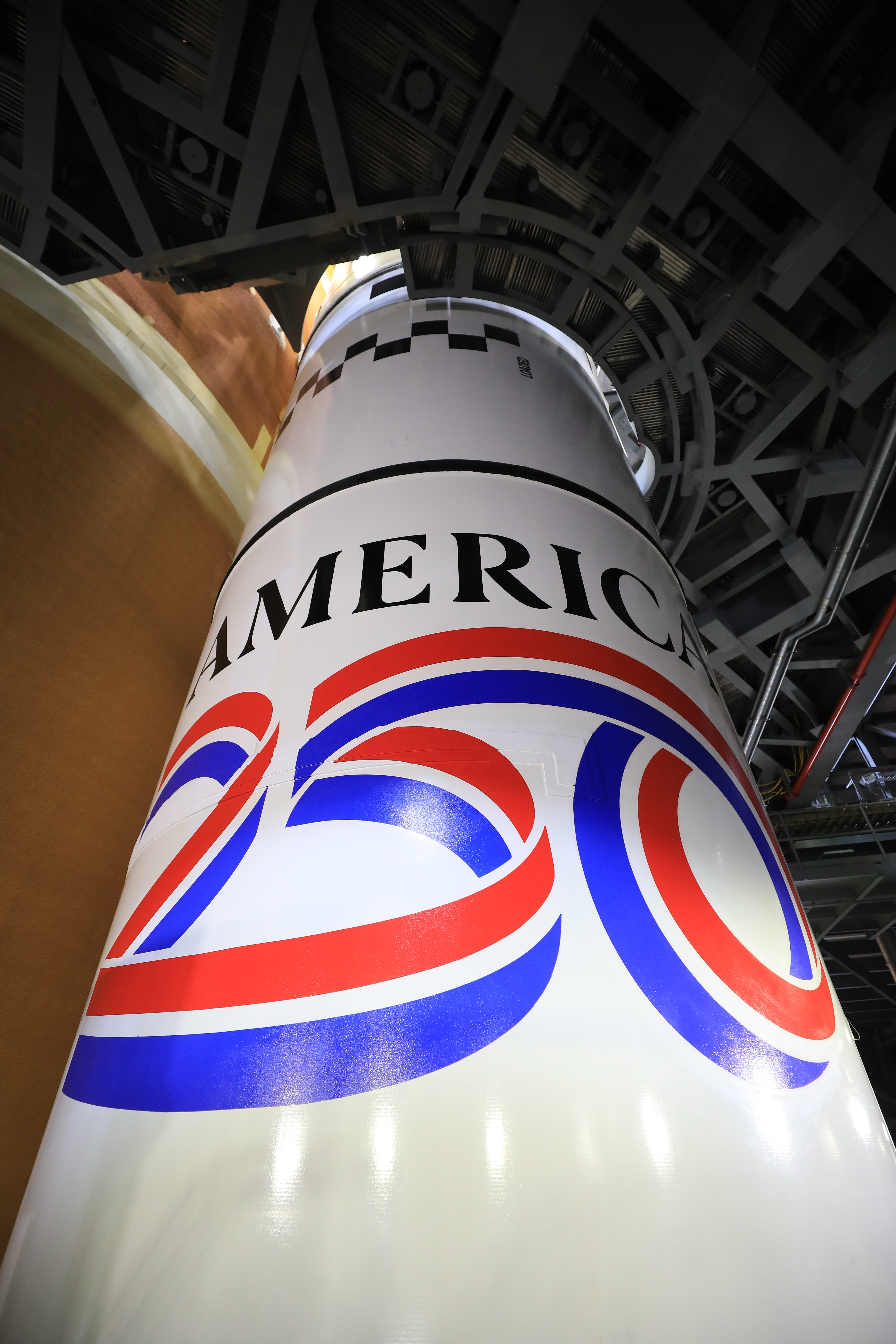
The America 250 emblem is now on the twin solid rocket boosters of the SLS (Space Launch System) rocket for Artemis II — the powerhouse that will launch a crew of four around the Moon next year. Unveiled Tuesday, the design echoes the America 250 Commission’s Spirit of Innovation theme, honoring a country that has never stopped pushing the horizon forward.
At NASA’s Kennedy Space Center in Florida, technicians spent recent weeks carefully applying the emblem on the rocket inside the Vehicle Assembly Building — the same place where rockets for Apollo once stood. Engineers are running final tests on SLS and the Orion spacecraft as preparations intensify for Artemis II.
The roughly 10-day Artemis II journey around the Moon will mark a defining moment in this new era of American exploration — paving the way for U.S. crews to land on the lunar surface and ultimately push onward to Mars.
America’s spirit of discovery is alive, and Artemis is carrying it to the Moon and beyond.
The asteroid Bennu continues to provide new clues to scientists’ biggest questions about the formation of the early solar system and the origins of life. As part of the ongoing study of pristine samples delivered to Earth by NASA’s OSIRIS-REx (Origins, Spectral Interpretation, Resource Identification, and Security-Regolith Explorer) spacecraft, three new papers published Tuesday by the journals Nature Geosciences and Nature Astronomy present remarkable discoveries: sugars essential for biology, a gum-like substance not seen before in astromaterials, and an unexpectedly high abundance of dust produced by supernova explosions.
Sugars essential to life
Scientists led by Yoshihiro Furukawa of Tohoku University in Japan found sugars essential for biology on Earth in the Bennu samples, detailing their findings in the journal Nature Geoscience. The five-carbon sugar ribose and, for the first time in an extraterrestrial sample, six-carbon glucose were found. Although these sugars are not evidence of life, their detection, along with previous detections of amino acids, nucleobases, and carboxylic acids in Bennu samples, show building blocks of biological molecules were widespread throughout the solar system.
For life on Earth, the sugars deoxyribose and ribose are key building blocks of DNA and RNA, respectively. DNA is the primary carrier of genetic information in cells. RNA performs numerous functions, and life as we know it could not exist without it. Ribose in RNA is used in the molecule’s sugar-phosphate “backbone” that connects a string of information-carrying nucleobases.
“All five nucleobases used to construct both DNA and RNA, along with phosphates, have already been found in the Bennu samples brought to Earth by OSIRIS-REx,” said Furukawa. “The new discovery of ribose means that all of the components to form the molecule RNA are present in Bennu.”
The discovery of ribose in asteroid samples is not a complete surprise. Ribose has previously been found in two meteorites recovered on Earth. What is important about the Bennu samples is that researchers did not find deoxyribose. If Bennu is any indication, this means ribose may have been more common than deoxyribose in environments of the early solar system.
Researchers think the presence of ribose and lack of deoxyribose supports the “RNA world” hypothesis, where the first forms of life relied on RNA as the primary molecule to store information and to drive chemical reactions necessary for survival.
A team of Japanese and US scientists have discovered the bio-essential sugars ribose and glucose in samples of asteroid Bennu that were collected by NASA’s OSIRIS-REx mission. This finding builds on the earlier discovery of nucleobases (the genetic components of DNA and RNA), phosphate, and amino acids (the building blocks of proteins) in the Bennu samples, showing that the molecular ingredients of life could have been delivered to early Earth by meteorites. Download this graphic from NASA’s Scientific Visualization Studio website: https://svs.gsfc.nasa.gov/14932
NASA/Goddard/University of Arizona/Dan Gallagher
“Present day life is based on a complex system organized primarily by three types of functional biopolymers: DNA, RNA, and proteins,” explains Furukawa. “However, early life may have been simpler. RNA is the leading candidate for the first functional biopolymer because it can store genetic information and catalyze many biological reactions.”
The Bennu samples also contained one of the most common forms of “food” (or energy) used by life on Earth, the sugar glucose, which is the first evidence that an important energy source for life as we know it was also present in the early solar system.
Mysterious, ancient ‘gum’
A second paper, in the journal Nature Astronomy led by Scott Sandford at NASA’s Ames Research Center in California’s Silicon Valley and Zack Gainsforth of the University of California, Berkeley, reveals a gum-like material in the Bennu samples never seen before in space rocks – something that could have helped set the stage on Earth for the ingredients of life to emerge. The surprising substance was likely formed in the early days of the solar system, as Bennu’s young parent asteroid warmed.
Once soft and flexible, but since hardened, this ancient “space gum” consists of polymer-like materials extremely rich in nitrogen and oxygen. Such complex molecules could have provided some of the chemical precursors that helped trigger life on Earth, and finding them in the pristine samples from Bennu is important for scientists studying how life began and whether it exists beyond our planet.
On this primitive asteroid that formed in the early days of the solar system, we’re looking at events near the beginning of the beginning.
Scott SandFord
Astrophysicist, NASA’s Ames Research Center
Bennu’s ancestral asteroid formed from materials in the solar nebula – the rotating cloud of gas and dust that gave rise to the solar system – and contained a variety of minerals and ices. As the asteroid began to warm, due to natural radiation, a compound called carbamate formed through a process involving ammonia and carbon dioxide. Carbamate is water soluble, but it survived long enough to polymerize, reacting with itself and other molecules to form larger and more complex chains impervious to water. This suggests that it formed before the parent body warmed enough to become a watery environment.
“With this strange substance, we’re looking at, quite possibly, one of the earliest alterations of materials that occurred in this rock,” said Sandford. “On this primitive asteroid that formed in the early days of the solar system, we’re looking at events near the beginning of the beginning.”
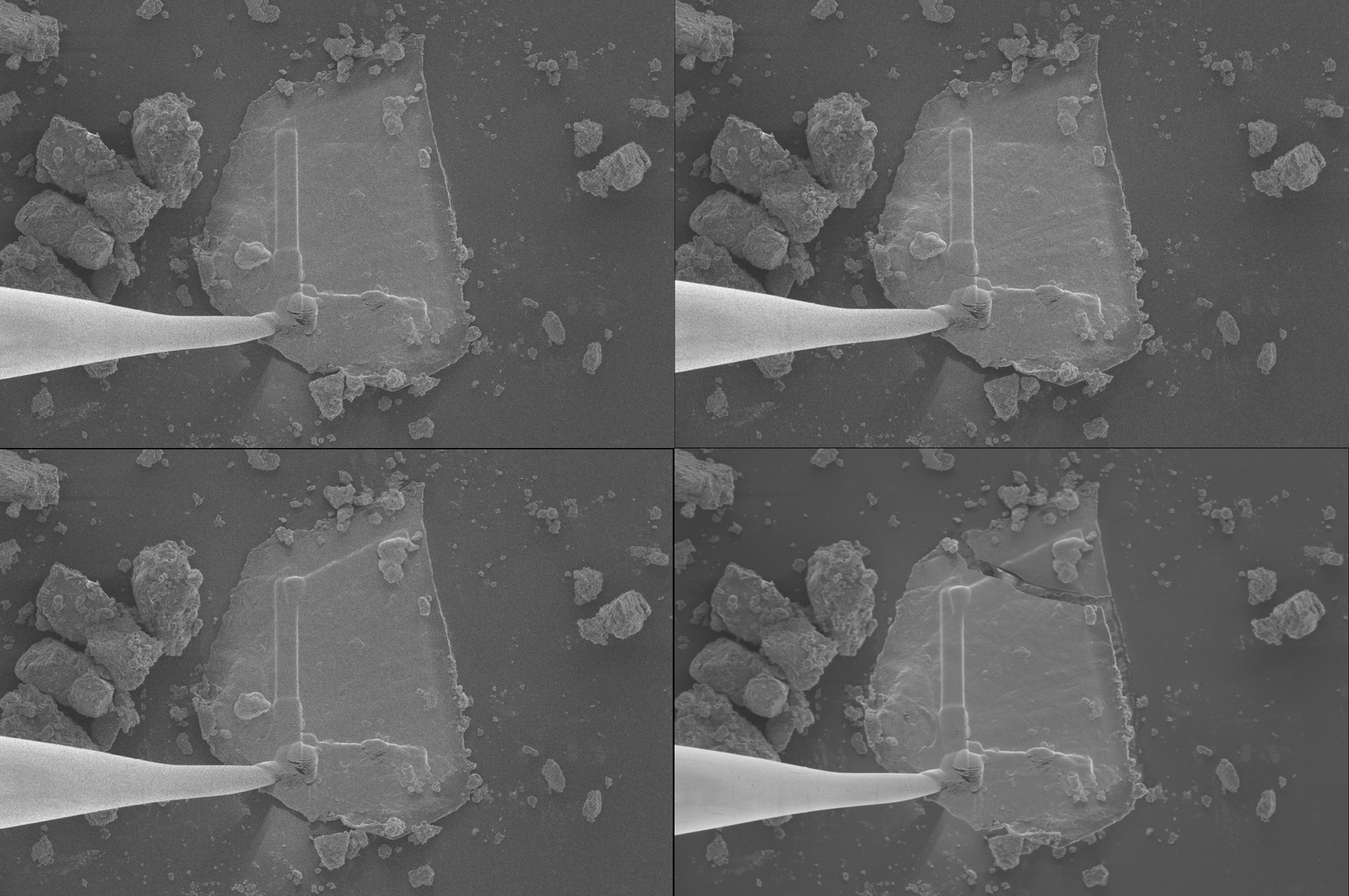
Using an infrared microscope, Sandford’s team selected unusual, carbon-rich grains containing abundant nitrogen and oxygen. They then began what Sandford calls “blacksmithing at the molecular level,” using the Molecular Foundry at Lawrence Berkeley National Laboratory (Berkeley Lab) in Berkeley, California. Applying ultra-thin layers of platinum, they reinforced a particle, welded on a tungsten needle to lift the tiny grain, and shaved the fragment down using a focused beam of charged particles.
A microscopic particle of asteroid Bennu, brought to Earth by NASA’s OSIRIS-REx mission, is manipulated under a transmission electron microscope. In order to move the fragment for further analysis, researchers first reinforced it with thin strips of platinum (the “L” shape on the particle’s surface) then welded a tungsten microneedle to it. The asteroid fragment measures 30 micrometers (about one-one thousandth of an inch) across.
NASA/University of California, Berkeley
When the particle was a thousand times thinner than a human hair, they analyzed its composition via electron microscopy at the Molecular Foundry and X-ray spectroscopy at Berkeley Lab’s Advanced Light Source. The ALS’s high spatial resolution and sensitive X-ray beams enabled unprecedented chemical analysis.
“We knew we had something remarkable the instant the images started to appear on the monitor,” said Gainsforth. “It was like nothing we had ever seen, and for months we were consumed by data and theories as we attempted to understand just what it was and how it could have come into existence.”
The team conducted a slew of experiments to examine the material’s characteristics. As the details emerged, the evidence suggested the strange substance had been deposited in layers on grains of ice and minerals present in the asteroid.
It was also flexible – a pliable material, similar to used gum or even a soft plastic. Indeed, during their work with the samples, researchers noticed the strange material was bendy and dimpled when pressure was applied. The stuff was translucent, and exposure to radiation made it brittle, like a lawn chair left too many seasons in the sun.
“Looking at its chemical makeup, we see the same kinds of chemical groups that occur in polyurethane on Earth,” said Sandford, “making this material from Bennu something akin to a ‘space plastic.’”
The ancient asteroid stuff isn’t simply polyurethane, though, which is an orderly polymer. This one has more “random, hodgepodge connections and a composition of elements that differs from particle to particle,” said Sandford. But the comparison underscores the surprising nature of the organic material discovered in NASA’s asteroid samples, and the research team aims to study more of it.
By pursuing clues about what went on long ago, deep inside an asteroid, scientists can better understand the young solar system – revealing the precursors to and ingredients of life it already contained, and how far those raw materials may have been scattered, thanks to asteroids much like Bennu.
Abundant supernova dust
Another paper in the journal Nature Astronomy, led by Ann Nguyen of NASA’s Johnson Space Center in Houston, analyzed presolar grains – dust from stars predating our solar system – found in two different rock types in the Bennu samples to learn more about where its parent body formed and how it was altered by geologic processes. It is believed that presolar dust was generally well-mixed as our solar system formed. The samples had six-times the amount of supernova dust than any other studied astromaterial, suggesting the asteroid’s parent body formed in a region of the protoplanetary disk enriched in the dust of dying stars.
The study also reveals that, while Bennu’s parent asteroid experienced extensive alteration by fluids, there are still pockets of less-altered materials within the samples that offer insights into its origin.
An artistic visualization of the OSIRIS-REx spacecraft descending towards asteroid Bennu to collect a sample.
NASA/Goddard/University of Arizona
“These fragments retain a higher abundance of organic matter and presolar silicate grains, which are known to be easily destroyed by aqueous alteration in asteroids,” said Nguyen. “Their preservation in the Bennu samples was a surprise and illustrates that some material escaped alteration in the parent body. Our study reveals the diversity of presolar materials that the parent accreted as it was forming.”
NASA’s Goddard Space Flight Center provided overall mission management, systems engineering, and the safety and mission assurance for OSIRIS-REx. Dante Lauretta of the University of Arizona, Tucson, is the principal investigator. The university leads the science team and the mission’s science observation planning and data processing. Lockheed Martin Space in Littleton, Colorado, built the spacecraft and provided flight operations. Goddard and KinetX Aerospace were responsible for navigating the OSIRIS-REx spacecraft. Curation for OSIRIS-REx takes place at NASA’s Johnson Space Center in Houston. International partnerships on this mission include the OSIRIS-REx Laser Altimeter instrument from CSA (Canadian Space Agency) and asteroid sample science collaboration with JAXA’s (Japan Aerospace Exploration Agency’s) Hayabusa2 mission. OSIRIS-REx is the third mission in NASA’s New Frontiers Program, managed by NASA’s Marshall Space Flight Center in Huntsville, Alabama, for the agency’s Science Mission Directorate in Washington.
For more information on the OSIRIS-REx mission, visit:
On Nov. 2, 2025, NASA honored 25 years of continuous human presence aboard the International Space Station. What began as a fragile framework of modules has evolved into a springboard for international cooperation, advanced scientific research and technology demonstrations, the development of a low Earth orbit economy, and NASA’s next great leaps in exploration, including crewed missions to the Moon and Mars.
The first expedition
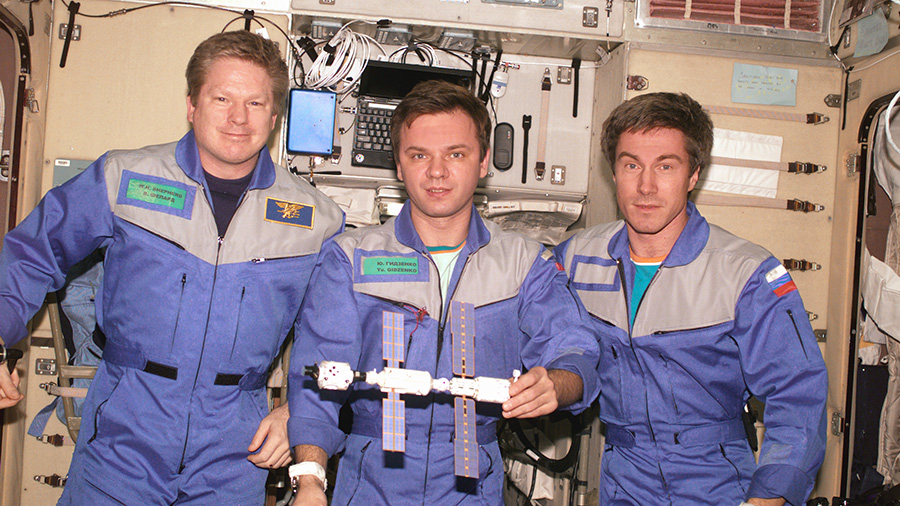
The Expedition One crew in the Zvezda Service module aboard the International Space Station. From left: commander William Shepherd, Soyuz commander Yuri Gidzenko and Flight Engineer Sergei Krikalev.
NASA
This legacy of achievement in global human endeavors began with the first crew’s arrival to the space station on Nov. 2, 2000. Expedition 1 crew members NASA astronaut William M. Shepherd and Russian Aviation and Space Agency, now Roscosmos, cosmonauts Yuri P. Gidzenko and Sergei K. Krikalev launched from the Baikonur Cosmodrome in Kazakhstan two days prior. After a successful docking, the crew transferred aboard the station and began bringing it to life. Their primary tasks during their four-month mission included installing and activating the life support and communications systems and working with three visiting space shuttle crews to continue the station’s assembly. The trio returned to Earth in March 2001 aboard space shuttle Discovery, after having turned the station over to the Expedition 2 crew.
(Space)walking into history
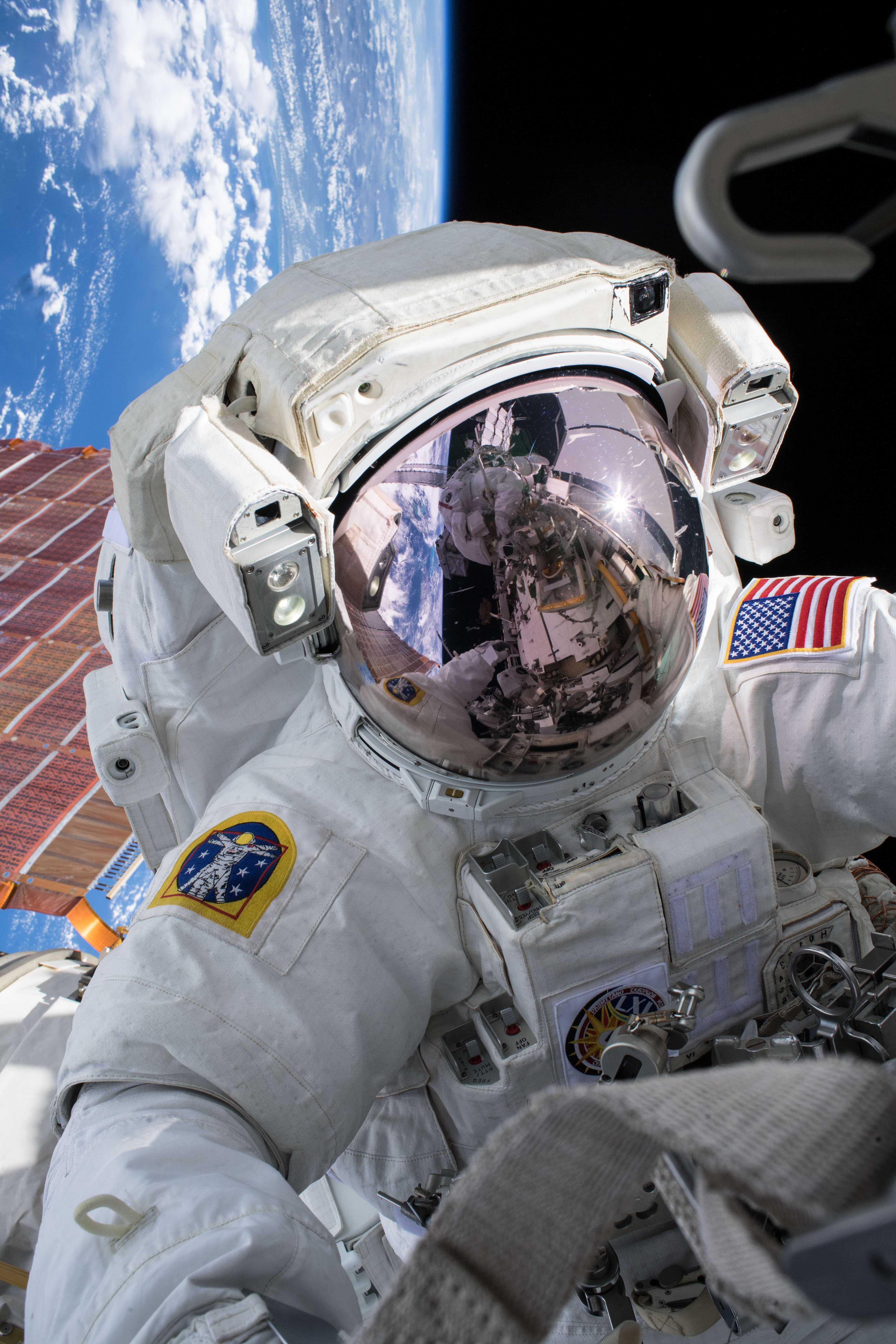
NASA astronaut Andrew Morgan conducts a spacewalk at the Port- 6 truss structure work site to upgrade International Space Station systems.
NASA/Christina Koch
Assembly and maintenance of the International Space Station would not be possible without the skilled work of crew members performing intricate tasks, in bulky spacesuits, in the harsh environment of space. In addition to station upkeep, spacewalks provide a platform for testing and improving spacesuits and tools – critical information for future exploration of the Moon and Mars. Other spacewalks have included operations for scientific research. In Jan. 2025, for example, crew members collected samples for an investigation examining whether microorganisms have exited through station vents and can survive in space, to better inform spacecraft design that helps prevent human contamination of Mars and other destinations.
More than 270 spacewalks dedicated to the space station have been accomplished in the last quarter century. Several made station and human spaceflight history:
May 1999: NASA astronaut Tamara Jernigan became the first woman to complete a spacewalk at the space station, in support of its construction.
September 2000: Also during space station assembly, NASA astronaut Edward T. “Ed” Lu and Roscosmos cosmonaut Yuri I. Malenchenko conducted the first U.S.-Russian spacewalk.
March 10, 2001: NASA astronauts James Voss and Susan Helms set the record for longest spacewalk in U.S. history, at 8 hours and 56 minutes.
First spacewalks by international partners included:
April 2001 – Canadian Space Agency astronaut Chris Hadfield
July 2005 – Japan Aerospace Exploration Agency astronaut Soichi Noguchi
Aug. 2006 – European Space Agency astronaut Thomas Reiter
Feb. 26, 2004: NASA astronaut Mike Foale and Russian cosmonaut Aleksandr Y. Kaleri complete the first spacewalk with no one inside the station.
Oct. 18, 2019: The first all-female spacewalk in history, conducted by NASA astronauts Christina Koch and Jessica Meir.
Orbiting laboratory welcomes first commercial crew
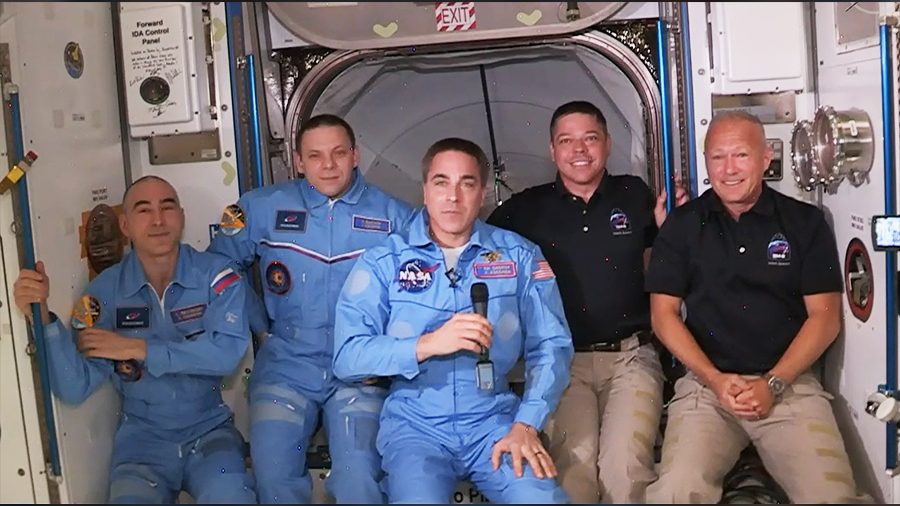
The Expedition 63 crew expanded to five members with the arrival of NASA’s SpaceX Crew Dragon on May 31, 2020. From left: Anatoly Ivanishin, Ivan Vagner, Chris Cassidy, Bob Behnken and Doug Hurley.
NASA
The International Space Station welcomed its first commercial crew members on May 31, 2020, when former NASA astronauts Robert Behnken and Douglas Hurley joined Expedition 63 Commander and NASA astronaut Chris Cassidy and Roscosmos cosmonauts Anatoly Ivanishin and Ivan Vagner aboard the orbiting laboratory.
Behnken and Hurley lifted off from Kennedy Space Center in Florida the day before on NASA’s SpaceX Demo-2 test flight – the first launch of American astronauts from U.S. soil since the space shuttle’s retirement in 2011.
The duo quickly integrated with the rest of the crew and participated in a number of scientific experiments, spacewalks, and public engagement events during their 62 days aboard station. Overall, the pair spent 64 days in orbit, completed 1,024 orbits around Earth, and contributed more than 100 hours of time to supporting the orbiting laboratory’s investigations before splashing down on Aug. 2.
Successful completion of the Demo-2 mission paved the way for regular SpaceX flights carrying astronauts to and from the space station. With another certified crew transportation system in place, the International Space Station Program added research time and increased the opportunity for discovery aboard humanity’s testbed for exploration, including preparations for human exploration of the Moon and Mars.
Frank Rubio’s record-breaking year in space
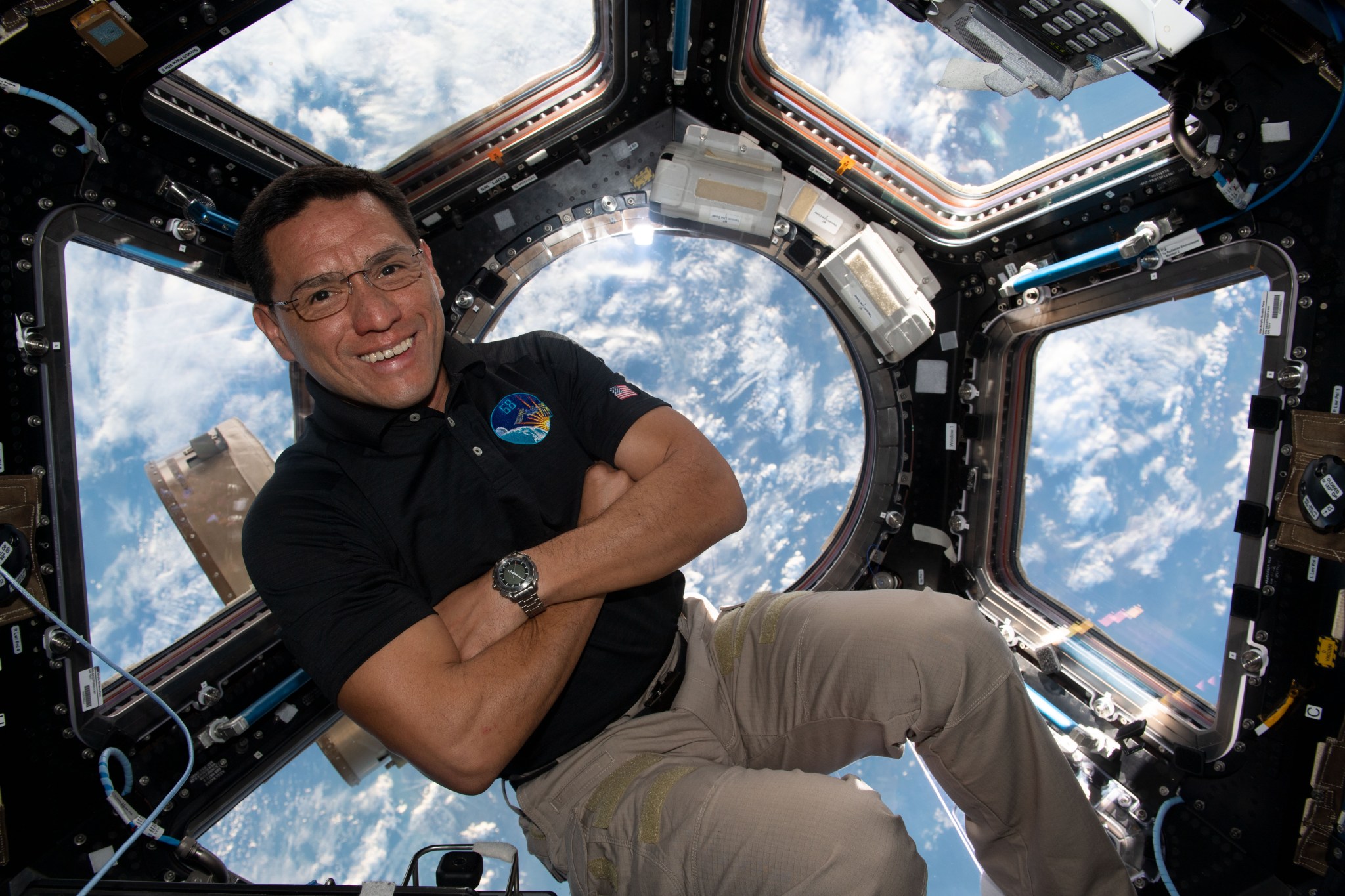
NASA astronaut and Expedition 68 Flight Engineer Frank Rubio inside the cupola, the International Space Station’s “window to the world,” as the orbiting laboratory flew 263 miles above southeastern England on Oct. 1, 2022.
NASA/Frank Rubio
On Sept. 27, 2023, NASA astronaut Frank Rubio returned to Earth after spending 371 days aboard the International Space Station—the longest single spaceflight by a U.S. astronaut in history. His mission surpassed the previous record of 355 days, set by NASA astronaut Mark Vande Hei, and provided scientists with an unprecedented look at how the human body adapts to more than a year in microgravity.
Rubio’s record-setting mission supported six human research studies, including investigations into diet, exercise, and overall physiology and psychology. He was the first astronaut to test whether limited workout equipment could still maintain health and fitness, an important consideration for future spacecraft with tighter living quarters. He also contributed biological samples, surveys, and tests for NASA’s Spaceflight Standard Measures, a study that collects health data from astronauts to better understand how the body adapts to space—knowledge that helps prepare crews for the Artemis campaign to the Moon and future trips to Mars.
Alongside his fellow crew members, Rubio participated in dozens of investigations and technology demonstrations, from growing tomato plants with hydroponic and aeroponic techniques to materials science experiments that advance spacecraft design.
Long-duration missions help inform future spaceflight and lay the groundwork for the next era of human exploration.
A global foundation for growing a low Earth orbit economy
Facilities around the world support the operation and management of the International Space Station.
NASA
The space station is one of the most ambitious international collaborations ever attempted.It brings together international flight crews, multiple launch vehicles, globally distributed launch and flight operations, training, engineering, and development facilities, communications networks, and the international scientific research community for the benefit of all humanity.
An international partnership of space agencies operates the elements of the orbiting laboratory: NASA, Roscosmos, ESA (European Space Agency), JAXA (Japan Aerospace Exploration Agency), and CSA (Canadian Space Agency). Each partner takes primary responsibility for managing and running the station hardware it provides, as well as on-Earth construction, launch support, mission operations, communications, and research and technology facilities that support the station.
At least 290 individuals representing 26 countries, and the five international partners have visited the orbiting laboratory during its 25 years of continuous human presence. Some of those visitors flew to the station on private astronaut missions. These missions contribute to scientific, outreach, and commercial activities. They also help demonstrate the demand for future commercial space stations and are an important component of NASA’s strategy for enabling a robust and competitive commercial economy in low Earth orbit.
The results of the international partnership created through the space station and its accomplishments exemplifies how countries can work together to overcome complex challenges and achieve collaborative goals.
Les massages sont bien plus qu’une simple détente; ils représentent une véritable science du bien-être qui allie techniques précises et bénéfices pour la santé globale. Enrichir une catégorie dédiée aux massages avec un contenu à la fois technique et axé sur le bien-être permet d’attirer un public varié, soucieux d’améliorer sa qualité de vie par des méthodes naturelles et efficaces.
Comprendre les différentes techniques de massage
Pour captiver les lecteurs dès le début, il est essentiel d’expliquer clairement les principales techniques de massage. Par exemple, le massage suédois, reconnu pour ses mouvements doux et fluides, favorise la relaxation musculaire et la circulation sanguine. En parallèle, le massage deep tissue cible les couches profondes des muscles pour soulager les tensions chroniques. Ces descriptions précises fournissent une base solide qui aide à différencier les méthodes selon les besoins spécifiques de chacun.
Intégrer les termes liés à la santé physique et mentale
Au-delà de la technique, les articles doivent souligner les bienfaits du massage sur la santé physique, comme la réduction des douleurs musculaires et l’amélioration de la mobilité. Mais aussi sur la santé mentale, en insistant sur la diminution du stress, l’amélioration du sommeil et l’équilibre émotionnel. Cette approche holistique renforce la crédibilité du contenu et répond aux attentes d’un lectorat recherchant des solutions complètes.
Adapter le contenu aux profils des lecteurs
Chaque profil de lecteur a des besoins et des intérêts différents. Certains recherchent des conseils pour gérer le stress du quotidien, d’autres veulent des techniques pour améliorer la récupération sportive, tandis que d’autres encore s’intéressent aux massages pour les seniors ou les femmes enceintes. Proposer des articles segmentés ou des rubriques spécifiques permet d’optimiser le référencement naturel en ciblant des mots clés adaptés et en offrant un contenu personnalisé.
Recommandations pratiques et conseils personnalisés
Il est également pertinent d’inclure des recommandations spécifiques, comme les huiles essentielles adaptées à chaque type de massage, les postures à adopter avant et après la séance, ou encore les précautions à prendre pour certaines conditions médicales. Ces détails enrichissent l’expérience du lecteur, favorisent l’engagement et positionnent la catégorie comme une référence fiable dans le domaine du bien-être et des thérapies naturelles.
Optimiser la structure et la lisibilité du contenu
L’utilisation de paragraphes courts, de sous-titres clairs et de transitions fluides entre les sections facilite la lecture et retient l’attention des visiteurs. Un article bien structuré répond aux exigences des moteurs de recherche tout en offrant une expérience utilisateur agréable, élément clé pour réduire le taux de rebond et améliorer le positionnement SEO.
Utilisation de mots-clés et termes liés
Intégrer naturellement des mots-clés principaux et secondaires, comme “techniques de massage”, “bienfaits pour la santé”, “massage relaxation”, ou “thérapies naturelles”, assure une meilleure visibilité sur les moteurs de recherche. L’emploi de synonymes et d’expressions connexes enrichit le texte et permet de capter un public plus large.
En enrichissant ainsi la catégorie Masajes avec un contenu complet, technique et bienveillant, elle devient une ressource incontournable pour tous ceux qui cherchent à améliorer leur bien-être par des méthodes naturelles. Offrir des informations claires, pratiques et adaptées à différents profils aide non seulement à renforcer la crédibilité du site, mais aussi à accompagner efficacement chaque lecteur dans son parcours de santé et de relaxation.
Attirer un large public vers votre blog spécialisé dans les mystères peut sembler un défi, mais avec les bonnes techniques, vous pouvez augmenter significativement sa visibilité. La clé réside dans l’optimisation SEO, la création de contenus captivants, et l’utilisation de formats adaptés aux lecteurs passionnés de technologie et de divertissement.
Optimiser le SEO pour les blogs de mystères
Le référencement naturel est un levier incontournable pour attirer des visiteurs qualifiés. Intégrer le mot-clé principal “blog mystères” dès les premiers paragraphes aide les moteurs de recherche à comprendre le sujet de votre contenu. Pensez également à utiliser des synonymes et expressions proches comme “énigmes”, “faits inexpliqués” ou “curiosités technologiques” pour enrichir votre texte.
Veillez à structurer vos articles avec des balises HTML appropriées, et à optimiser les méta-descriptions en incluant des phrases accrocheuses et informatives. Cela encouragera les internautes à cliquer sur vos liens dans les résultats de recherche.
Le rôle des titres et des descriptions
Des titres bien formulés sont essentiels pour capter l’attention. Ils doivent être clairs, intrigants, et contenir des mots-clés pertinents. Par exemple, un titre comme “Les mystères les plus fascinants révélés grâce à la technologie” combine intérêt et SEO. De même, les descriptions doivent synthétiser efficacement le contenu tout en incitant à la lecture.
Créer des contenus attractifs et diversifiés
Pour maintenir l’intérêt de vos lecteurs, il est important de varier les formats. Intégrez des vidéos explicatives, des infographies et des podcasts sur des sujets liés aux mystères et aux avancées technologiques. Ces formats interactifs augmentent le temps passé sur votre site et améliorent l’engagement.
En parallèle, proposez des articles approfondis mais accessibles, mêlant anecdotes, analyses et données scientifiques pour satisfaire un public curieux et exigeant.
Utiliser la technologie pour enrichir l’expérience utilisateur
Les outils interactifs comme les quiz, les sondages ou les cartes interactives peuvent transformer votre blog en une plateforme dynamique. Ils encouragent les visiteurs à participer activement, créant ainsi une communauté fidèle autour de votre thématique.
Promouvoir efficacement votre blog dans l’univers du divertissement
Une présence active sur les réseaux sociaux est indispensable pour toucher une audience plus large. Partagez régulièrement vos articles, accompagnez-les de visuels attractifs et engagez la conversation avec vos abonnés. Collaborer avec des influenceurs spécialisés dans les mystères ou la technologie peut aussi booster votre visibilité.
Ne négligez pas les forums et groupes de discussion en ligne où se retrouvent les passionnés. Participer à ces espaces vous positionne en expert tout en attirant un trafic ciblé vers votre blog.
En appliquant ces stratégies, vous maximisez l’impact de vos contenus et créez une véritable communauté autour de votre blog mystères. L’objectif est de proposer une expérience enrichissante qui incite vos visiteurs à revenir régulièrement et à partager vos articles, contribuant ainsi à une croissance organique durable.
Pour réussir à capter l’attention des lecteurs et améliorer la visibilité de vos articles sur le Système Solaire, il est essentiel d’optimiser leur structure. Une organisation claire, une profondeur pertinente et un usage judicieux des éléments visuels permettent non seulement d’enrichir l’expérience utilisateur mais aussi d’augmenter le référencement naturel sur les moteurs de recherche.
Comprendre l’importance de la structure dans les articles scientifiques
Un article bien structuré facilite la compréhension de sujets complexes comme le Système Solaire. Il guide le lecteur à travers les différentes parties du contenu, rendant chaque section accessible et attrayante. De plus, une organisation réfléchie favorise le référencement SEO en intégrant naturellement des mots-clés et des expressions liées.
Utiliser des titres et sous-titres pertinents
Les titres jouent un rôle crucial pour segmenter l’article et améliorer la navigation. Par exemple, des sous-titres comme “Les planètes du Système Solaire” ou “Les caractéristiques des astres” permettent d’introduire clairement chaque thème. Ces balises H2 et H3 doivent inclure des mots-clés stratégiques pour renforcer la visibilité sur les moteurs de recherche.
Rédiger des paragraphes courts et clairs
La lisibilité est un facteur déterminant pour retenir les visiteurs. Chaque paragraphe devrait contenir 2 à 4 phrases, facilitant ainsi une lecture fluide et agréable. Une écriture concise évite la surcharge d’informations et maintient l’attention du lecteur sur les points essentiels.
Optimiser l’utilisation des images pour renforcer le contenu
Les images jouent un rôle fondamental dans l’illustration des concepts scientifiques. Utiliser des photos réalistes des planètes, diagrammes explicatifs ou infographies aide à matérialiser les informations. Chaque image doit être accompagnée d’un texte alternatif descriptif pour améliorer l’accessibilité et le référencement SEO.
Choisir des images de qualité supérieure
Privilégiez des images photoréalistes qui capturent la beauté et la complexité du Système Solaire. Cela suscite l’intérêt visuel et soutient la crédibilité de l’article. Par exemple, une représentation détaillée de la Terre ou de Jupiter peut renforcer l’impact scientifique du contenu.
Intégrer des légendes et des appels à l’action
Les légendes explicatives enrichissent la compréhension et incitent les lecteurs à approfondir leurs connaissances. Par ailleurs, insérer des appels à l’action, comme des invitations à commenter ou à partager, augmente l’interactivité et favorise l’engagement.
Améliorer la profondeur et la clarté avec des transitions efficaces
Les transitions fluides entre les sections garantissent une progression logique du contenu. Utiliser des phrases de liaison permet de connecter les idées et d’éviter les ruptures dans la lecture. Cela rend l’article plus cohérent et agréable à parcourir.
Employer des variations sémantiques pour enrichir le texte
Pour renforcer le SEO, il est utile d’intégrer des synonymes et des termes connexes comme “planètes”, “astres”, “orbites” ou “exploration spatiale”. Cette diversité lexicale élargit le champ sémantique et améliore la pertinence du contenu aux yeux des moteurs de recherche.
En appliquant ces techniques, vos articles sur le Système Solaire gagneront en clarté, en profondeur et en attractivité. Une structure optimisée associée à une utilisation stratégique des images et des appels à l’action multiplie vos chances d’augmenter l’engagement des lecteurs et de booster votre référencement naturel. Ainsi, vous contribuez efficacement à diffuser la connaissance scientifique tout en maximisant la portée de vos publications.
Attirer et fidéliser les lecteurs passionnés par les animaux de compagnie nécessite un contenu à la fois captivant et informatif. Pour une catégorie Mascotas encore en développement, il est essentiel d’aborder des sujets qui répondent aux besoins réels des propriétaires d’animaux, tout en proposant des formats diversifiés et engageants.
Thèmes pratiques pour un contenu enrichissant
Une des clés pour créer un contenu attractif est de se concentrer sur des guides pratiques. Par exemple, des articles détaillant l’alimentation équilibrée pour chiens et chats apportent une valeur ajoutée immédiate. Les conseils sur le choix des aliments adaptés à chaque âge ou condition de santé permettent d’attirer un public soucieux du bien-être de ses compagnons.
Soins quotidiens et prévention
Aborder le thème des soins quotidiens, comme le toilettage, l’hygiène ou l’exercice physique, aide à instaurer une relation de confiance avec les lecteurs. Des astuces pour prévenir les maladies courantes chez les animaux de compagnie peuvent également enrichir la catégorie, en répondant à des préoccupations fréquentes.
Formats variés pour capter l’attention
La diversité des formats est essentielle pour maintenir l’intérêt des lecteurs. Les listes à puces, les infographies et les vidéos courtes sont parfaits pour une consommation rapide. Par exemple, un article sous forme de liste des “10 conseils pour un chien heureux” facilite la lecture et le partage.
Histoires et témoignages
Inclure des témoignages de propriétaires ou des récits d’expériences personnelles peut créer un lien émotionnel fort. Ces contenus humanisent la catégorie Mascotas et encouragent l’interaction via les commentaires ou les réseaux sociaux.
Résolution de problèmes courants
Proposer des solutions claires aux problèmes fréquents, comme l’anxiété de séparation, les troubles du comportement ou les allergies, attire un public en quête de réponses concrètes. Ces articles doivent être rédigés avec empathie et précision pour instaurer une crédibilité durable.
FAQ et conseils d’experts
Une section FAQ ou des articles rédigés en collaboration avec des vétérinaires ou des éducateurs canins renforcent la valeur informative. Les lecteurs apprécient les sources fiables qui les aident à mieux comprendre et prendre soin de leurs animaux.
En développant une catégorie Mascotas riche en contenus variés et ciblés, vous créez un espace incontournable pour les amoureux des animaux. L’objectif est d’offrir des ressources utiles et engageantes qui répondent aux attentes tout en stimulant la curiosité et la fidélité des lecteurs.
W sercu hiszpańskiego systemu finansowego znajduje się banco de españa, instytucja, która odgrywa kluczową rolę w stabilności ekonomicznej kraju. W artykule przyjrzymy się funkcjom, historii oraz wpływowi tej instytucji na codzienne życie obywateli.
Historia Banco de España
Banco de España został założony w 1856 roku i od tego czasu przeszedł wiele zmian. Jako centralny bank Hiszpanii, jego głównym celem jest zarządzanie polityką monetarną oraz stabilizowanie finansów kraju. W ciągu lat, banco de españa stał się nie tylko instytucją regulacyjną, ale również ważnym graczem na międzynarodowej scenie finansowej.
Rola w Europejskim Systemie Banków Centralnych
W 1999 roku Hiszpania przyjęła euro, co oznaczało, że banco de españa stał się częścią Europejskiego Systemu Banków Centralnych (ESBC). Współpraca z innymi bankami centralnymi w strefie euro pozwala na koordynację polityki monetarnej, co jest kluczowe dla stabilności gospodarczej regionu.
Funkcje Banco de España
Banco de España pełni wiele ważnych funkcji, które mają wpływ na obywateli i gospodarkę. Oto niektóre z nich:
Kontrola Inflacji
Jednym z głównych zadań banco de españa jest kontrolowanie inflacji. Poprzez ustalanie stóp procentowych, bank wpływa na koszt kredytów oraz oszczędności, co ma bezpośredni wpływ na portfele obywateli.
Polityka Monetarna
W ramach polityki monetarnej, banco de españa podejmuje decyzje dotyczące podaży pieniądza w gospodarce. Dzięki tym działaniom możliwe jest stymulowanie wzrostu gospodarczego lub jego hamowanie w przypadku nadmiernej inflacji.
Regulacja Sektora Finansowego
Banco de España odpowiada również za nadzór nad sektorem finansowym. Monitoruje instytucje bankowe, aby zapewnić ich stabilność i bezpieczeństwo. Dzięki temu klienci mogą mieć pewność, że ich oszczędności są chronione.
Znaczenie Banco de España dla Obywateli
Jakie konkretne korzyści przynosi banco de españa przeciętnemu obywatelowi? Przede wszystkim stabilność finansowa kraju, która przekłada się na bezpieczeństwo oszczędności oraz dostępność kredytów.
Bezpieczeństwo Oszczędności
Dzięki regulacjom wprowadzanym przez banco de españa, klienci banków mogą czuć się pewnie, wiedząc, że ich pieniądze są chronione. Instytucja ta wprowadza przepisy, które zmniejszają ryzyko bankructw banków.
Dostęp do Kredytów
Polityka monetarna banku wpływa na dostępność kredytów. W okresach niskich stóp procentowych, obywateli łatwiej uzyskać finansowanie na zakup mieszkań czy inwestycje w biznes.
Jak Banco de España Wpływa na Gospodarkę?
W pracy banco de españa widać, jak istotna jest jego rola w kształtowaniu gospodarki kraju. Działa ono nie tylko na poziomie krajowym, ale także w kontekście międzynarodowym, co wpływa na stabilność europejskiej strefy euro.
Wsparcie w Czasie Kryzysu
W czasach kryzysu gospodarczego, banco de españa odgrywa kluczową rolę w działaniach stabilizacyjnych. Pomaga w utrzymaniu płynności w sektorze bankowym oraz wspiera programy rządowe, które mają na celu ożywienie gospodarki.
Współpraca z Międzynarodowymi Instytucjami
Banco de España współpracuje z Międzynarodowym Funduszem Walutowym oraz innymi instytucjami, aby wzmocnić stabilność finansową regionu. Taka współpraca jest niezbędna w obliczu globalnych wyzwań gospodarczych.
Warto zrozumieć, jak ważną rolę odgrywa banco de españa w codziennym życiu obywateli. Jego działania mają dalekosiężne skutki, które wpływają na stabilność finansową oraz rozwój gospodarczy Hiszpanii. Świadomość tych aspektów pozwala lepiej zrozumieć meandry hiszpańskiego systemu finansowego i korzystać z jego możliwości.
La entradilla de una casa es la primera impresión que se llevan los visitantes. Por esta razón, es fundamental que refleje la personalidad de quienes habitan el lugar. Un espacio acogedor y bien decorado puede marcar la diferencia en la percepción de tu hogar.
Elementos Clave en la Decoración
Para lograr una decoración atractiva, es esencial considerar varios elementos. Primero, el color es crucial; tonos cálidos como el amarillo o el naranja pueden hacer que tu entradilla se sienta más acogedora. También puedes optar por colores más neutros, que aportan un aire de elegancia y sofisticación.
Muebles y Accesorios
Los muebles, aunque sean pequeños, juegan un papel importante. Un banco o una silla pueden ser perfectos para que los visitantes se sientan bienvenidos. Además, los accesorios como cojines, jarrones con flores o una alfombra pueden añadir un toque de color y textura.
Iluminación Adecuada
La iluminación es otro aspecto que no debe pasarse por alto. Una buena iluminación exterior no solo mejora la estética, sino que también aumenta la seguridad. Considera luces solares o faroles que se enciendan al anochecer para crear un ambiente cálido y acogedor.
Plantas y Naturaleza
Las plantas son ideales para dar vida a la entradilla. Puedes optar por macetas con plantas de bajo mantenimiento que florezcan en diferentes estaciones. Las plantas no solo son decorativas, sino que también purifican el aire y aportan frescura al entorno.
Estilo Personalizado
Finalmente, la clave está en personalizar tu entradilla. Añadir elementos que cuenten tu historia, como fotografías familiares o souvenirs de viajes, puede hacer que tu hogar se sienta aún más especial. Recuerda que la decoración es una forma de expresión; no temas ser creativo y único.
¿Te has preguntado alguna vez si el pienso que le das a tu mascota realmente aporta salud y energía? Identificar un pienso de calidad no es solo una cuestión de marca o precio; se trata de entender ingredientes, procesos y cómo se adapta a las necesidades de tu perro o gato. En los próximos párrafos descubrirás señales claras que te ayudarán a elegir con confianza.
¿Qué significa realmente “pienso de calidad”?
Cuando hablamos de un pienso de calidad nos referimos a un alimento formulado con ingredientes nobles, procesado para conservar nutrientes y diseñado para cubrir las necesidades específicas de la especie. En otras palabras, no es solo una etiqueta: es la combinación entre composición, elaboración y resultados observables en la mascota.
Además, un pienso de calidad suele evitar subproductos de baja categoría y aditivos innecesarios, priorizando fuentes de proteína reconocibles como pollo, cordero, pescado o pavo.
Ingredientes y composición: la base del análisis
Lo primero que debes mirar es la lista de ingredientes. Prioriza aquellos piensos que tengan una fuente de proteína fresca como primer ingrediente y evita las harinas cárnicas indeterminadas. Por ejemplo, frases como “pollo deshidratado” o “carne fresca” suelen ser preferibles a “subproductos cárnicos”.
Asimismo, revisa el porcentaje de proteína, grasas y fibra en la composición analítica. Un equilibrio adecuado, acorde a la etapa de vida (cachorro, adulto, senior) y al tamaño del animal, es esencial para garantizar energía y mantenimiento muscular.
Procesos de elaboración que marcan la diferencia
No todos los procesos de fabricación conservan igual los nutrientes. Métodos como la cocción a baja temperatura o fórmulas que evitan el extrusionado agresivo preservan vitaminas, aminoácidos y aceites esenciales.
Por otro lado, la envasado en atmósfera protectora y el uso de conservantes naturales ayudan a mantener la frescura sin recurrir a químicos innecesarios. En consecuencia, el pienso mantiene mejor su calidad desde la fábrica hasta tu casa.
Características clave a valorar
Para facilitar la elección, a continuación tienes puntos prácticos que funcionan como checklist. Tenlos presentes cada vez que leas un saco o una lata.
1. Fuente de proteína clara
Prioriza ingredientes donde figure la carne o el pescado al frente de la lista. Esto garantiza un aporte proteico de mayor calidad y mejor digestibilidad.
2. Etiqueta transparente
Las marcas responsables detallan el origen de ingredientes y porcentajes. Si la etiqueta es ambigua o usa términos genéricos, desconfía y busca alternativas más claras.
3. Ausencia de aditivos innecesarios
Evita piensos con colorantes artificiales, aromas o conservantes sintéticos. Opta por antioxidantes naturales como extracto de romero o tocoferoles cuando sea posible.
4. Formulación según etapa y condición
Es importante que la fórmula se adapte a la edad, al tamaño y al estado fisiológico (esterilizado, activo, senior). Un pienso para cachorro no debe utilizarse indefinidamente en un adulto, por ejemplo.
Transición práctica: cómo comparar productos
Para comparar dos o más piensos, coloca en paralelo la lista de ingredientes, la analítica nutricional y el proceso de elaboración. Además, valora referencias como pruebas clínicas, certificaciones y opiniones veterinarias.
Un truco útil es calcular la proteína y la grasa “por porción masticable” y valorar la densidad calórica: un pienso más nutritivo puede necesitar menor volumen diario, lo que también influye en costes reales y saciedad.
Señales en tu mascota que indican buena calidad
Finalmente, observa cambios en el pelaje, el peso, la energía y las heces. Un alimento bien formulado suele traducirse en brillo en el pelo, heces compactas, buen apetito y niveles de actividad apropiados.
Si detectas pérdida de pelo, picazón persistente o problemas digestivos, revisa la fórmula y consulta con tu veterinario para descartar intolerancias o alergias alimentarias.
Si aplicas estas pautas al elegir, reducirás la incertidumbre y mejorarás el bienestar de tu compañero. Como primer paso concreto, revisa la etiqueta del saco actual, anota el primer y segundo ingrediente, y compáralos con las recomendaciones de esta guía; así podrás decidir si es momento de cambiar o mantener su dieta.